Total de visualitzacions de pàgina:

15.11.23


THE TEMPTATIONS - PAPA WAS A ROLLING STONE

Publicació: 28 de setembre de 1972

Llistes: Regne Unit: #14   EUA: #1 (1 setmana)


"Papa Was a Rollin' Stone" va ser escrita per Norman Whitfield i Barrett Strong el 1971. Va ser gravada per primera vegada per The Undisputed Truth, però Whitfield també va fer que The Temptations l'enregistressin amb molt més èxit.


La cançó "Papa Was a Rollin' Stone" parla d'un pare que va viure una vida errant i mai es va establir en un sol lloc. El cantant, que és fill del pare en qüestió, no el va conèixer mai abans de la seva mort. Busca respostes de la seva mare sobre l'estil de vida del seu pare i per què mai el va conèixer. La mare confirma que el pare no va ser mai del tipus d’establir-se en un lloc i que va tenir una altra dona. A més, mai no va tenir feina i es passava el temps bevent i perseguint dones amb les que va tenir molts fills. El pare també afirmava estar implicat en la predicació i la salvació d'ànimes, però tot era una façana. Les accions del pare no van deixar a la família més que problemes i solitud. La lletra transmet una sensació de decepció i dolor cap al pare, que mai va estar allà per a la seva família.


Una història que es difon sovint i que es relata a la minisèrie de 2001 The Temptations tracta els versos d'aquesta cançó:


It was the 3rd of September

That day I'll always remember

'cause that was the day

That my daddy died’.


(Era el 3 de setembre

Aquell dia sempre el recordaré

perquè aquell era el dia

Que el meu pare va morir’)


La història diu que el cantant principal Dennis Edwards odiava la cançó i es va indignar quan va escoltar aquesta frase, ja que el seu pare va morir en aquella data i va pensar que Norman Whitfield va posar-ho per incitar-lo. Aquest relat donaria per a un bon drama, si no s’hagués exagerat considerablement. El pare d'Edwards va morir el 3 d'octubre, i ell era qualsevol cosa menys un Rolling Stone com el de la cançó. L'ancià Edwards va ser un ministre que va donar al seu fill una bona educació. Whitfield va triar la data simplement perquè encaixava bé a la cançó i no tenia ni idea de quan havia mort el pare d'Edwards.


La versió de l'àlbum dura 11:46. El senzill va ser llançat amb la cançó dividida en dues parts: la cara A és la versió vocal i dura 6:58; la cara B és l'instrumental i s’allarga fins 4:49. Fins i tot retallada per al llançament en single, la cara A era excepcionalment llarga i segueix sent un dels numero 1 més llargs de la història del Billboard Hot 100. No va ser, però, el número 1 més llarg de 1972, aquest va ser "American Pie" de Don McLean, que va arribar a una durada de 8:33. Les dues cares del senzill van ser premis Grammy. La cara A va guanyar el premi a la millor interpretació vocal de R&B per un duo, grup o coral, i la cara B va guanyar el premi a la millor interpretació instrumental de R&B.


THE TEMPTATIONS - PAPA WAS A ROLLING STONE


Released : September 28, 1972

Charted:  UK: #14    US: #1 (1 week)


"Papa Was a Rollin' Stone" was written by Norman Whitfield and Barrett Strong in 1971. It was first recorded by The Undisputed Truth, but Whitfield also had The Temptations record it, with much greater success.


The song "Papa Was a Rollin’ Stone" is about a father who lived a life of wandering and never settling down in one place. The singer, who is the son of the father in question, never got to meet him before his passing. He seeks answers from his mother about his father's lifestyle and why he never knew him. The mother confirms that the father was never the type to settle down in one place and he had many outside children and another wife. Additionally, he never held down a job and spent his time drinking and chasing women. The father also claimed to be involved in preaching and saving souls, but it was all a façade for his leeching and stealing. The father's actions left the family with nothing except loneliness. The lyrics convey a sense of disappointment and hurt towards the father, who was never there for his family.


A story that is often circulated and is recounted in the 2001 miniseries The Temptations deals with the lines of this song:


It was the 3rd of September

That day I'll always remember

'cause that was the day

That my daddy died’.


The story goes that lead singer Dennis Edwards hated the song and was incensed when he heard this line, since his father died on that date and he thought Norman Whitfield put that in to goad him. This tale made for good drama, but was considerably overblown. Edwards' father actually died on October third, and he was anything but a rolling stone. The elder Edwards was a minister who gave his son a good upbringing. Whitfield chose the date simply because it fit well in the song; he had no idea when Edwards' father had died.


The album version of this song runs 11:46. The single was released with the song split into two parts: the A-side was the vocal version and runs 6:58; the B-side is the instrumental and goes 4:49. Even truncated for single release, the A-side was exceptionally long and remains one of the longest chart-toppers in Hot 100 history. It was not, however, the longest #1 of 1972 - that was Don McLean's "American Pie", which clocked in at 8:33. Both sides of the single was Grammy awards. The A-side won for Best R&B Vocal Performance By A Duo, Group Or Chorus, and the B-side took the award for Best R&B Instrumental Performance.


MARTHA & THE VANDELLAS - DANCING IN THE STREET / NOWHERE TO RUN / (LOVE IS LIKE A) HEAT WAVE


DANCING IN THE STREET

Released : July 31, 1964

Charted:  UK: #4     US: #2 


"Dancing in the Street" is a song written by Marvin Gaye, William "Mickey" Stevenson and Ivy Jo Hunter. It first became popular in 1964 when recorded by Martha and the Vandellas. It is one of Motown's signature songs and is the group's premiere signature song. This song was written during the height of the civil rights movement in the US, and many African Americans interpreted it as a call to "demonstrate in the streets" of all of the cities mentioned in the song: Chicago, New Orleans, New York, Philadelphia, Baltimore, Washington, D.C. and Detroit. All of these cities went through periods of civil unrest and riots.


According to the song's co-writer Mickey Stevenson, the idea for dancing came to him while riding with Marvin Gaye through Detroit. During the summer, the city would open up fire hydrants and let the water out in the streets so they could play in the water to cool off. They appeared to be dancing in the water.


The group was led by Martha Reeves, who became a secretary at Motown when she couldn't get an audition to sing. One of her duties was singing lyrics to new songs onto tapes so backup singers could learn the words. This led to fill-in work as a backup singer, where she impressed Motown executives with her voice. She convinced them to hire her former bandmates, Annette Sterling and Rosalind Ashford, and let them record as a trio. After backing up Marvin Gaye on some of his songs, Motown gave them songs to sing on their own.


Martha Reeves told the story behind this song: "Marvin Gaye had recorded 'Dancing in the Street' when I first heard it, and he had put a real smooth vocal on there, sort of like (jazzy singing) 'Calling all around the world, are you ready for a brand new beat baby?' and for some reason, Marvin said, 'let's try this song on Martha.' I was in the office and they let me hear the song, but I couldn't quite feel it that way. I had been to Rio De Janeiro, I had traveled to New Orleans during Carnival time, so I just knew it had to be somewhere about dancing in the street. I said, 'Can I sing it the way that I feel it?' And they said, 'Go ahead.' So, I sang it (singing on the beat) 'calling all around the world are you ready for a brand-new beat,' and, they loved it. There was all kinds of congratulatory hand slaps and 'hey man, we got a hit in that window up there,' and the engineer, Lawrence Horn, looked and said, 'I didn't turn the machine on.' I had to sing it again. So, the second time I sang it, there's a little bit of anger there because I had to repeat it. It was a straight performance and that's why it sounds live. I think that's the secret of the success of the hit - the fact that I had to do it again, and I did it without a mistake or without any interruption, and the feeling was just right on that song." Regarding the message Marvin Gaye was sending in the song, Reeves said: "The words are very simple: he wanted everybody to dance in the street. Everybody to rejoice and have a very good time. It was a hot, #1 hit, and it spread love all over the world. When you play it today, people get up and do what? Dance!"


NOWHERE TO RUN


Released : February 10, 1965

Charted:  UK: #26    US: #8 


"Nowhere to Run" is a 1965 song by Martha and the Vandellas for the Gordy (Motown) label and is one of the group's signature songs. The song, written and produced by Motown's main production team of Holland–Dozier–Holland, depicts the story of a woman trapped in a bad relationship with a man she cannot help but love.


One of the inspirations for this song was an encounter that Lamont Dozier had with a frightened teenager who was on his way to Vietnam. He recalled to The Guardian: "His friends asked if I would throw a party for him at my house before he was shipped out. We had the party, but he was very solemn, just sitting with his girlfriend. He had a premonition that he wouldn't be coming back. I told him to be positive, but he was adamant. I found myself thinking about how he was feeling trapped – nowhere to run.


By this time, Martha & the Vandellas had been supplanted by The Supremes as the most successful girl group at Motown. The Supremes were about six months into their run of hits and were getting the bulk of Motown's promotional resources, pushing The Vandellas to second-class status. "Nowhere To Run" has held up as a classic, but it reached just #8 at a time when most Supremes releases were pushed to #1. Martha & the Vandellas never got any higher on the chart.


(LOVE IS LIKE A) HEAT WAVE


Released : July 9, 1963

Charted:  US: #4 


Written by the Motown songwriting team of Eddie Holland, Lamont Dozier and Brian Holland, this was the first Top 10 hit for Martha & the Vandellas. This was the group's second hit written by Holland-Dozier-Holland, following "Come and Get These Memories." It was also one of the first songs to create the style of music that would be known as the "Motown Sound".


Many of the jaunty songs Holland-Dozier-Holland wrote at Motown are underpinned with heartbreaking lyrics, often inspired by real-life breakups. This one is more congruent and less personal. Lamont Dozier explained: "It was summertime and hot and sticky in Detroit. I often sat at the piano and played a warm-up riff to get my day started. This one particular day the heat was over the top and I was watching tv and the weatherman said we had a record-breaking five-day heat wave that was not going to let up. So all this funky riff needed was for me to throw a girl into the mix and this song was born."


Linda Ronstadt recorded a cover in 1975. Her version was released as a single in September 1975, reaching number 5 on Billboard Hot 100. Artists who have covered this song include Lou Christie, the Jam, Joan Osborne, the Supremes, and The Who.


THE TEMPTATIONS - THE WAY YOU DO THE THINGS YOU DO / AIN’T TO PROUD TO BEG


THE WAY YOU DO THE THINGS YOU DO

Released : January 23, 1964

Charted:  US: #11 


"The Way You Do the Things You Do" is a 1964 hit single by the Temptations for the Gordy (Motown) label. Written by Miracles members Smokey Robinson and Bobby Rogers, the single was the Temptations' first charting single on the Billboard Hot 100, peaking in the Top 20 at number eleven. The song has been an American Top 40 hit in four successive decades, from the 1960s to the 1990s. A version by Hall & Oates featuring Temptation members Eddie Kendricks and David Ruffin was nominated for a Grammy Award in 1986. A cover version by British reggae band UB40 hit number six in the U.S. in 1990.


Smokey Robinson wrote this after Berry Gordy implored his Motown writers to come up with something for The Temptations. Gordy wrote his own song for the group, but he put it on the shelf when enough people at Motown told him that Smokey's song was better. Robinson became the primary songwriter for The Temptations.


This is one of the most memorable lyrics in music history, this song is a great bit of romantic poetry, listing all the wonderful things about the lady. From the first lines, it's clear the singer is on to something:


“You got a smile so bright

You know you could have been a candle”


Otis Williams of The Temptations recalled in Mojo magazine February 2009: "The first time we heard the song, we loved it. The melody swung, and the lyrics had lots of charm. They were silly in a way, talking about a girl you loved as a candle, a handle, a schoolbook, a cool crook, a broom, a perfume, but, typical Smokey, he made it work. It got a good response whenever we did it live, so our hopes were up. We knew from past experience that even the best tracks don't always click."


A dancer named Cholly Atkins was brought in to do choreography for The Temptations, which was particularly effective on this song, where they did literal interpretations of the lyrics, miming sweeping the floor or putting on cologne, for example.


AIN’T TO PROUD TO BEG


Released : May 3, 1966

Charted:  US: #13  UK: #21


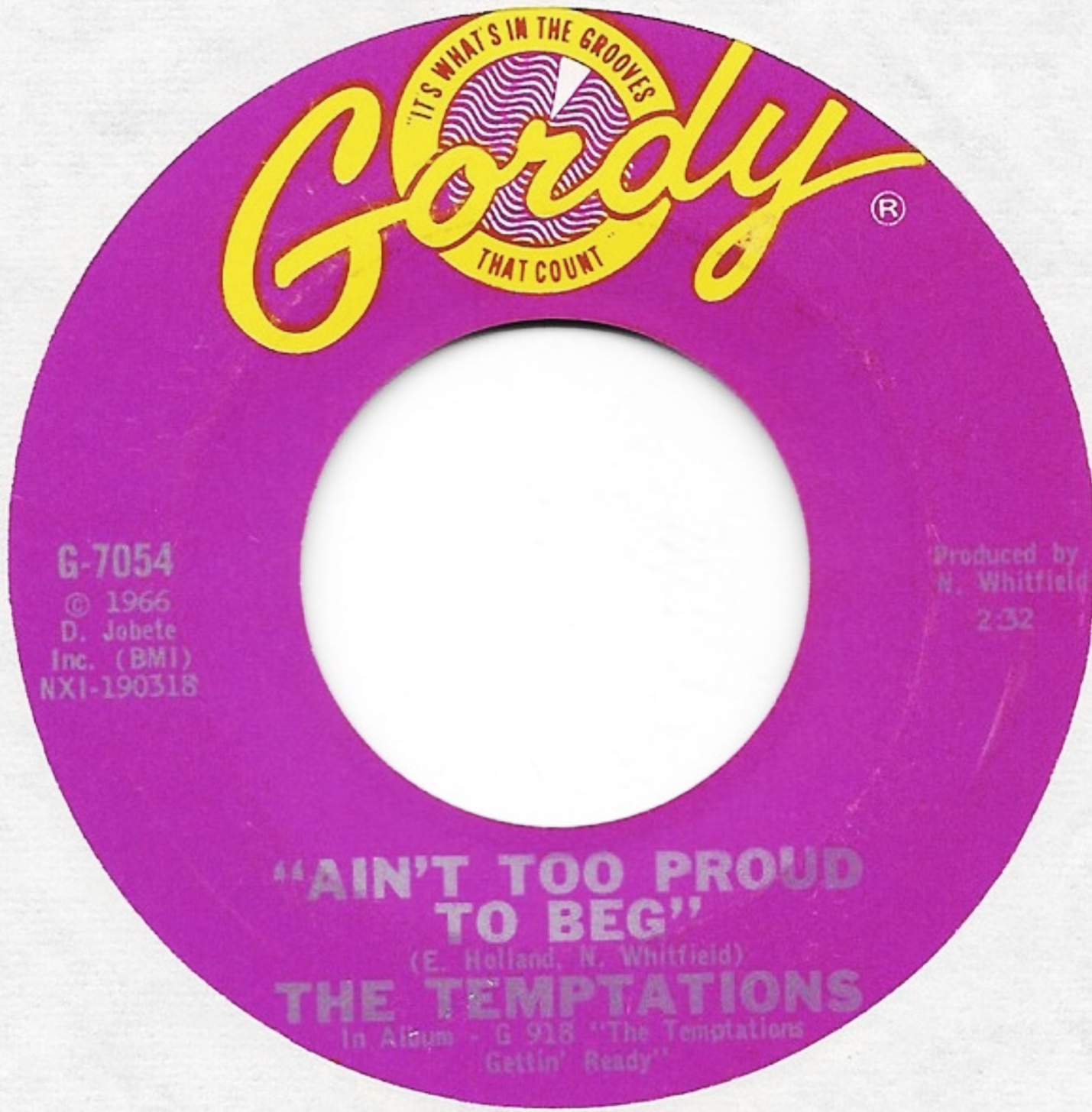
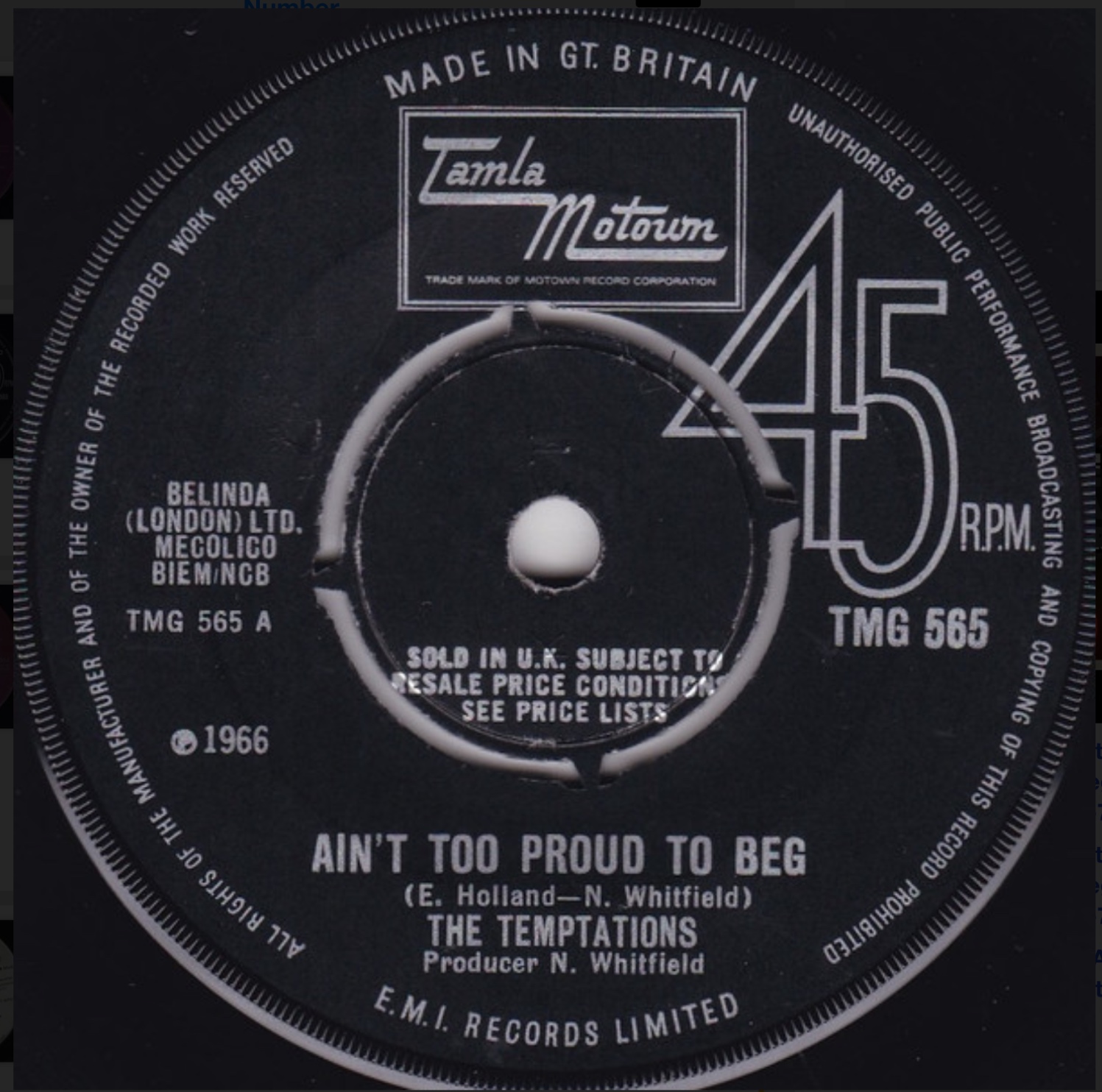
"Ain't Too Proud to Beg" is a 1966 song and hit single by The Temptations for Motown Records' Gordy label, produced by Norman Whitfield and written by Whitfield and Edward Holland Jr. The song was a number-one hit on the Billboard R&B charts for eight non-consecutive weeks. This was very popular among US soldiers who were fighting in Vietnam.


Smokey Robinson was The Temptations' main writer at the time. Motown decided to release his "Get Ready" instead of this song, which drove Whitfield nuts. After "Get Ready" didn't meet expectations, "Ain't Too Proud To Beg" was released as The Temptations next single. From there, Whitfield became the regular producer of the Temptations.


Whitfield also produced this song. He had Temptations singer David Ruffin sing slightly higher than his normal range, resulting in the pained vocal that went with the lyrics. Whitfield had Marvin Gaye do the same thing on "Heard It Through The Grapevine." "Norman was hell-bent on taking us in a new direction," The Temptations' Otis Williams told Uncut magazine. "Norman pushed David to vocal heights we hadn't heard before. David was sweating like crazy through the entire session."