"Maybe I'm Amazed" is a song written by Paul McCartney, released on his debut solo album "McCartney" in 1970. McCartney penned this emotional ballad in 1969, a period marked by the impending breakup of the Beatles. He acknowledged his wife Linda's support during this challenging time. Unlike most of the songs on the album, "Maybe I'm Amazed" was recorded in EMI's Number Two studio at Abbey Road on February 15, 1970. It wasn't released as a single, but a live version from the “Wings Over America” live album was released in 1977 as the lead single of the album.
"Maybe I'm Amazed" stood out as a standout track on McCartney's first solo album, which he crafted mostly by himself, playing all the instruments. The album received mixed reviews, with some critics deeming it unfinished, but "Maybe I'm Amazed" was widely praised as an exception. McCartney, irritated by criticism, even wrote a rebuttal defending the album in response to a negative review in Melody Maker.
Rolling Stone's Langdon Winner recognized "Maybe I'm Amazed" as a powerful song, emphasizing its theme of love dispelling the burden of loneliness. Winner considered it the standout track on the album, acknowledging its proximity to McCartney's best efforts from the past. Despite not being initially released as a single, the studio version has become one of McCartney's enduring and celebrated songs from his solo career.
THE COUNTRY HAMS - WALKING IN THE PARK WITH ELOISE
Released : October 18, 1974
"Walking in the Park with Eloise" is a jazz instrumental originally written by Jim McCartney, Paul McCartney's father, in the early 1920s to the late 1930s. Later, Paul McCartney recorded the track with his band Wings and released it as a single under the name the Country Hams. The B-side, "Bridge on the River Suite," is another instrumental jazz composition credited to Paul and Linda McCartney.
This song came about during a Wings Nashville recording session in the mid-'70s, when the idea of compiling an album featuring McCartney's songs left off previous albums or those still waiting for a place arose. The track, inspired by a conversation between Paul McCartney and Chet Atkins about their fathers, has a jazz and twenties-inspired style.
McCartney would surprise his father James by recording the song with two of his father’s favorite artists Chet Atkins and Floyd Kramer. Jim, who passed away in 1976, was reportedly very pleased with the effort. “He really used to love this one,” Paul reminisced.
The connection to his father might explain why Paul chose it as one of his Desert Island Discs years later. In 1982, during a conversation with Desert Island Discs host Roy Plomley on BBC radio, Paul McCartney surprised his interviewer by admitting he wasn't great at maintaining his own record collection. Despite this, he shared a list of eight songs he would choose if stranded on a deserted island. Among them were Elvis Presley's 'Heartbreak Hotel' and Chuck Berry's 'Sweet Little Sixteen,' which McCartney described as a magical influence on their early rock 'n' roll journey. He also included Benjamin Britten's 'Courtly Dances,' expressing a love for classical music. McCartney reminisced about buying Gene Vincent's 'Be-Bop-A-Lula,' the first record he ever purchased, and selected 'Beautiful Boy (Darling Boy)' from John Lennon's Double Fantasy, finding it moving. The Coasters' 'Searchin'' held a special place, as it was a popular request during their Cavern Club days. To honor his Hamburg friend, Little Richard, he chose 'Tutti Frutti.' Lastly, he mentioned 'Walking In The Park With Eloise,' a song written by his father, from Wings.
"Walking in the Park with Eloise" showcases a departure from Paul McCartney's more typical pop and rock styles, embracing a Dixieland jazz approach. The song, along with its B-side, was later included in the Archive Collection reissue of Wings' 1975 album Venus and Mars in 2014. An orchestral version arranged by Carl Davis and performed by the Chamber Orchestra of London appeared in the 2016 film Ethel & Ernest, also making its way to the film's soundtrack. This orchestral rendition was included in The 7" Singles Box in 2022.
PAUL McCARTNEY - HERE TODAY
Released: April 26, 1982
"Here Today" is a heartfelt tribute to his late friend and former Beatles bandmate, John Lennon released on the 1982 album “Tug of War”. McCartney wrote the song as a way to express his feelings about Lennon, who was tragically murdered in 1980. The lyrics are crafted as an imaginary conversation, offering a poignant reflection on their relationship. Despite not being released as a single, "Here Today" resonated with listeners and reached No. 46 on the Billboard Mainstream Rock charts.
"Here Today" becomes even more poignant with the context of Paul McCartney using it as a means to reconcile and set the record straight about his relationship with John Lennon. McCartney's desire to express the genuine love and camaraderie between them, amid external speculations and rumors, adds a layer of sincerity to the song. It stands as a personal tribute, capturing the essence of their deep connection and emphasizing the enduring affection McCartney held for Lennon.
Paul McCartney's personal reflection on the genesis of "Here Today" provides a poignant insight into the emotional journey he experienced after John Lennon's passing. The song's organic development, emerging as McCartney sat quietly with his guitar, underscores its sincerity and genuine expression of their complex relationship. McCartney's acknowledgment of the pride factor and the public perception of their post-Beatles interactions adds depth to the narrative, highlighting the intricacies of their bond.
Performing the song in New York, where Lennon was tragically killed, intensifies the emotional impact, turning it into a heartfelt tribute echoing sentiments of love and gratitude. The final verse takes on a universal quality, expressing sentiments akin to addressing a departed loved one, capturing the bittersweet essence of loss and remembrance.
9.1.24
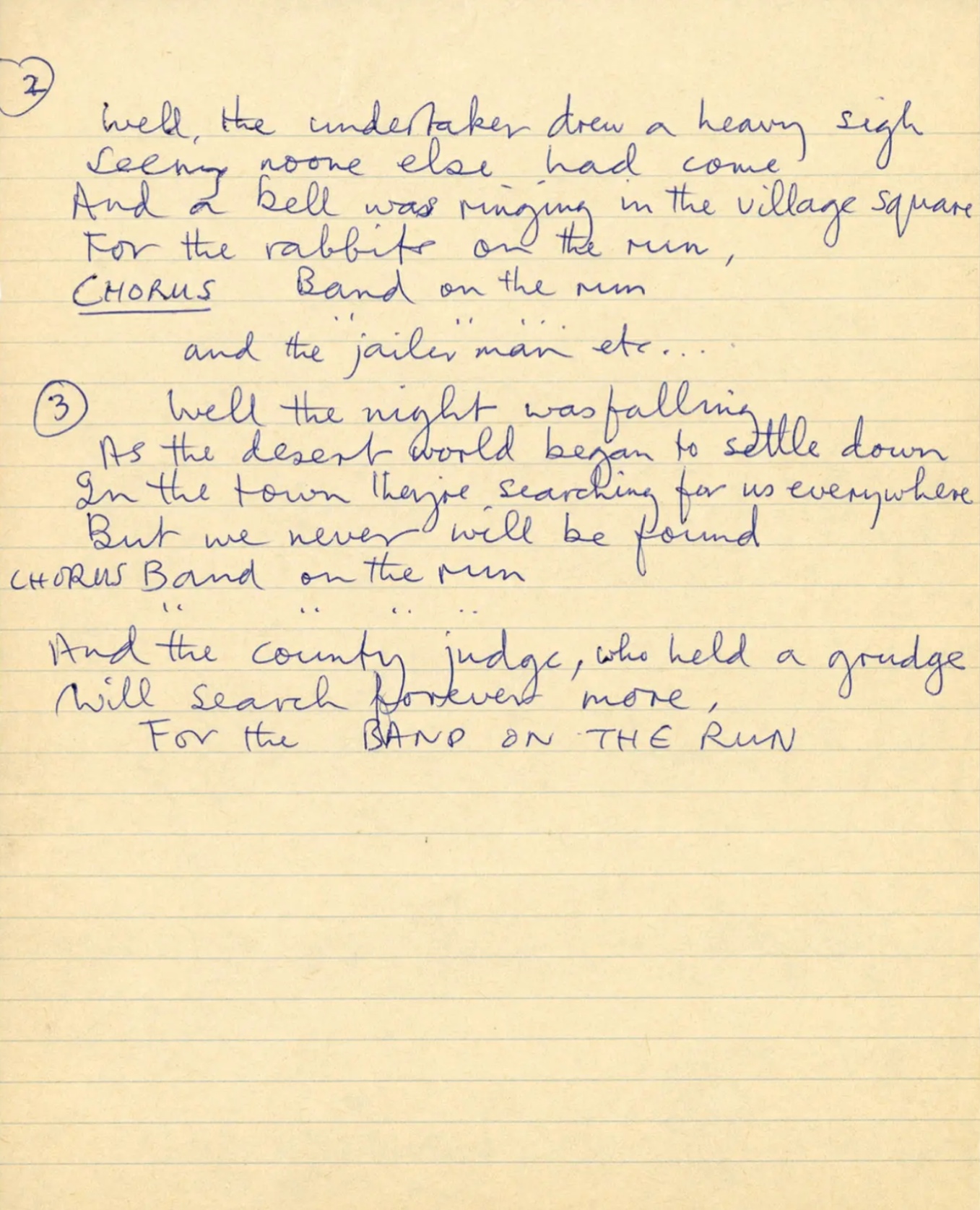
PAUL McCARTNEY & WINGS - BAND ON THE RUN
Publicació: 8 d'abril de 1974
Llistes: Regne Unit: #3 EUA: #1 (1 setmana)
"Band On The Run," la cançó principal del cinquè àlbum en solitari de Paul McCartney després dels Beatles, és una de les clàssiques de la seva carrera en solitari, amb un medley de tres parts que inclou una balada lenta, rock-funk i seccions de caire country. L'estructura experimental però accessible de la cançó, que barreja peces de cançons diferents, reflecteix la capacitat de McCartney per entreteixir elements musicals diversos en una composició cohesionada i memorable.
Els Beatles eren coneguts per combinar fragments de cançons mig acabades en obres cohesionades, mostrant la seva innovadora manera d'escriure cançons. Exemples d'aquesta tècnica inclouen temes com "A Day In The Life", "She Said She Said" i el medley d'Abbey Road. John Lennon, en particular, feia servir sovint el mètode de combinar tres idees no relacionades dins d'una única cançó. Aquest enfocament creatiu és evident en cançons com "I Am The Walrus", "Happiness Is A Warm Gun" i "(Just Like) Starting Over".
Paul McCartney va escriure "Band On The Run" com a resposta a les lleis sobre les drogues que els criminalitzaven a ell i als seus amics, destacant el seu desig de llibertat i escapada. La lletra gira entorn al tema general de trencar les cadenes, representat metafòricament com estar tancat dins de quatre parets. McCartney va imaginar la secció orquestral com una representació de fer un forat en una de les parets, simbolitzant l'escapada cap a la llibertat. El canvi de tempo durant el vers "The rain exploded with a mighty crash" significa un moment de lliberació, reflectint la narrativa de la transició de la captivitat a la llibertat.
El terme "Band on the Run" va ser acunyat per George Harrison durant una tensa reunió de la junta d'Apple en els darrers dies dels Beatles. McCartney va recordar que va començar amb la frase "If I ever get out of here", que va sorgir d'alguna cosa que George va dir sobre tothom sent presoner d'alguna manera. McCartney va trobar que era una bona forma de començar un àlbum, simbolitzant l'escapada, la llibertat i diversos temes sobre criminalitat. Va expressar que hi havia milions de raons darrere de la cançó, preferint no analitzar-les en excés però apreciant com totes es van ajuntar.
"Band on the Run" va ser un èxit rotund per a Paul McCartney i Wings, llançada com a simgle als Estats Units el 8 d'abril de 1974. Va ser la següent darrera el seu anterior top 10, "Jet". La cançó va rebre un gran elogi, convertint-se en el tercer senzill de McCartney que liderava les llistes als Estats Units com a artista en solitari i el segon amb Wings. A Gran Bretanya, el single, amb "Zoo Gang" a la cara B, va assolir la tercera posició a les llistes. La pista va rebre l'elogi ni més ni menys que de John Lennon, qui la va reconèixer com una gran cançó i una de les destacades de l'àlbum homònim.
PAUL McCARTNEY & WINGS - BAND ON THE RUN
Released : April 8, 1974
Charted: UK: #3 US: #1 (1 week)
"Band On The Run," the title track of Paul McCartney's fifth post-Beatles album, stands as one of McCartney's solo career classics, featuring a three-part medley with a slow ballad, funk-rock, and country-esque sections. The song's experimental yet accessible structure, blending pieces of different songs, reflects McCartney's ability to weave diverse musical elements into a cohesive and memorable composition.
The Beatles were known for combining half-finished song fragments into cohesive works, showcasing their innovative approach to songwriting. Examples of this technique include tracks like "A Day In The Life," "She Said She Said", and the Abbey Road medley. John Lennon, in particular, frequently employed the method of combining three unrelated ideas within a single song. This creative approach is evident in songs like "I Am The Walrus", "Happiness Is A Warm Gun", and "(Just Like) Starting Over".
Paul McCartney wrote "Band On the Run" as a response to drug laws that criminalized him and his friends, emphasizing their desire for freedom and escape. The lyrics revolve around the general theme of breaking free from captivity, depicted metaphorically as being stuck inside four walls. McCartney envisioned the orchestral section as a representation of blasting a hole in one of the walls, symbolizing the escape to freedom. The tempo change during the line "The rain exploded with a mighty crash" signifies a freeing moment, reflecting the song's narrative of transition from captivity to liberation.
The term "Band on the Run" was coined by George Harrison during a tense Apple board meeting in the Beatles' final days. McCartney recalled that it started with the phrase "If I ever get out of here", which originated from something George said about everyone being prisoners in some way. McCartney found it to be a nice way to start an album, symbolizing escaping, freedom, and various themes such as criminals. He expressed that there were a million reasons behind the song, preferring not to overanalyze them but appreciating how they all came together.
"Band on the Run" proved to be a major success for Paul McCartney and Wings, released as a single in America on April 8, 1974. It served as the follow-up to their previous top-ten hit, "Jet". The song achieved significant acclaim, becoming McCartney's third chart-topping single in the United States as a solo artist and the second with Wings. In Britain, the single, backed with "Zoo Gang", reached the third position on the charts. The track received praise from none other than John Lennon, who recognized it as both a great song and a standout from the album of the same name.