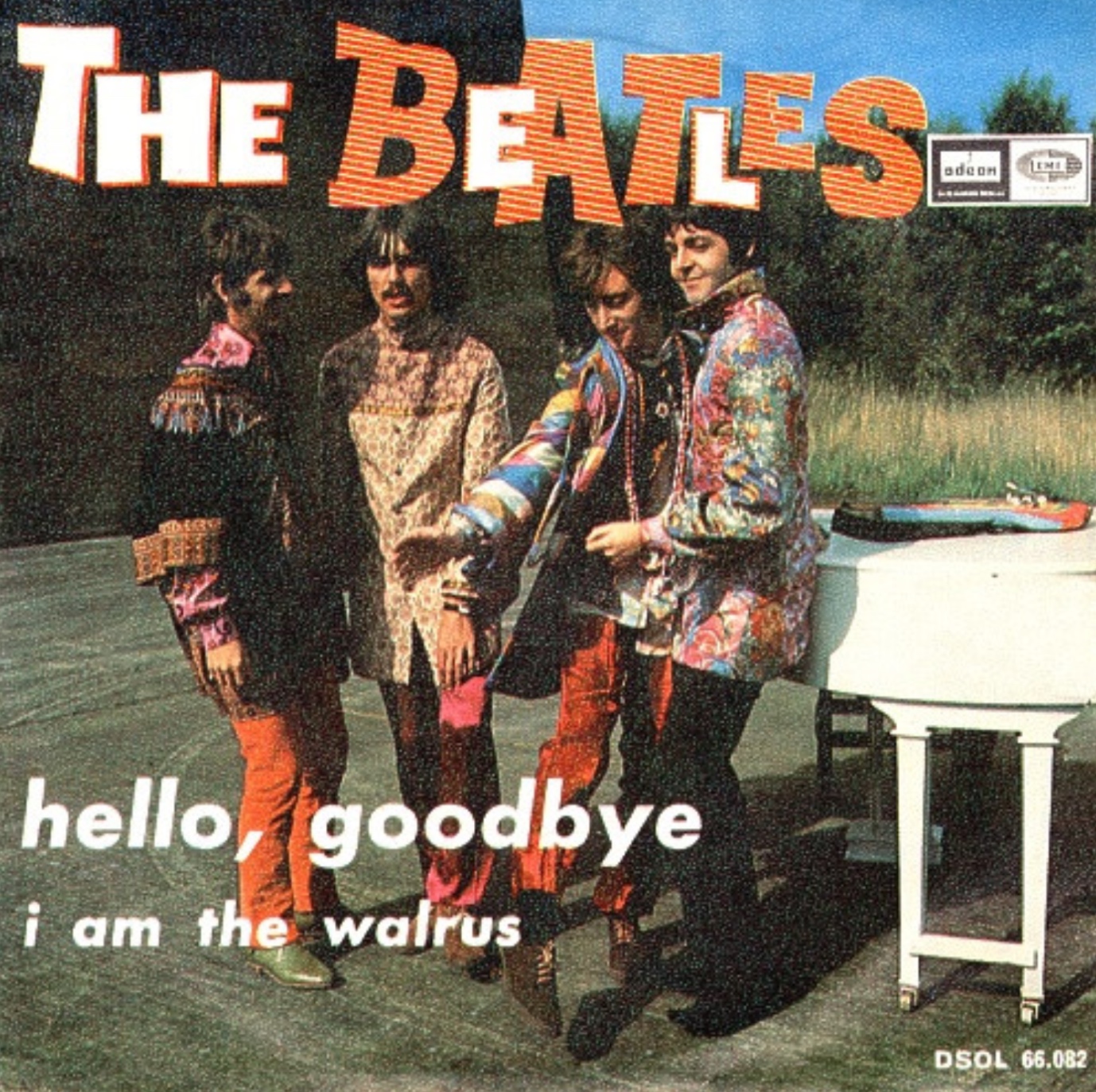
THE BEATLES - HELLO, GOODBYE / I AM THE WALRUS
Publicació: 24 de novembre de 1967
Llistes: Regne Unit: #1 (7 setmanes) EUA: #1 (3 setmanes)
HELLO, GOODBYE
"Hello, Goodbye" és una clàssica cançó dels Beatles escrita per Paul McCartney i acreditada a Lennon–McCartney. Llançada al novembre de 1967 com a senzill que no formava part d'cap àlbum, tenia com a cara B "I Am the Walrus" de John Lennon. La cançó va aconseguir èxit comercial a nivell mundial, arribant al capdavant de les llistes en diversos països.
"Hello, Goodbye" de Paul McCartney va ser inspirada per un experiment amb el seu amic Alistair Taylor. McCartney va demostrar el seu procés de composició tocant l'harmonium i demanant a Taylor que cridés el contrari del que ell cantava. Parelles oposades, com ara hola i adeu, van formar la base de la cançó. La lletra reflecteix la idea que les persones sovint expressen sentiments diferents, creant una composició divertida i enganxosa.
Paul McCartney va comentar a la dècada de 1990 que la lletra de "Hello, Goodbye" aborda el tema de la dualitat, inspirat pel seu signe astrològic, Gèminis. Segons McCartney, la cançó explora elements oposats a l'univers, com home i dona, negre i blanc, i hola i adeu. Tenia com a objectiu destacar els aspectes més positius d'aquesta dualitat a través de la lletra de la cançó.
"Hello, Goodbye" va ser triada com a single per a la temporada de Nadal del 1967, marcant el seu primer llançament després de la mort del seu representant Brian Epstein. Tot i que John Lennon inicialment defensava que la seva composició "I Am the Walrus" fos la cara A, Paul McCartney i el productor George Martin van insistir que "Hello, Goodbye" tenia més atractiu comercial. Lennon tenia sentiments contraris sobre "Hello, Goodbye", considerant-la una cançó lleugera amb el que percebia com a una lletra sense sentit i va mantenir la seva crítica vers la cançó, expressant la seva incredulitat que superés "I Am the Walrus". Alguns han suggerit que la elecció de "Hello, Goodbye" per sobre de la cançó de Lennon va contribuir a les tensions dins del grup.
I AM THE WALRUS
"I Am the Walrus", escrita per John Lennon, va ser llançada com a cara B del single "Hello, Goodbye" i va ser inclosa en l'EP i l'àlbum “Magical Mystery Tour”. Lennon va escriure la cançó per desconcertar els oients que analitzaven amb diligència les lletres dels Beatles. Influïda per dues experiències amb LSD i pel poema de Lewis Carroll "The Walrus and the Carpenter," la cançó destaca per l'acompanyament orquestral dirigit pel productor George Martin, amb violins, violoncels, trompes i clarinet.
Lennon va trobar inspiració per l’enigmàtica lletra després de saber que el professor d'anglès d'un estudiant descomponia cançons dels Beatles a classe. John la va escriure per desconcertar els acadèmics. Era la seva resposta al estil críptic d'escriptura de cançons de Bob Dylan. Lennon va comentar en una entrevista a Playboy del 1980 que la primera frase la va escriure durant un viatge amb LSD, la segona en un altre viatge i la resta després de conèixer Yoko Ono. La lletra critica subtilment el moviment Hare Krishna i la devoció simplista als ídols.
La inspiració per la morsa a "I Am the Walrus" prové del poema de Lewis Carroll "The Walrus and The Carpenter" de la seqüela d'Alicia al país de les meravelles, "A través del mirall." En una entrevista a Playboy del 1980, John Lennon va mencionar que inicialment no va adonar-se de la crítica social en l'obra de Carroll. Més tard, va reconèixer que la morsa era l'antagonista de la història, mentre que el fuster era el protagonista. Reflexionant sobre això, Lennon va dir humorísticament que a la cançó hauria d’haver afirmat ser el fuster, però no hauria tingut el mateix impacte.
Les teories conspiratòries de "Paul is dead” (Paul és mort) associades a "I Am the Walrus" són elaborades i imaginatives, però és essencial destacar que aquestes interpretacions no es basen en cap evidència de fet. Vegem algunes de les suposades proves:
- "Waiting for the van to come" significa que els tres Beatles restants estan esperant que vingui una furgoneta de la policia. "Pretty little policemen in a row" significa que els policies van arribar.
- "Goo goo ga joob" van ser les últimes paraules que va dir Humpty Dumpty abans de caure del mur i morir.
- al final, mentre la coral canta, es pot sentir una veu que diu "Bury Me" ("Enterra'm"), que podria ser el que Paul hauria dit després de morir. També es pot escoltar algú recitant l'escena de la mort de l'obra "El rei Lear" de Shakespeare.
- Va circular un rumor que deia que "Walrus" significava "cos mort" en grec (la qual cosa no és certa), de manera que la gent pensava que Paul era la morsa. A més, al vídeo, la morsa era l'únic amb un vestit fosc.
Les pistes esmentades són principalment coincidències i no aguanten un anàlisi rigorós. La idea que Paul McCartney estigués mort va ser una llegenda urbana molt estesa a finals dels anys 60, però ha estat desmentida, i el mateix McCartney ha confirmat constantment que és viu. La lletra de "I Am the Walrus" era intencionadament críptica, i Lennon hi va afegir elements per confondre aquells que intentaven descodificar el significat, contribuint a les teories de la conspiració.
A més, a "Glass Onion", John reconeix de manera jocosa la confusió entorn dels rumors de "Paul és mort" i la identitat de la morsa. La frase "The Walrus was Paul" és una referència directa al personatge que Paul interpretava a "I Am the Walrus".
Eric Burdon va afirmar en la seva biografia que ell és “the egg man”. Sembla que li va explicar a John Lennon una experiència sexual en la qual un ou hi tenia un paper important. Després d'això, John el va anomenar l’home ou.
Aquesta va ser la primera cançó que els Beatles van enregistrar després de la mort de Brian Epstein. L'enginyer Geoff Emerick va recordar "la mirada buida als seus rostres quan estaven tocant".
THE BEATLES - HELLO, GOODBYE / I AM THE WALRUS
Released : November 24, 1967
Charted: UK: #1 (7 weeks) US: #1 (3 weeks)
HELLO, GOODBYE
"Hello, Goodbye" is a classic Beatles song written by Paul McCartney and credited to Lennon–McCartney. Released in November 1967, as a non-album single, it was backed by John Lennon's "I Am the Walrus." The song achieved commercial success globally, reaching the top of charts in various countries.
"Hello, Goodbye" by Paul McCartney was inspired by an experiment involving his friend Alistair Taylor. McCartney demonstrated his songwriting process by playing the harmonium and having Taylor shout out the opposite of whatever he sang. The contrasting pairs, such as hello and goodbye, formed the basis of the song. The lyrics reflect the idea that people often express differing sentiments, creating a playful and catchy composition.
Paul McCartney mentioned in the 1990s that the lyrics of "Hello, Goodbye" address the theme of duality, inspired by his astrological sign Gemini. According to McCartney, the song explores contrasting elements in the universe, such as man and woman, black and white, and hello and goodbye. He aimed to emphasize the more positive aspects of this duality through the song's lyrics.
"Hello, Goodbye" was chosen as the Beatles' single for the 1967 Christmas season, marking their first release since the death of their manager Brian Epstein. Although John Lennon initially advocated for his composition "I Am the Walrus" to be the A-side, Paul McCartney and producer George Martin insisted that "Hello, Goodbye" had more commercial appeal. Lennon had strong feelings about "Hello, Goodbye," considering it a lightweight song with what he perceived as meaningless lyrics and remained critical of the song, expressing his disbelief that it beat out "I Am the Walrus." Some have suggested that choosing "Hello, Goodbye" over Lennon's track contributed to the tensions within the band.
I AM THE WALRUS
"I Am the Walrus" written by John Lennon, was released as the B-side to the single "Hello, Goodbye" and featured in the Magical Mystery Tour EP and album. Lennon penned the song to bewilder listeners who were diligently analyzing the Beatles' lyrics. Influenced by two LSD trips and Lewis Carroll's poem "The Walrus and the Carpenter," the song boasts orchestral accompaniment arranged by producer George Martin, incorporating violins, cellos, horns, and clarinet.
Lennon drew inspiration for the enigmatic lyrics after learning that a student's English teacher was dissecting Beatles songs in class. John wrote it to confound the scholars. It was his response to Bob Dylan's cryptic style of songwriting. Lennon mentioned in a 1980 Playboy interview that the first line was written during one acid trip, the second line on another trip, and the rest after meeting Yoko Ono. The lyrics subtly critique the Hare Krishna movement and the simplistic devotion to idols.
The inspiration for the Walrus in "I Am the Walrus" came from Lewis Carroll's poem "The Walrus and The Carpenter" in the sequel to Alice in Wonderland, "Through the Looking-Glass." In a 1980 Playboy interview, John Lennon mentioned that he initially didn't realize the social commentary in Carroll's work. He later acknowledged that the Walrus was the antagonist in the story, while the Carpenter was the protagonist. Reflecting on this, Lennon humorously said he should have claimed to be the Carpenter instead, but it wouldn't have had the same impact.
The "Paul is dead" conspiracy theories associated with "I Am the Walrus" are indeed elaborate and imaginative, but it's essential to note that these interpretations are not based on any factual evidence. Let’s see some supposed evidences:
- "Waiting for the van to come" means the three remaining Beatles are waiting for a police van to come. "Pretty little policemen in a row" means policemen did show up.
- "Goo goo ga joob" were the final words that Humpty Dumpty said before he fell off the wall and died.
- During the fade, while the choir sings, a voice says "Bury Me" which is what Paul might have said after he died. Also we hear someone reciting the death scene from Shakespeare's play "King Lear."
- a rumor circulated that Walrus was Greek for "corpse" (it isn't) in Greek, so that is what people thought of Paul being the Walrus. Also, in the video, the walrus was the only dark costume.
The clues mentioned are largely coincidental and don't hold up under scrutiny. The idea of Paul McCartney being dead was a widespread urban legend during the late 1960s, but it has been debunked, and McCartney himself has consistently confirmed that he is alive. The "I Am the Walrus" lyrics were intentionally cryptic, and Lennon added elements to confuse those trying to decipher the meaning, contributing to the conspiracy theories.
Besides, in "Glass Onion", John playfully acknowledges the confusion surrounding the "Paul is dead" rumors and the identity of the Walrus. The line "The Walrus was Paul" is a direct reference to the character Paul played in "I Am the Walrus".
Eric Burdon stated in his biography that he is the Egg Man. It seems he told John Lennon of a sexual experience he was involved in where an egg played a major part. After that, John called him Egg Man.
This was the first song the Beatles recorded after Brian Epstein's death. Engineer Geoff Emerick recalled, "the look of emptiness on their faces when they were playing”.