"What You Need" is a dynamic and energetic track by Australian rock band INXS, released as a single in 1985 and serving as the lead track from their sixth studio album, "Listen Like Thieves." Written by INXS members Andrew Farriss and Michael Hutchence, the song seamlessly blends rock with funk and dance elements. Anchored by a driving bassline, a memorable guitar riff, and Hutchence's charismatic vocals, "What You Need" exudes power and vitality. Lyrically, the song expresses a sense of desire and urgency, emphasizing the importance of essential elements in life.
The creation of "What You Need" was a stroke of serendipity for INXS. Producer Chris Thomas urged the band to come up with one more guaranteed hit after finishing recording their album "Listen Like Thieves." After some deliberation, the band revisited a demo tape made by Andrew Farriss, initially labeled "Funk Song No. 13." Impressed by its infectious groove and potential, Thomas encouraged the band to work on it further. In just two days, the song evolved into "What You Need," ultimately becoming the breakout hit that propelled INXS to new heights.
Lynn-Maree Milburn directed the vibrant and dynamic music video for "What You Need," which showcased the band members performing amidst a colorful and energetic backdrop. The video's use of strobing effects and graphic overlays added to its visual appeal and contributed to its success on MTV, marking INXS's breakthrough into the mainstream music scene.
Inspired by the success of "What You Need" and “Listen Like Thieves”, INXS was determined to make their next album be one in which all the songs were possible singles. They recorded "Kick", and despite the label's doubts, the album soared up the charts and became the band's most successful album.
INXS - BEAUTIFUL GIRL
Released: February 1, 1993
Charted: UK: #23 US: #46
"Beautiful Girl" is a heartfelt song by Australian rock band INXS, released internationally in February 1993 from their album "Welcome to Wherever You Are."
Keyboardist Andrew Farriss, inspired by the birth of his daughter, penned the track as an ode to the joy and wonder of parenthood. In an interview with Debbie Kruger, Farriss shared his realization of life's dramatic change after welcoming his daughter, Grace. This significant milestone prompted Farriss to explore themes of joy, love, and newfound responsibility of having someone else to care for and cherish.
"Beautiful Girl" delves into the poignant narrative of a vulnerable runaway whom the singer encounters and feels compelled to protect in a paternal manner. Describing her harrowing journey from "doorway to doorway, corner to corner" in a quest for survival, the song sheds light on the plight of runaways grappling with adversity. INXS frontman Michael Hutchence provided insight into the inspiration behind the song, citing the prevalence of runaways in his native Sydney, Australia. Despite the existence of support systems, Hutchence observed the grim reality faced by these youths, often lured into dangerous paths involving prostitution and substance abuse due to their naivety.
The delicate melody and introspective lyrics deviate from the band's usual energetic and anthemic style, offering a more nuanced and subdued musical expression. Hutchence's delivery evokes the raw and emotive quality reminiscent of Lou Reed's vocals during his time with The Velvet Underground.
BLONDIE - HANGING ON THE TELEPHONE / ONE WAY OR ANOTHER
HANGING ON THE TELEPHONE
Estrena: novembre de 1978
Llistes: Regne Unit: #5
"Hanging on the Telephone" és una cançó escrita originalment per Jack Lee i llançada per primera vegada el 1976 per la seva banda de power pop de la Costa Oest, The Nerves. Va guanyar més reconeixement quan la banda nord-americana de new wave Blondie va enregistrar i llançar la seva versió el 1978. Blondie va descobrir la cançó a través d'una cinta de cassette recopilatòria que els va donar Jeffrey Lee Pierce. Produïda per Mike Chapman, la versió de Blondie comença amb un efecte de so de telèfon. Inclosa en l'àlbum de Blondie, “Parallel Lines”, la cançó va arribar al top 5 al Regne Unit i des de llavors ha estat reconeguda com una de les pistes més destacades de la banda.
"Hanging on the Telephone" captura la perspectiva de Debbie Harry mentre espera ansiosa una resposta d'un noi al qual intenta contactar, retractat a través de la lupa d'una trucada telefònica des d'una cabina. La urgència de la lletra, especialment "Don't leave me hanging on the telephone” (No em deixis penjada al telèfon), es podria interpretar com una petició o fins i tot com una amenaça velada.
Jack Lee, el compositor, va explicar en una entrevista del 2007 amb la revista Mojo com l'oportunitat de fer que Blondie enregistrés la seva cançó va transformar la seva situació financera. Enfrontant-se a la imminent desconnexió dels seus serveis públics vom la llum o el telèfon, Lee va rebre la trucada de Debbie Harry expressant interès per enregistrar "Hanging on the Telephone". L'acord de Lee amb la proposta va canviar dràsticament les seves circumstàncies, marcant un moment decisiu a la seva vida.
"Hanging on the Telephone", la primera pista de l'àlbum de Blondie "Parallel Lines", és una barreja catxonda de punk i pop, amb només 2 minuts i 17 segons de durada. Amb el productor Mike Chapman al comandament, els ganchos pop infecciosos de la cançó són el punt focal, establint el to per a tot l'àlbum. La tornada, descrita com a capturar "aquella magia pop al estil de les Ronettes" per Harry Doherty de Melody Maker, exemplifica la naturalesa irresistiblement enganxosa de la cançó.
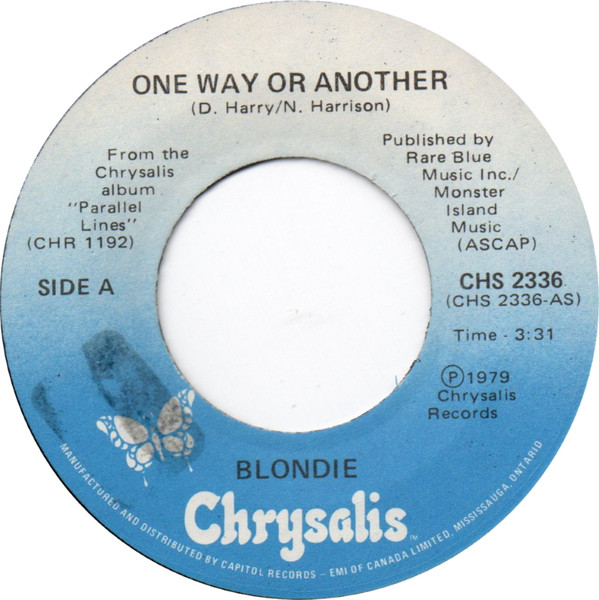
ONE WAY OR ANOTHER
Publicació: maig de 1979
Llistes: EUA: #24
"One Way or Another" inclosa a l'àlbum "Parallel Lines" (1978), explora l'experiència inquietant de la cantant principal, Debbie Harry, que va ser assetjada a principis dels anys 70, cosa que la va portar a traslladar-se de Nova Jersey. Malgrat el contingut líric fosc que detalla les accions d'un perseguidor amenaçador, la música animada i enganxosa contrasta amb el seu tema sinistre. Segons Harry, la cançó va sorgir de la seva trobada personal amb un assetjador, que la va portar a infondre una certa lleugeresa a la lletra com a mecanisme de defensa. Harry i el baixista de la banda, Nigel Harrison, van col·laborar en el procés de composició, amb Harry centrant-se en la lletra mentre Harrison contribuïa amb la música.
"One Way or Another", llançada com a quart senzill de l'àlbum "Parallel Lines", va assolir un èxit moderat als Estats Units i Canadà, arribant al número 24 a la llista Billboard Hot 100 i el número 7 a la llista RPM 100 Singles. Tot i que no es va llançar oficialment com a senzill al Regne Unit, va arribar a les llistes el febrer de 2013 a causa de la popularitat de la versió de One Direction.
BLONDIE - HANGING ON THE TELEPHONE / ONE WAY OR ANOTHER
HANGING ON THE TELEPHONE
Released: November 1978
Charted: UK: #5
"Hanging on the Telephone" is a song originally written by Jack Lee and first released in 1976 by his West Coast power pop band The Nerves. It gained more widespread recognition when American new wave band Blondie recorded and released their version in 1978. Blondie came across the song through a cassette tape compilation given to them by Jeffrey Lee Pierce. Produced by Mike Chapman, Blondie's rendition begins with a phone sound-effect, adding to its distinctive charm. Included on Blondie's breakthrough album, Parallel Lines, the song became a top-five hit in the UK and has since been celebrated as one of the band's standout tracks.
"Hanging on the Telephone" captures Debbie Harry's perspective as she waits anxiously for a response from a guy she's trying to reach, portrayed through the lens of a phone call from a booth. The urgency in the lyrics, particularly "Don't leave me hanging on the telephone," could be interpreted as a plea or even a veiled threat, adding depth to the song's narrative.
Jack Lee, the song's composer, recounted in a 2007 interview with Mojo magazine how the opportunity to have Blondie record his song transformed his financial situation. Facing imminent disconnection of utilities, Lee received Debbie Harry's call expressing interest in recording "Hanging on the Telephone." Lee's agreement to the proposal altered his circumstances dramatically, marking a pivotal moment in his life.
"Hanging on the Telephone," the opening track of Blondie's influential album "Parallel Lines," is a catchy blend of punk and pop, clocking in at just 2 minutes and 17 seconds. With producer Mike Chapman at the helm, the song's infectious pop hooks are front and center, setting the tone for the entire album. The chorus, described as capturing "that magical Ronettes-like poppiness" by Melody Maker's Harry Doherty, exemplifies the song's irresistibly catchy nature.
ONE WAY OR ANOTHER
Released: May 1979
Charted: US: #24
"One Way or Another" by Blondie, featured on their album "Parallel Lines" (1978), delves into the unsettling experience of lead singer Debbie Harry being stalked during the early 1970s, leading her to relocate from New Jersey. Despite the dark lyrical content detailing the actions of a menacing pursuer, the song's upbeat and catchy music contrasts with its sinister theme. According to Harry, the song emerged from her personal encounter with a stalker, prompting her to infuse some levity into the lyrics as a coping mechanism. Harry and the band's bassist, Nigel Harrison, collaborated on the songwriting process, with Harry focusing on the lyrics while Harrison contributed to the music.
"One Way or Another" released as the fourth single from the album "Parallel Lines", achieved moderate success in the US and Canada, peaking at number 24 on the Billboard Hot 100 and number 7 on the RPM 100 Singles chart. While not officially released as a single in the UK, it charted there in February 2013 due to the popularity of One Direction's cover version.
Critically acclaimed since its release, "One Way or Another" has been praised for its energetic and aggressive sound. Billboard described the song as moving in "machine gun fashion", with Debbie Harry's vocals sounding almost demonic. Cash Box highlighted the gritty guitar, drumbeat, and engaging bass line, noting Harry's vocals delivered with "playful aggressiveness." Pitchfork praised it as "exuberant new wave," noting its loose feel compared to other tracks of the era.
JOE DOLCE - SHADDAP YOU FACE
Released: 1980
Charted: UK: #1 (3 weeks) US: #53
"Shaddap You Face" by Joe Dolce Music Theatre is a humorous novelty song released in late 1980, capturing the antics of a rebellious Italian boy. The song quickly gained popularity, setting sales and longevity records upon its release under Mike Brady's Full Moon Records label.
"Shaddap You Face" playfully lampoons Italian Americans, featuring thick accents and exaggerated gestures. Joe Dolce, born in Ohio to Italian-American parents, penned the song in the late '70s during a train journey from Ohio to California, where he wrote poetry, including the humorous "Shaddap You Face." After moving to Australia in 1979, Dolce formed the Joe Dolce Music Theater and adopted the persona of Giuseppe to perform the song. Drawing from childhood memories of familial kitchen banter in broken English, Dolce incorporated audience participation into the song, with crowds shouting "Hey!" after each line during early performances.
Despite initial criticism from BBC Radio 2 DJ Terry Wogan, who famously dubbed it the worst thing he'd ever heard, "Shaddap You Face" became a sensation. Wogan's disparaging remark inadvertently fueled publicity for the song, prompting CBS to fly Dolce to the UK for three TV appearances. The track swiftly climbed charts worldwide, reaching the top spot in over 15 countries, including Australia, Canada, France, and Germany. In the UK, it dethroned Ultravox's "Vienna" to claim the #1 position. With global sales exceeding 6 million copies and over 35 foreign-language cover versions, "Shaddap You Face" remains the most successful Australian-produced single in the nation's music history.
In the United States, "Shaddap You Face" reached modest chart positions, peaking at number 53 on the Billboard Hot 100, number 43 on the Cash Box Top 100, and number 24 on Record World in 1981. Despite its moderate commercial success, the song gained significant exposure on the Dr. Demento show, where it became a favorite and ranked number six on the year-end Funny 25 chart. In the Canadian province of Quebec, "Shaddap You Face" enjoyed remarkable popularity, spending twelve weeks at number one on the charts.