Total de visualitzacions de pàgina:

11.5.24


ROLLING STONES - START ME UP


Publicació: 14 d'agost de 1981

Llistes: EUA: #2   Regne Unit: #7


"Start Me Up" és una cançó de la banda de rock anglesa The Rolling Stones, inclosa al seu àlbum de 1981 "Tattoo You". Com a single principal de l'àlbum, va assolir èxit comercial arreu del món, arribant al número u a la llista australiana de Kent Music Report, al número dos al Canadà, al número dos al Billboard Hot 100 i al número set a l’UK Singles Chart. A més, va entrar al top deu en diversos països europeus.


"Start Me Up" va néixer com una cançó de reggae enregistrada durant les sessions dels àlbums dels Rolling Stones "Black and Blue" (1976) i "Some Girls" (1978). Inicialment titulada "Never Stop", se’n van fer nombroses preses però finalment es va abandonar. Keith Richards va descriure el procés, assenyalant el repte de trencar amb la naturalesa repetitiva de la música. Malgrat els esforços per incorporar-la a l'àlbum "Emotional Rescue", la cançó no es va materialitzar com s'esperava i es va deixar de banda per a una futura consideració. El 1981, mentre els Rolling Stones es preparaven per a una gira, l'enginyer Chris Kimsey va suggerir a Mick Jagger la idea d'incorporar cançons arxivades a la seva llista de cançons pels concerts. Mentre explorava els arxius de la banda, Kimsey va descobrir dues versions rockeres de "Start Me Up" entre aproximadament cinquanta versions de reggae.


Keith Richards va descriure el viatge de "Start Me Up" d'una cançó de reggae a una pista de rock: "La vam fer en 38 preses com a cançó de reggae, però no va funcionar. En algun moment del mig d'una pausa, Charlie i jo vam trobar la versió de rock and roll. Ens en vam oblidar fins que algú va passar per les demos de reggae anys després i la va trobar enterrada allà. Ens hi vam posar de nou, vam fer algunes gravacions i va ser com un regal. Els Stones tenen un enorme arxiu de material, i el que ningú escolta és només la punta de l'iceberg. Però cal explorar-lo pacientment."


Chris Kimsey, l'enginyer de la cançó, va recordar la reacció inicial de Keith Richards: "Després de gravar-la, vaig dir, 'És molt bo! Vine i escolta'. No obstant això, quan la vaig reproduir, Keith va dir, 'Nah, sona com alguna cosa que he escoltat a la ràdio. Esborra-la.' Òbviament, no ho vaig fer, però realment no li va agradar, i no estic segur que li agradi fins dia d’avui. No crec que sigui una de les seves cançons favorites, tot i que és evidentment el riff de guitarra preferit de tothom; el seu riff de guitarra. Potser perquè a Keith li agrada tant el reggae, volia que fos una cançó de reggae, però això no va ser possible."


La cançó comença amb el riff icònic de Keith Richards, acompanyat per la base sòlida de Charlie Watts i el baix de Bill Wyman, formant l'esquelet de la pista. Ronnie Wood afegeix profunditat amb una variació del riff de Richards, ampliant-lo ocasionalment durant les actuacions en directe. Mick Jagger intervé amb el pont recurrent "You make a grown man cry", intercalat amb insinuacions d,automotivació al llarg de la cançó.


"Start Me Up" va marcar l'entrada dels Rolling Stones a l'era de MTV com el primer single de "Tattoo You". Llançada l'agost de 1981, al voltant del mateix temps que MTV es va llançar, el vídeo mostrava la banda actuant contra un fons negre en una producció impecable. MTV la va posar en rotació constant, guanyant als Stones una nova onada de fans americans.


ROLLING STONES - START ME UP


Released: August 14, 1981

Charted:  US: #2   UK: #7 


"Start Me Up" is a song by the English rock band the Rolling Stones, featured on their 1981 album “Tattoo You”. Serving as the album's lead single, it achieved commercial success worldwide. The song reached number one on the Australian Kent Music Report, number two in Canada, number two on the Billboard Hot 100, and number seven on the UK Singles Chart. Additionally, it entered the top ten in several European countries.


"Start Me Up" originated as a reggae song recorded during the sessions for the Rolling Stones' albums “Black and Blue” (1976) and “Some Girls” (1978). Initially titled "Never Stop," the track underwent numerous takes but was ultimately abandoned. Keith Richards described the process, noting the challenge of breaking away from the repetitive nature of the music. Despite efforts to incorporate it into the “Emotional Rescue” album, the song didn't materialize as intended and was set aside for future consideration. In 1981, as the Rolling Stones prepared for a tour, engineer Chris Kimsey suggested to Mick Jagger the idea of incorporating archived songs into their setlist. While exploring the band's archives, Kimsey discovered two rock-oriented takes of "Start Me Up" among approximately fifty reggae versions. 


Keith Richards described the journey of "Start Me Up" from a reggae song to a rock track: "We did it in 38 takes as a reggae song, but it didn't make it. Somewhere in the middle of a break, Charlie and I hit the rock and roll version. We forgot about it until someone sifted through the reggae takes years later and found it buried in there. We leapt on it again, did some overdubs, and it was like a gift. The Stones have an enormous vault of material, and what anyone hears is just the tip of the iceberg. But you have to sift through it patiently."


Chris Kimsey, the engineer for the song, recounted the initial reaction from Keith Richards: "After they cut it, I said, 'That's bloody great! Come and listen.' However, when I played it back, Keith said, 'Nah, it sounds like something I've heard on the radio. Wipe it.' Of course, I didn't, but he really did not like it, and I'm not sure whether he likes it to this day. I don't think it's one of his favorite songs, although it's obviously everyone's favorite guitar riff; his guitar riff. Maybe because Keith loves reggae so much, he wanted it to be a reggae song, but that wasn't to be."


The song begins with Keith Richards' iconic riff, accompanied by Charlie Watts' solid backbeat and Bill Wyman's resonant bass, forming the backbone of the track. Ronnie Wood adds depth with a layered variation of Richards' riff, occasionally expanding on it during live performances. Mick Jagger interjects with the recurring bridge "You make a grown man cry," interspersed with suggestive automotive innuendos throughout the song.


"Start Me Up" marked the Rolling Stones' entry into the MTV era as the first single from “Tattoo You”. Released in August 1981, around the same time MTV launched, the well-shot video featured the band performing against a black background. MTV put it in hot rotation, earning the Stones a new wave of American fans.


 EURYTHMICS - DON’T ASK ME WHY

Estrenada: octubre de 1989

Llistes: Regne Unit: #25   EUA: #40


"Don't Ask Me Why" és una cançó de l'àlbum "We Too Are One" dels Eurythmics que va servir com a segon senzill de l'àlbum. Escrita per Annie Lennox i David A. Stewart, la cançó va ser produïda per Stewart juntament amb Jimmy Iovine. Als Estats Units, es va llançar com a primer single de l'àlbum. El disc va arribar al número 25 a la llista de singles del Regne Unit i es va convertir en l'últim èxit dels Eurythmics a la llista Billboard Hot 100 als Estats Units, assolint el número 40.


"Don't Ask Me Why" és una pista pop caracteritzada per la seva lletra agredolça, que detalla la dissolució d'una relació amorosa. La veu d'Annie Lennox transmet una sensació de melangia mentre expressa sense embuts els seus sentiments, afirmant, "don't ask me why / I don't love you any more / I don't think I ever did” (no em preguntis per què / ja no t'estimo / no crec que mai ho hagi fet). Tot i que la inspiració específica darrere de la cançó roman confusa, s’especula que reflecteix les experiències personals de Lennox, possiblement referint-se al seu divorci o a la tensa relació entre ella i Dave Stewart. Com a últim senzill del seu àlbum "We Too Are One", va marcar la fi d'una era pels Eurythmics, amb Lennox i Stewart separant-se després durant una dècada.


"Don't Ask Me Why" va rebre ressenyes positives per part dels crítics, que van elogiar la interpretació vocal emotiva d'Annie Lennox i la lletra commovedora de la cançó. Billboard la va descriure com un "número a mitja velocitat" on la veu de Lennox destaca, realçant el seu potencial com a èxit inesperat. Mick Williams del Lennox Herald la va elogiar molt, destacant la veu excepcional de Lennox. Un crític de Music & Media va apreciar el contrast entre les harmonies encantadores i la trista lletra de la cançó. David Giles de Music Week va elogiar la cançó per permetre més expressivitat a la veu de Lennox, amb Stewart mostrant moderació fins a la pausa de guitarra. Iestyn George de Record Mirror va notar que, tot i que la cançó era més emotiva que la seva predecessora, podria perdre's entre l'abundància de discos de pop-dance a les ones de ràdio. En general, "Don't Ask Me Why" va ser ben rebuda per la seva musicalitat i profunditat emocional.


El videoclip dirigit per Sophie Muller mostra una actuació dels Eurythmics al costat de membres d'una banda de suport. Filmada en colors vibrants i saturats, el vídeo evoca l'atmosfera de les escenes de discoteca de la pel·lícula de David Lynch, Blue Velvet.


EURYTHMICS - DON’T ASK ME WHY


Released: October 1989

Charted:  UK: #25  US: #40 


"Don't Ask Me Why" is a track from Eurythmics' album "We Too Are One" and served as the album's second single. Written by Annie Lennox and David A. Stewart, the song was produced by Stewart alongside Jimmy Iovine. In the US, it was issued as the album's lead single. The single reached number 25 on the UK Singles Chart and became Eurythmics' final Billboard Hot 100 hit in the US, peaking at number 40. 


"Don't Ask Me Why" is a pop track characterized by its bittersweet lyrics, detailing the dissolution of a romantic relationship. Annie Lennox's vocals deliver a sense of melancholy as she bluntly expresses her feelings, stating, "don't ask me why / I don't love you any more / I don't think I ever did." While the specific inspiration behind the song remains ambiguous, it's speculated to reflect Lennox's personal experiences, possibly referencing her divorce or the strained relationship between her and Dave Stewart. As the final single from their album "We Too Are One," it marked the end of an era for Eurythmics, with Lennox and Stewart parting ways for a decade afterward.


"Don't Ask Me Why" received positive reviews from critics, who praised Annie Lennox's emotive vocal performance and the song's poignant lyrics. Billboard described it as a "subdued midtempo number" where Lennox's vocal shines, highlighting its potential as a sleeper hit. Mick Williams of the Lennox Herald gave it high praise, emphasizing Lennox's exceptional voice. A reviewer from Music & Media appreciated the contrast between the enchanting harmonies and the song's sad lyrics. David Giles from Music Week commended the song for allowing Lennox's voice more expressiveness, with Stewart showing restraint until the guitar break. Iestyn George of Record Mirror noted that while the song was moodier than its predecessor, it might get lost among the abundance of pop-dance records on the airwaves. Overall, "Don't Ask Me Why" was well-received for its musicality and emotional depth.


The music video directed by Sophie Muller, showcases a performance by Eurythmics alongside members of a backing band. Shot in vibrant, saturated colors, the video evokes the atmosphere of nightclub scenes from David Lynch's film Blue Velvet.


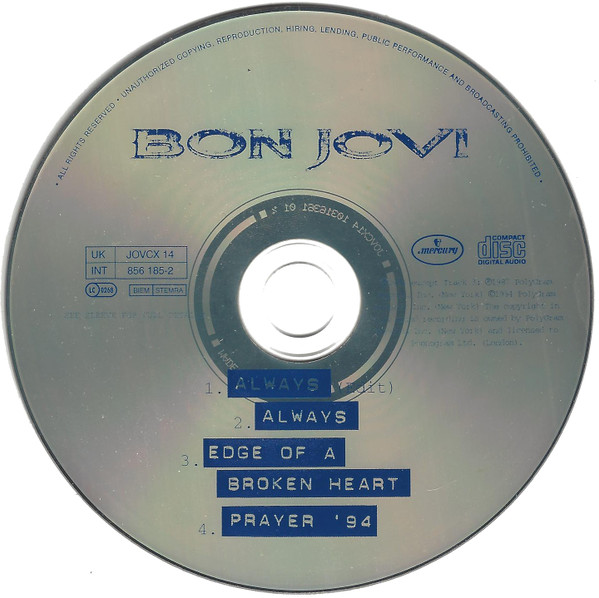
BON JOVI - ALWAYS

Publicació: 12 de setembre de 1994

Llistes: EUA: #4  Regne Unit: #2 


"Always" és una balada de Bon Jovi, llançada al setembre de 1994 com a senzill del seu àlbum de grans èxits, "Cross Road". Es va convertir en un dels seus singles de més èxit, amb més d'un milió de còpies venudes als Estats Units i més de tres milions a tot el món. La cançó va arribar al número quatre al Billboard Hot 100 dels Estats Units, marcant el seu 11è i últim èxit en el Top 10. Internacionalment, va arribar al número u a Bèlgica, Canadà, Irlanda i Suïssa, al número dos a Austràlia i al Regne Unit, i al número quatre a Alemanya.


La cançó va ser escrita inicialment per Jon Bon Jovi per a la banda sonora de la pel·lícula de 1993 "Romeo Is Bleeding", protagonitzada per Gary Oldman com a policia corrupte que afronta problemes matrimonials. Després de quedar decebut en veure una còpia del film, Jon Bon Jovi va decidir no contribuir amb la cançó a la banda sonora. Va deixar la pista de racó fins que l'executiu A&R John Kalodner la va redescobrir i el va persuadir per tornar-la a enregistrar i publicar-la.


La lletra transmet un profund sentit de compromís i devoció, però, quan s'analitza de prop, també revela una inquietant obsessió. La declaració d'amor del protagonista, juntament amb la resolució de dedicació eterna, pot ser interpretada com romàntica per alguns, però inquietant per altres, especialment si l'afecte no és mutu. El mateix Jon Bon Jovi va reconèixer els tons més foscos de la cançó, describint-la com "malalta" i retratant el protagonista com "pràcticament un assetjador" en la seva implacable recerca de l'amor.


El vídeo musical va ser dirigit per Marty Callner i compta amb els actors Jack Noseworthy, Carla Gugino, Jason Wiles i Keri Russell. Una versió alternativa del vídeo mostra únicament la banda interpretant la cançó.


BON JOVI - ALWAYS


Released: September 12, 1994

Charted:  US: #4  UK: #2  


"Always" is a ballad by Bon Jovi, released in September 1994 as a single from their greatest hits album, “Cross Road”. It became one of their best-selling singles, with over a million copies sold in the US and more than three million worldwide. The song peaked at number four on the US Billboard Hot 100, marking their 11th and final top 10 hit. Internationally, it reached number one in Belgium, Canada, Ireland, and Switzerland, number two in Australia and the United Kingdom, and number four in Germany.


The song was initially written by Jon Bon Jovi for the soundtrack to the 1993 film “Romeo Is Bleeding”, featuring Gary Oldman as a corrupt cop facing marital turmoil. After being disappointed after saw a viewing copy by, Jon Bon Jovi chose not to contribute the song to the soundtrack. He left the track on the shelf until A&R executive John Kalodner rediscovered it and persuaded him to re-record and release it.


The lyrics convey a deep sense of commitment and devotion, but when examined closely, they also reveal an unsettling obsession. The protagonist's unwavering declaration of love, coupled with imagery of eternal dedication, can be interpreted as romantic by some but disturbing by others, especially if the affection is not mutual. Jon Bon Jovi himself acknowledged the darker undertones of the song, describing it as "sick" and portraying the protagonist as "practically a stalker" in his relentless pursuit of love.


The music video for "Always" was directed by Marty Callner and features actors Jack Noseworthy, Carla Gugino, Jason Wiles, and Keri Russell. An alternate version of the video solely features the band performing the song. 


MARILLION - KAYLEIGH


Publicació: 7 de maig de 1985

Llistes: EUA: #74  Regne Unit: #2 


"Kayleigh" és una cançó de la banda britànica Marillion, que serveix com a single principal del seu àlbum conceptual "Misplaced Childhood". Esdevé el senzill més exitós de la banda al Regne Unit, arribant a la segona posició a la llista de singles mantenint-se en la llista durant 14 setmanes. La cançó també va assolir l'èxit internacional, entrant al top 10 a Irlanda, Noruega i Alemanya Occidental. Als Estats Units, "Kayleigh" va significar l'única aparició de Marillion a la llista Billboard Hot 100, assolint la posició número 74 l'octubre de 1985. La cançó va contribuir a fer popular el nom Kayleigh al Regne Unit.


"Kayleigh" va enfrontar una dura competició per aconseguir el primer lloc al juny de 1985, ja que va ser superada per una versió de "You'll Never Walk Alone" interpretada pel supergrup de beneficència The Crowd. Aquest single es va publicar com a resposta al tràgic incendi de l'estadi Bradford City, que va ocórrer aquell any. 


"Kayleigh" va inspirar-se en les pròpies experiències i relacions del cantant Fish. La cançó reflecteix el peatge que la seva carrera va suposar per a la seva vida personal, especialment en la seva relació amb una dona anomenada Kay Lee. La seva ruptura va servir de teló de fons per a la lletra. La curiositat sobre l’identitat de Kayleigh va despertar un interès generalitzat, amplificant la popularitat de la cançó i contribuint al seu èxit comercial. L’ansia dels tabloids va alimentar encara més la intriga pública, impulsant "Kayleigh" i l'àlbum de Marillion a la part superior de les llistes i revivint l'interès pels seus llançaments anteriors.


La improvisació del guitarrista de Marillion, Steve Rothery, mentre explicava el seu procés musical a la seva futura dona, va donar lloc a l'iconic riff de "Kayleigh". Sense aquella interacció particular, la trajectòria de la carrera musical de Marillion podria haver seguit un camí molt diferent.


El vídeo promocional del senzill es va gravar a Berlin Occidental, on es va enregistrar l'àlbum "Misplaced Childhood". Va comptar amb Tamara Nowy, una dona alemanya que més tard es va casar amb el cantant Fish, i Robert Mead, el nen retratat a la portada tant de l'àlbum com del single.


Malgrat l’èxit generalitzat a la majoria de parts del món, especialment a Europa, van lluitar per fer-se un lloc en el mercat nord-americà. La seva primera gira pels Estats Units el 1983 va ser rebuda amb decepció, deixant la banda descoratjada. Fins i tot després de l'èxit de "Misplaced Childhood", la seva gira del 1986 com a teloners de Rush no va aconseguir captar l'atenció dels americans, consolidant el seu estatus com una de les principals bandes britàniques oblidades als Estats Units.


MARILLION - KAYLEIGH


Released: May 7, 1985

Charted:  US: #74   UK: #2 


"Kayleigh" is a song by the British band Marillion, serving as the lead single from their concept album "Misplaced Childhood." It stands as the band's most successful single in the UK, reaching the second position on the UK Singles Chart and remaining on the chart for 14 weeks. The song also achieved success internationally, entering the top 10 in Ireland, Norway, and West Germany. In the United States, "Kayleigh" marked Marillion's sole appearance on the Billboard Hot 100 chart, peaking at number 74 in October 1985. 


"Kayleigh" faced stiff competition for the number-one spot in June 1985, as it was edged out by a version of "You'll Never Walk Alone" performed by the charity supergroup the Crowd. This rendition was released in response to the tragic Bradford City stadium fire, which occurred earlier that year. Additionally, the song contributed to popularizing the name Kayleigh in the UK.


"Kayleigh" drew inspiration from singer Fish own experiences and relationships. The song reflects his realization of the toll his career took on his personal life, particularly his romance with a woman named Kay Lee. Their breakup served as a backdrop for the lyrics. The curiosity surrounding the identity of Kayleigh sparked widespread interest, amplifying the song's popularity and contributing to its commercial success. The tabloid frenzy further fueled public intrigue, driving "Kayleigh" and Marillion's album to the top of the charts and reigniting interest in their previous releases.


Marillion guitarist Steve Rothery's improvisation while explaining his musical process to his wife-to-be led to the creation of the iconic "Kayleigh" riff. Without that particular interaction, the trajectory of Marillion's musical journey might have unfolded quite differently.


The promotional video for the single was filmed in West Berlin, where the album "Misplaced Childhood" was recorded. It featured Tamara Nowy, a German woman who later married lead singer Fish, and Robert Mead, the boy depicted on the sleeve of both the album and the single.


"Kayleigh" marked Marillion's sole chart entry in America. Despite their widespread success in most parts of the world, especially in Europe, they struggled to break into the US market. Their first American tour in 1983 was met with disappointment, leaving the band disheartened. Even after the success of "Misplaced Childhood," their 1986 tour supporting Rush failed to garner significant attention, solidifying their status as one of the major British acts largely overlooked in the US.