“The Girl I Knew Somewhere” is a 1967 song by The Monkees, written by Michael Nesmith and originally released as the B-side to “A Little Bit Me, a Little Bit You.” It was recorded during a period when the band gained creative control. The track reached #39 on the Billboard Hot 100, while the A-side peaked at #2. It later appeared on reissues of their third album, “Headquarters”.
After major success with their first two albums, The Monkees grew frustrated with being restricted to vocals while studio musicians handled the instrumentation under music supervisor Don Kirshner. Led by Michael Nesmith, they pushed for creative control, eventually leading to Kirshner’s dismissal. This marked a turning point, as the band gained the freedom to play their own instruments and produce their own music, beginning with the “Headquarters” sessions. Nesmith likened their collaboration to skilled athletes from different sports coming together to try making garage-band music.
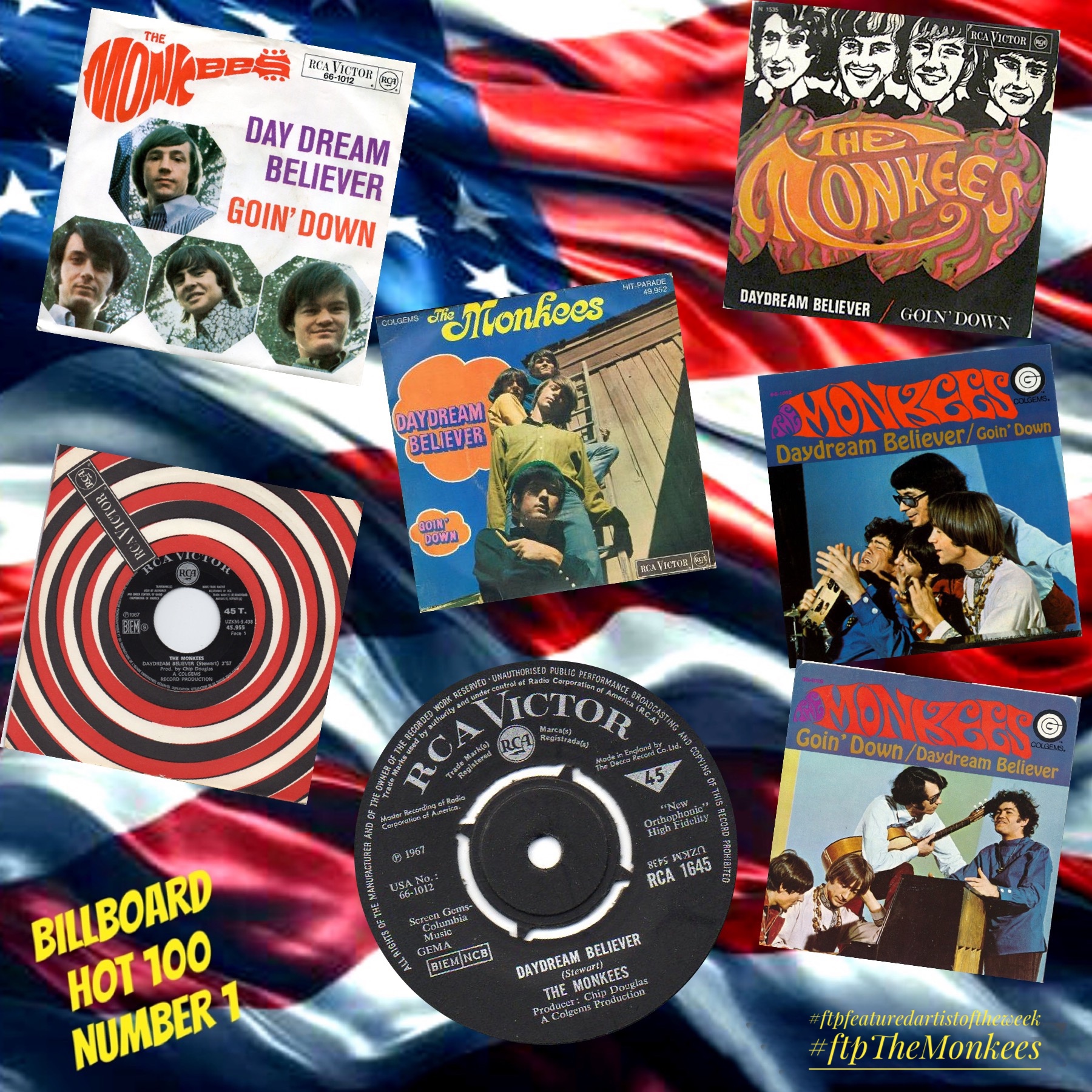
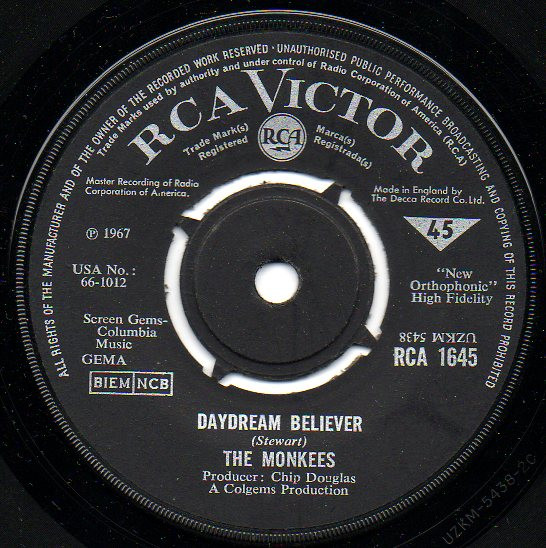
THE MONKEES - DAYDREAM BELIEVER
Released: October 25, 1967
Charts: US: #1 (4 weeks) UK: #5
“Daydream Believer,” written by John Stewart and sung by Davy Jones, became The Monkees’ third US No. 1 hit in December 1967, holding the top spot for four weeks. It also reached No. 5 in the UK. The Monkees performed the song during the second season of their series. Davy Jones named "Daydream Believer" his favorite Monkees song.
Folk artist John Stewart wrote it after leaving the Kingston Trio. Initially rejected by other bands, the song was picked up by The Monkees producer Chip Douglas and became the group’s final US. Inspired partly by an Andrew Wyeth painting, it was the most successful and profitable song Stewart ever wrote, later covered widely and used in media. A small lyric change (“funky” to “happy”) was made to appease the band’s label. Stewart passed away in 2008, leaving behind an extensive musical legacy.
“Daydream Believer” re-entered the charts in 1986 when a new version by the reunited Monkees reached #79, fueled by a resurgence in popularity after MTV began airing reruns of their show 20 years after its original debut.
PHIL COLLINS - YOU CAN’T HURRY LOVE
Llançament: Octubre de 1982
Llistes: UK: #1 (2 setmanes) EUA: #10
“You Can’t Hurry Love” és una cançó de 1966 de The Supremes, llançada sota el segell Motown com el segon senzill del seu àlbum “The Supremes A’ Go-Go”. Escrita i produïda pel prestigiós trio Holland-Dozier-Holland, la cançó és considerada un dels grans èxits tant de The Supremes com de Motown. La revista Billboard la va descriure com la cançó més emocionant del grup fins aquell moment, destacant les extraordinàries veus i la brillant instrumentació.
Eddie Holland va crear el títol per encaixar amb la melodia de Brian Holland. Segons Lamont Dozier, en una entrevista per “1000 UK #1 Hits”, la idea original era reformular “Come See About Me”, però en el procés van acabar transformant-la en una nova cançó amb una forta influència del gospel.
La versió de Phil Collins va obtenir un gran èxit comercial, arribant al #10 al Billboard Hot 100 dels EUA i assolint el #1 al Regne Unit a finals de 1982. Aquesta versió va ser també el tema principal de la pel·lícula de 1988 “Buster”, en la qual Collins era el protagonista.
El baix de la versió de Collins va ser una font d’inspiració per a Andy Rourke en la seva línia de baix a This Charming Man de The Smiths.
Collins va expressar la seva admiració per Motown incloent la dedicatòria “Motown, we salute you” a la funda del seu àlbum “Hello, I Must Be Going”, que incloïa la seva versió de “You Can’t Hurry Love”.
El videoclip d’aquesta versió ret homenatge a The Supremes, mostrant tres Phil Collins alineats i imitant la seva icònica coreografia.
PHIL COLLINS - YOU CAN’T HURRY LOVE
Released : October 1982
Charts: UK: #1 (2 weeks) US: #10
"You Can't Hurry Love" is a 1966 song by the Supremes, released under the Motown label as the second single from their album "The Supremes A' Go-Go". Produced and written by Motown's renowned team Holland-Dozier-Holland, the song is celebrated as one of the Supremes' and Motown's standout releases. Billboard praised it as the group's most thrilling song to date, highlighting its top-notch vocals and exceptional instrumental backing.
Eddie Holland coined the title for "You Can't Hurry Love" to fit Brian Holland's melody. Lamont Dozier remembered the song's origins in an interview for "1000 UK #1 Hits" by Jon Kutner and Spencer Leigh, noting that the team initially aimed to remodel "Come See About Me" but ended up transforming it into "You Can't Hurry Love". Their goal was to infuse the song with a gospel vibe, which ultimately shaped its distinctive sound.
Phil Collins' cover achieved significant success, reaching number 10 on the US Billboard Hot 100 and topping the UK Singles Chart in late 1982. This version of the song was prominently featured as the main theme for the 1988 film also titled "Buster," in which Collins starred. The bassline from Collins' rendition of "You Can't Hurry Love" inspired Andy Rourke's bassline in The Smiths' song "This Charming Man."
Phil Collins demonstrated his admiration for Motown by inscribing "Motown, we salute you" on the sleeve of his album "Hello, I Must Be Going," which included his cover of "You Can't Hurry Love." The accompanying music video for Collins' version paid homage to The Supremes, featuring three Phil Collinses standing in a line, reminiscent of The Supremes' iconic lineup and choreography.
10.5.25
JOAN ARMATRADING - ME MYSELF I
Publicació: 6 de juny de 1980
Llistes: Regne Unit: #21
Publicada el 6 de juny de 1980, “Me Myself I” és una cançó de Joan Armatrading, llançada com a single principal del seu àlbum del mateix nom. Amb Marcus Miller al baix, va arribar al número 21 de la llista de singles del Regne Unit. A diferència de moltes cançons que parlen de la solitud com una cosa trista, aquesta és un himne empoderador que celebra les alegries de la independència personal.
Joan Armatrading va descriure “Me Myself I” com un himne per a persones introvertides, destacant la importància de l’autoconeixement i l’autonomia. Va explicar que, mentre moltes persones tenen dificultats amb la solitud, ella la troba poderosa i gaudeix de la seva pròpia companyia. Tot i així, també reconeix la necessitat de connexions humanes, com expressa en la lletra: “I want to have a girlfriend and a boy for laughs” (“Vull tenir una xicota i un noi per riure”).
L’any 2018 va publicar “I Like It When We’re Together”, que suggereix una visió diferent sobre la solitud. Quan li van preguntar per aquest contrast, va aclarir que, tot i que la independència és valuosa, les relacions humanes són igualment essencials, reforçant la idea que l’equilibri és clau.
El videoclip, estrenat abans de l’era de l’MTV, representa aquesta temàtica de manera creativa, mostrant Armatrading jugant una partida d’escacs contra ella mateixa i viatjant en cotxe com a passatgera d’ella mateixa.
JOAN ARMATRADING - ME MYSELF I
Released: June 6, 1980
Charts: UK: #21
“Me Myself I” is a song by Joan Armatrading, released in June 1980 as the lead single from her album of the same name. Featuring Marcus Miller on bass, it peaked at number 21 on the UK Singles Chart. Unlike many songs about solitude, this one is an empowering anthem, celebrating the joys of independence.
Joan Armatrading described “Me Myself I” as an introvert anthem, emphasizing the importance of self-awareness and independence. She explained that while many struggle with solitude, she finds it empowering and enjoys being on her own. She also acknowledged the need for human connection, as reflected in the song’s lyrics: “I want to have a girlfriend and a boy for laughs.”
In 2018, she released “I Like It When We’re Together”, which suggests a different perspective on solitude. When asked about the contrast, she clarified that while independence is valuable, human relationships remain essential, reinforcing the idea that balance is key.
The music video, released before MTV, creatively portrays this theme, featuring Armatrading playing chess against herself and riding in a car as her own passenger.
9.5.25
THE MONKEES - (I’M NOT YOUR) STEPPIN’ STONE
Released: November 12, 1966
Charts: US: #20
“(I’m Not Your) Steppin’ Stone,” written by Tommy Boyce and Bobby Hart, was originally intended for Paul Revere and the Raiders but became a hit for the Monkees. Released in November 1966 as a B-side, it reached #20 on the Billboard Hot 100, becoming the Monkees’ first charting B-side. Featured in early episodes of their TV series, the song tells the story of a man rejecting a manipulative partner who used him to elevate her social status.
Monkees drummer Micky Dolenz sang lead vocals on it and was the only band member to perform on the recording, with session musicians handling the instruments and backing vocals. Early Monkees tracks were mostly recorded by studio players, as the group was originally cast as actors for a TV show about a fictional band. The members pushed to be taken seriously as musicians and began playing their own instruments in 1967. The Monkees toured successfully through 1969 and enjoyed a major revival in 1986 when MTV aired reruns of their show, prompting a reunion and new tours.
Peter Tork highlighted the emotional depth of “(I’m Not Your) Steppin’ Stone,” noting its intensity and substance compared to more lighthearted ‘60s songs, even referencing its punk credibility via the Sex Pistols’ cover.
The song exists in multiple versions—stereo, single, and mono album—with differences in vocals, fadeouts, and length. Early compilations used the stereo version, but later ones often featured the single version.
THE MONKEES - PLEASANT VALLEY SUNDAY
Released: July 1967
Charts: US: #3 UK: #11
“Pleasant Valley Sunday,” written by Gerry Goffin and Carole King, was inspired by suburban life in West Orange, New Jersey. Recorded by the Monkees in 1967, the single became one of their biggest hits, reaching No. 3 on the charts and appearing on their fourth album, “Pisces, Aquarius, Capricorn & Jones Ltd”.
Carole King revealed that “Pleasant Valley Sunday” was inspired by her and Gerry Goffin’s move to suburban West Orange, New Jersey, where Goffin grew disillusioned with the conformity and materialism of suburban life. His lyrics critique status-seeking, boredom, and societal pressure, making the song a sharp social commentary. Scholars have linked it to the New Left and 1960s counterculture, while Michael Nesmith humorously claimed it was about a mental institution.
The Monkees mostly played their own instruments on “Pleasant Valley Sunday,” with Peter Tork on piano and Mike Nesmith performing the iconic opening guitar riff. Producer Chip Douglas, formerly of The Turtles, created the riff—based on The Beatles’ “I Want to Tell You”—and taught it to Nesmith, who overdubbed it twice. Vocals were handled in unison by Nesmith and drummer Micky Dolenz, creating a distinctive blend of contrasting tones that Peter Tork later praised as a unique melding of their voices.