Total de visualitzacions de pàgina:

15.11.23


MARTHA & THE VANDELLAS - DANCING IN THE STREET / NOWHERE TO RUN / (LOVE IS LIKE A) HEAT WAVE


DANCING IN THE STREET

Released : July 31, 1964

Charted:  UK: #4     US: #2 


"Dancing in the Street" is a song written by Marvin Gaye, William "Mickey" Stevenson and Ivy Jo Hunter. It first became popular in 1964 when recorded by Martha and the Vandellas. It is one of Motown's signature songs and is the group's premiere signature song. This song was written during the height of the civil rights movement in the US, and many African Americans interpreted it as a call to "demonstrate in the streets" of all of the cities mentioned in the song: Chicago, New Orleans, New York, Philadelphia, Baltimore, Washington, D.C. and Detroit. All of these cities went through periods of civil unrest and riots.


According to the song's co-writer Mickey Stevenson, the idea for dancing came to him while riding with Marvin Gaye through Detroit. During the summer, the city would open up fire hydrants and let the water out in the streets so they could play in the water to cool off. They appeared to be dancing in the water.


The group was led by Martha Reeves, who became a secretary at Motown when she couldn't get an audition to sing. One of her duties was singing lyrics to new songs onto tapes so backup singers could learn the words. This led to fill-in work as a backup singer, where she impressed Motown executives with her voice. She convinced them to hire her former bandmates, Annette Sterling and Rosalind Ashford, and let them record as a trio. After backing up Marvin Gaye on some of his songs, Motown gave them songs to sing on their own.


Martha Reeves told the story behind this song: "Marvin Gaye had recorded 'Dancing in the Street' when I first heard it, and he had put a real smooth vocal on there, sort of like (jazzy singing) 'Calling all around the world, are you ready for a brand new beat baby?' and for some reason, Marvin said, 'let's try this song on Martha.' I was in the office and they let me hear the song, but I couldn't quite feel it that way. I had been to Rio De Janeiro, I had traveled to New Orleans during Carnival time, so I just knew it had to be somewhere about dancing in the street. I said, 'Can I sing it the way that I feel it?' And they said, 'Go ahead.' So, I sang it (singing on the beat) 'calling all around the world are you ready for a brand-new beat,' and, they loved it. There was all kinds of congratulatory hand slaps and 'hey man, we got a hit in that window up there,' and the engineer, Lawrence Horn, looked and said, 'I didn't turn the machine on.' I had to sing it again. So, the second time I sang it, there's a little bit of anger there because I had to repeat it. It was a straight performance and that's why it sounds live. I think that's the secret of the success of the hit - the fact that I had to do it again, and I did it without a mistake or without any interruption, and the feeling was just right on that song." Regarding the message Marvin Gaye was sending in the song, Reeves said: "The words are very simple: he wanted everybody to dance in the street. Everybody to rejoice and have a very good time. It was a hot, #1 hit, and it spread love all over the world. When you play it today, people get up and do what? Dance!"


NOWHERE TO RUN


Released : February 10, 1965

Charted:  UK: #26    US: #8 


"Nowhere to Run" is a 1965 song by Martha and the Vandellas for the Gordy (Motown) label and is one of the group's signature songs. The song, written and produced by Motown's main production team of Holland–Dozier–Holland, depicts the story of a woman trapped in a bad relationship with a man she cannot help but love.


One of the inspirations for this song was an encounter that Lamont Dozier had with a frightened teenager who was on his way to Vietnam. He recalled to The Guardian: "His friends asked if I would throw a party for him at my house before he was shipped out. We had the party, but he was very solemn, just sitting with his girlfriend. He had a premonition that he wouldn't be coming back. I told him to be positive, but he was adamant. I found myself thinking about how he was feeling trapped – nowhere to run.


By this time, Martha & the Vandellas had been supplanted by The Supremes as the most successful girl group at Motown. The Supremes were about six months into their run of hits and were getting the bulk of Motown's promotional resources, pushing The Vandellas to second-class status. "Nowhere To Run" has held up as a classic, but it reached just #8 at a time when most Supremes releases were pushed to #1. Martha & the Vandellas never got any higher on the chart.


(LOVE IS LIKE A) HEAT WAVE


Released : July 9, 1963

Charted:  US: #4 


Written by the Motown songwriting team of Eddie Holland, Lamont Dozier and Brian Holland, this was the first Top 10 hit for Martha & the Vandellas. This was the group's second hit written by Holland-Dozier-Holland, following "Come and Get These Memories." It was also one of the first songs to create the style of music that would be known as the "Motown Sound".


Many of the jaunty songs Holland-Dozier-Holland wrote at Motown are underpinned with heartbreaking lyrics, often inspired by real-life breakups. This one is more congruent and less personal. Lamont Dozier explained: "It was summertime and hot and sticky in Detroit. I often sat at the piano and played a warm-up riff to get my day started. This one particular day the heat was over the top and I was watching tv and the weatherman said we had a record-breaking five-day heat wave that was not going to let up. So all this funky riff needed was for me to throw a girl into the mix and this song was born."


Linda Ronstadt recorded a cover in 1975. Her version was released as a single in September 1975, reaching number 5 on Billboard Hot 100. Artists who have covered this song include Lou Christie, the Jam, Joan Osborne, the Supremes, and The Who.


THE TEMPTATIONS - THE WAY YOU DO THE THINGS YOU DO / AIN’T TO PROUD TO BEG


THE WAY YOU DO THE THINGS YOU DO

Released : January 23, 1964

Charted:  US: #11 


"The Way You Do the Things You Do" is a 1964 hit single by the Temptations for the Gordy (Motown) label. Written by Miracles members Smokey Robinson and Bobby Rogers, the single was the Temptations' first charting single on the Billboard Hot 100, peaking in the Top 20 at number eleven. The song has been an American Top 40 hit in four successive decades, from the 1960s to the 1990s. A version by Hall & Oates featuring Temptation members Eddie Kendricks and David Ruffin was nominated for a Grammy Award in 1986. A cover version by British reggae band UB40 hit number six in the U.S. in 1990.


Smokey Robinson wrote this after Berry Gordy implored his Motown writers to come up with something for The Temptations. Gordy wrote his own song for the group, but he put it on the shelf when enough people at Motown told him that Smokey's song was better. Robinson became the primary songwriter for The Temptations.


This is one of the most memorable lyrics in music history, this song is a great bit of romantic poetry, listing all the wonderful things about the lady. From the first lines, it's clear the singer is on to something:


“You got a smile so bright

You know you could have been a candle”


Otis Williams of The Temptations recalled in Mojo magazine February 2009: "The first time we heard the song, we loved it. The melody swung, and the lyrics had lots of charm. They were silly in a way, talking about a girl you loved as a candle, a handle, a schoolbook, a cool crook, a broom, a perfume, but, typical Smokey, he made it work. It got a good response whenever we did it live, so our hopes were up. We knew from past experience that even the best tracks don't always click."


A dancer named Cholly Atkins was brought in to do choreography for The Temptations, which was particularly effective on this song, where they did literal interpretations of the lyrics, miming sweeping the floor or putting on cologne, for example.


AIN’T TO PROUD TO BEG


Released : May 3, 1966

Charted:  US: #13  UK: #21


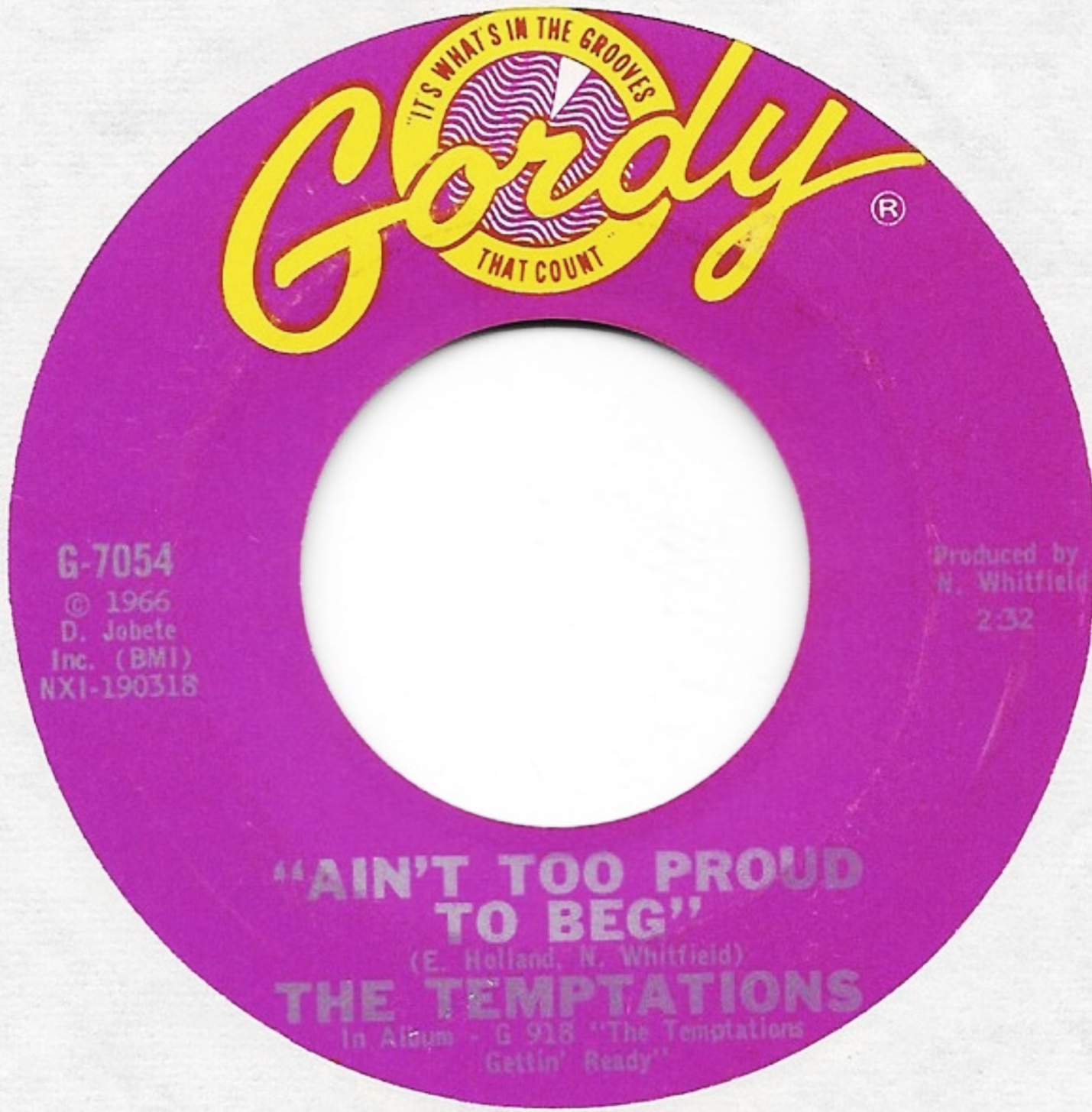
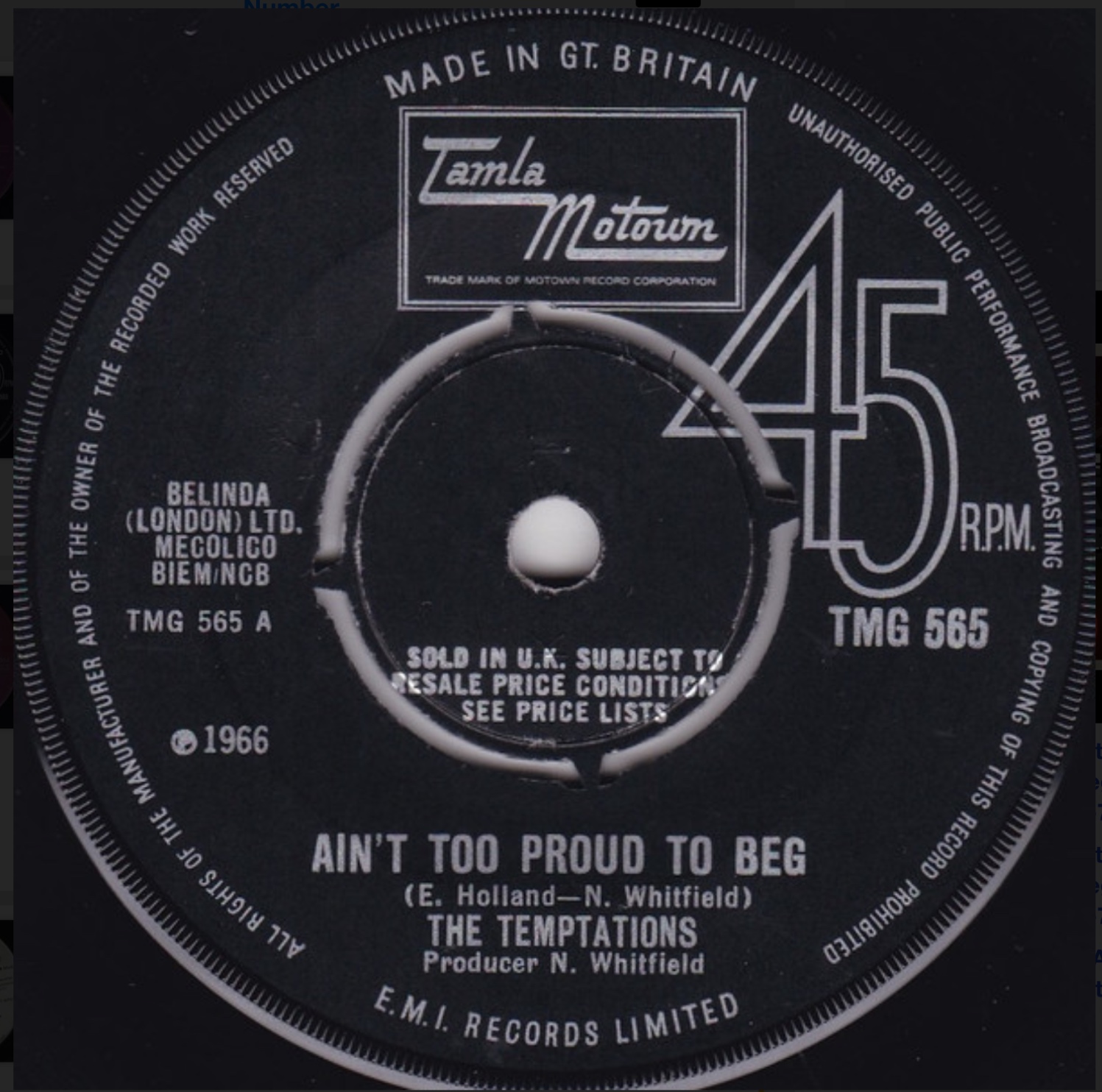
"Ain't Too Proud to Beg" is a 1966 song and hit single by The Temptations for Motown Records' Gordy label, produced by Norman Whitfield and written by Whitfield and Edward Holland Jr. The song was a number-one hit on the Billboard R&B charts for eight non-consecutive weeks. This was very popular among US soldiers who were fighting in Vietnam.


Smokey Robinson was The Temptations' main writer at the time. Motown decided to release his "Get Ready" instead of this song, which drove Whitfield nuts. After "Get Ready" didn't meet expectations, "Ain't Too Proud To Beg" was released as The Temptations next single. From there, Whitfield became the regular producer of the Temptations.


Whitfield also produced this song. He had Temptations singer David Ruffin sing slightly higher than his normal range, resulting in the pained vocal that went with the lyrics. Whitfield had Marvin Gaye do the same thing on "Heard It Through The Grapevine." "Norman was hell-bent on taking us in a new direction," The Temptations' Otis Williams told Uncut magazine. "Norman pushed David to vocal heights we hadn't heard before. David was sweating like crazy through the entire session."


JACKSON 5 - I’LL BE THERE

Released : August 28, 1970

Charted:  UK: #4  US: #1 (5 wks)


The day after the Jackson 5 released “I’ll Be There,” their fourth national single and fourth #1, Michael Jackson turned 12. Even if you’ve been living your entire life with “I’ll Be There,” with the myth of Michael Jackson’s whole career, that’s staggering. “I’ll Be There” is an almost painfully adult song, a song about regret and longing and warmth and support and mixed-up feelings. And Jackson sings it with an almost absurd grace, a sense of empathy and tenderness and understanding. 


Before “I’ll Be There,” the three Jackson 5 songs that had hit #1 were all variations on the same thing. They were springy, funky, uptempo jams that reimagined the giddiest bits from Sly & The Family Stone, as reworked by Motown’s assembly line geniuses and interpreted by a group of adorable, frighteningly talented children. This was a formula, and it was a formula that worked better than anyone could’ve ever anticipated. On their first three singles Michael Jackson and his brothers practically vibrate with excitement. That’s not what happens on “I’ll Be There.” “I’ll Be There” is something else.


The song itself is as shatteringly lovely as any Motown ballad. It’s a pledge to support and comfort another person, no matter what happens. We don’t find out the whole story until the third verse: “If you should ever find someone new, I know he better be good to you / Cuz if he doesn’t, I’ll be there.” With that line, the whole song shifts. We learn that we’re hearing someone singing about an ex, promising that he’ll drop everything and come running whenever his former love gets lonely. That line transforms it from a song of friendship to one of heartbreak.


A song like “I’ll Be There” is central to the legend of Michael Jackson, both for being an amazing song and for what it represents. Here, this angelic child was singing these incredibly adult songs, doing them better than any adult ever could. Jackson was a global superstar as a small child, which means he never got to enjoy anything resembling childhood. Then, as a galactically famous adult, Jackson chased those childhood feelings that he never got to feel, remaking himself as an alien manchild. In that pursuit of what all his money couldn’t buy him, Michael became strange and creepy and tragic. He definitely died too young. All that transcendence came with a heavy price tag. And yet, after all that, after everything we saw, those songs are perfect. “I’ll Be There” is perfect.


In his autobiography Moon Walk, Michael Jackson noted that "I'll Be There" was the song that solidified The Jackson 5's careers and showed audiences that the group had potential beyond bubblegum pop. Nevertheless, "I'll Be There" was the Jackson 5's final number-one Hot 100 hit as a group. For the rest of their career as a major-label act, Jackson 5 singles would climb no higher than number 2.


MARVIN GAYE - WHAT’S GOING ON

Publicació: 20 de gener de 1971

Llistes: EUA: #2


"What's Going On" és una cançó del cantautor nord-americà Marvin Gaye, publicada el 1971 a la filial de Motown, Tamla. Originalment inspirada en un incident de brutalitat policial presenciat per Renaldo "Obie" Benson, la cançó va ser composta per Benson, Al Cleveland i Gaye i produïda pel mateix Gaye. La lletra de Gaye en aquesta cançó es va inspirar en les històries que el seu germà Frankie li va explicar quan va tornar de la guerra del Vietnam. La cançó va marcar la sortida de Gaye del Motown Sound cap a un material més personal.


La cançó tracta sobre els disturbis civils i la injustícia social de principis dels anys setanta. Es tracta de protestar contra la brutalitat policial, la guerra i el racisme i l'opressió als afroamericans. Gaye canta sobre la necessitat de trobar solucions a aquests problemes i la necessitat de portar comprensió i pau. La cançó anima els oients a pensar per què estan passant aquests problemes i a preguntar-se: "Què està passant?"


Aquesta va ser una de les primeres cançons de Motown a fer una declaració política potent. Stevie Wonder and the Temptations també estaven gravant material més seriós i desafiant, cosa que va suposar una sortida radical dels èxits de Motown dels anys 60. La cançó va tenir un impacte enorme perquè els oients no estaven acostumats a escoltar comentaris socials de Gaye. Com va dir Jackson Browne en una entrevista de 2008 a Rolling Stone: "Ningú esperava una cançó contra la guerra d'ell. Però va ser un moment en el temps en què la gent estava disposada a escoltar-la de qualsevol, si fos sincer. I qui millor que la persona que t'ha parlat d'amor i desig?"


Segons el llibre "Mercy, Mercy Me: The Art, Loves & Demons of Marvin Gaye", el cap de Motown, Berry Gordy, es va negar inicialment a publicar aquesta cançó, qualificant-la de "el pitjor disc que he escoltat a la meva vida". La cançó la va treure l'home al capdavant de l’empresa mentre Gordy estava de vacances i, per descomptat, es va posar furiós fins que es va assabentar que el senzill va vendre 100.000 còpies als EUA quan es va llançar. No cal dir que aviat va canviar d'opinió sobre la cançó. Tot i que Berry Gordy admet que tenia reserves sobre "What's Going On", afirma que totes les històries que envolten la seva negativa a publicar la cançó són falses.


Gordy va explicar al Wall Street Journal: "Durant anys, la gent ha escrit que vaig impedir el llançament d'aquesta cançó i que Marvin m'havia amenaçat amb no tornar a gravar mai més si no la publicava, Això és una lectura fantàstica, però no és cert". Va continuar explicant les possibles ramificacions de la cançó: "El meu motiu per rebutjar-la no va ser aturar el senzill, només va ser per determinar si aquesta era o no una altra de les seves idees estrambòtiques. Motown parlava de música per a totes les persones: blancs i negres, blaus i verds, policies i lladres. Em vaig mostrar reticent a que la nostra música alienés ningú. Això era un gran risc per a la imatge de la discogràfica."


MARVIN GAYE - WHAT’S GOING ON


Released : January 20, 1971

Charted:  US: #2 


"What's Going On" is a song by American singer-songwriter Marvin Gaye, released in 1971 on the Motown subsidiary Tamla. Originally inspired by a police brutality incident witnessed by Renaldo "Obie" Benson, the song was composed by Benson, Al Cleveland, and Gaye and produced by Gaye himself. Gaye's lyrics in this song were inspired by the stories his brother Frankie told him when he came back from the Vietnam war. The song marked Gaye's departure from the Motown Sound towards more personal material.


The song is about the civil unrest and social injustice of the early 1970s. It touches on protesting police brutality, war, and the racism and oppression of African Americans. Gaye sings about the need to find solutions to these issues and the need to bring understanding and peace. The song encourages listeners to think about why these issues are happening and to ask themselves, “What's going on?”


This was one of the first Motown songs to make a powerful political statement. Stevie Wonder and the Temptations were also recording more serious and challenging material, which was a radical departure from the Motown hits of the '60s. The song had a tremendous impact because listeners weren't used to hearing social commentary from Gaye. As Jackson Browne said in a 2008 interview with Rolling Stone: "No one was expecting an anti-war song from him. But it was a moment in time when people were willing to hear it from anybody, if it was heartfelt. And who better than the person who has talked to you about love and desire?"


According to the book “Mercy, Mercy Me: The Art, Loves & Demons of Marvin Gaye”, Motown head Berry Gordy initially refused to release this song, calling it the ‘worst record I ever heard in my life’. The song was slipped out by the man in charge while Gordy was on vacation and, of course, he was furious... until he found out the single sold 100,000 copies in the US upon its release. Needless to say, he soon changed his mind about this song. Although Berry Gordy admits he had reservations about "What's Going On", he claims all of the stories surrounding his refusal to release the song are false. 


He explained to the Wall Street Journal: "For years, people have written that I stood in the way of this song's release and that Marvin had threatened never to record for me again if I didn't put it out," he said. "That must make for great reading, but none of it is true." He went on to explain the potential ramifications of the song: "My reason for pushing back on Marvin wasn't to stop the single, just to determine whether or not this was another one of his wild ideas," Gordy said. "Motown was about music for all people - white and black, blue and green, cops and the robbers. I was reluctant to have our music alienate anyone. This was a big risk for his image."