Total de visualitzacions de pàgina:

18.11.23


STEVIE WONDER - SIR DUKE / I WISH


SIR DUKE

Released: March 22, 1977

Charted: UK #2    US #1 (3 weeks)


"Sir Duke” is a song from his 1976 album “Songs in the key of life”.. Released as a single in 1977. Stevie Wonder wrote this song as a tribute to music, specifically to Duke Ellington, who had passed away in 1974. Ellington was a jazz bandleader and composer who was a big influence on Wonder. It's a tribute to jazz and roots, with a beat that lies somewhere between jazz and funk, and a horn section that dances on winged feet.


"I knew the title from the beginning but wanted it to be about the musicians who did something for us," Stevie said. "So soon they are forgotten. I wanted to show my appreciation. They gave us something that is supposed to be forever. That's the basic idea of what we do and how we hook it up."


This wasn't the first song Wonder wrote in tribute to one of his musical inspirations: "Bye Bye World" from his 1968 album Eivets Rednow is about the guitarist Wes Montgomery. Wonder's second album, released in 1962 when he was just 12 years old, was Tribute to Uncle Ray, which paid homage to Ray Charles. This was more of a marketing ploy by Motown, who were pushing Wonder as the second coming of Charles.


Cash Box said that "it's a tribute to jazz and roots, with a beat that lies somewhere between jazz and funk, and a horn section that dances on winged feet." Record World said upon its single release: "Already familiar from its radio play and already on The Singles Chart, it is shaping up as a major hit."


The lead guitarist on this song was Mike Sembello, who had a hit in 1983 with "Maniac” from “Flashdance” soundtrack.


I WISH 


Released: November 1976

Charted: UK #5   US #1 (1 week)


"I Wish” is a song released in late 1976 as the lead single from his 1976 album, “Songs in the key of life”. The song focuses on his childhood from the 1950s into the early 1960s about how he wished he could go back and relive it. The single hit number one on the Billboard Hot 100 and soul singles chart. At the 19th Grammy Awards, Stevie Wonder won the Best R&B Vocal Performance Male for this song.


Wonder recollected how the music for "I Wish" came to him: The day I wrote it was a Saturday, the day of a Motown picnic in the summer of '76. God, I remember that because I was having this really bad toothache. It was ridiculous...I had such a good time at the picnic that I went to Crystal Recording Studio right afterward and the vibe came right to my mind – running at the picnic, the contests, we all participated. It was a lot of fun ... and from that came the 'I Wish' vibe.


This song finds Stevie chronicling his younger days from the 1950s onto the early '60s when he was a "nappy-headed boy" growing up in difficult circumstances. Despite living in poverty, he looks fondly on those days and wishes they could come back once more. It was a simple time when his only worry was "for Christmas what would be my toy."


Stevie Wonder told ABC Audio during a virtual press conference that he always writes the music and melody first to let the words become their own. He cited this song as an example, explaining it was originally going to be about "The Wheel of 84" and other Eastern religious spiritual teachings. "But then it was one time we were in the studio," he added, "just talking about things that happened when we were kids... back in the day... So it turned into 'I Wish.'"


Nathan Watts' infectious 8-note bassline is one reason why "I Wish" is one of Stevie Wonder's most sampled songs. 


In 2015, Wonder was honored with the TV special Stevie Wonder: Songs in the Key of Life - An All-Star Grammy Salute, where Lady GaGa gave an excellent performance of "I wish".


Taking two years to complete, the album “Songs in the key of life” was a salute to Wonder's perfectionist ethos ("If it takes two years or seven years, I must be satisfied when it's done"), with the largest and most diverse collection of songs out of all his releases. It was the first album Wonder produced after signing a seven year contract with Motown Records, reputed to be worth $13 million. The Motown representative that bartered the contract said that the success of this album, which won the Album of the Year Grammy Award, convinced him that he had not been cheated in the deal. Clearly it was worth it, earning not just commercial success but praise from other artists who cite its influence. Elton John said of the album in 2003, "Let me put it this way: wherever I go in the world, I always take a copy of “Songs in the key of life”. For me, it's the best album ever made, and I'm always left in awe after I listen to it."


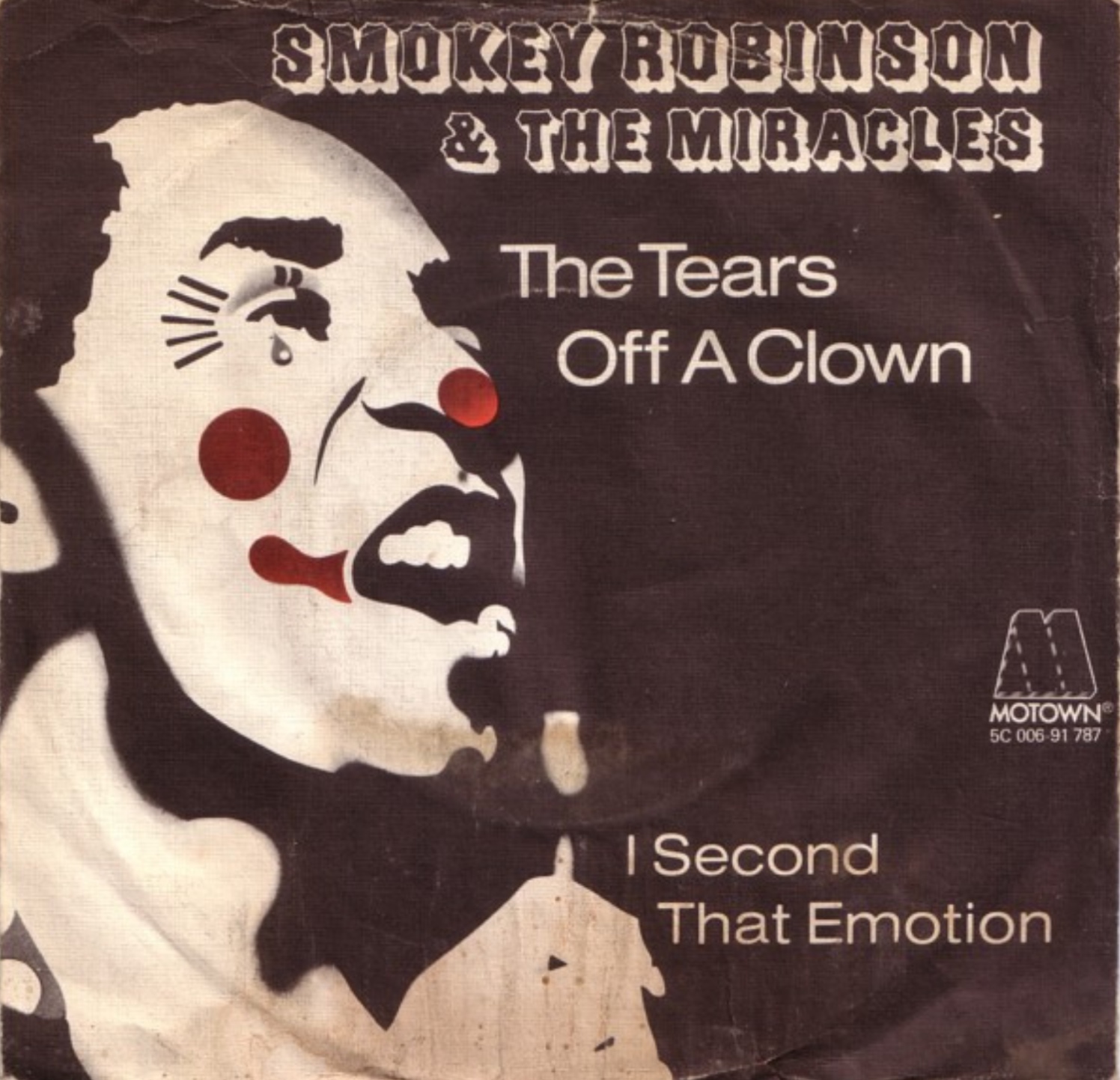
 

SMOKEY ROBINSON & THE MIRACLES - THE TEARS OF A CLOWN

Released: July 1970 (UK)  September 24, 1970 (US)

Charted:  UK: #1 (1 week)  US: #1 (2 weeks)


"The Tears of a Clown" is a song written by Hank Cosby, Smokey Robinson, and Stevie Wonder and originally recorded by Smokey Robinson & the Miracles for the Tamla Records label subsidiary of Motown, first appearing on the 1967 album “Make It Happen”. The track was re-released in the United Kingdom as a single in July 1970, and it became a #1 hit on the UK Singles Chart for the week ending 12 September 1970. Subsequently, Motown released a partially re-recorded and completely remixed version as a single in the United States as well, where it quickly became a #1 hit on both the Billboard Hot 100 and R&B Singles charts.


Smokey Robinson based this song on the Italian opera Pagliacci, which is about a clown who must make the audience laugh while he weeps behind his makeup because his wife betrayed him. In the last verse, Robinson sings: "Just like Pagliacci did, I try to keep my sadness hid". Robinson heard the Pagliacci story when he was young, and always found it intriguing.


Stevie Wonder came up with the music for this song with a top Motown producer named Hank Cosby. They recorded an instrumental demo and asked Robinson to complete the song - it was common practice for Motown writers to work on each other's songs at the time. Robinson listened to the song for a few days and decided it sounded like a circus - he came up with the lyrics based on the clown. "I was trying to think of something that would be significant, that would touch people's hearts, but still be dealing with the circus," said Smokey. "So what is that? Pagliacci, of course. The clown who cries. And after he makes everyone else happy with the smile painted on his face, then he goes into his dressing room and cries because he's sad. That was the key."


SMOKEY ROBINSON & THE MIRACLES - I SECOND THAT EMOTION


Released: October 19, 1967

Charted:  UK: #27     US: #4 


"I Second That Emotion" is a 1967 song written by Smokey Robinson and Al Cleveland. First charting as a hit for Smokey Robinson and the Miracles on the Tamla/Motown label in 1967. This was the first Top 10 hit for the group after their 1967 name change from The Miracles.


"I second that motion" is a common phrase heard at meetings in America where policy is being determined. It's what Motown producer Al Cleveland meant to say when he was on a shopping trip with Smokey Robinson. As Robinson recalls in his 1989 autobiography, he and Cleveland went to a Detroit department store called Hudson's to do Christmas shopping in December 1967. Smokey's wife, Claudette, had recently given birth to twins that didn't survive the premature birth, and he was looking to get her a gift. At the jewelry counter, Smokey picked out some pearls and asked Robinson what he thought. "I second that emotion" was his reply, and later that afternoon the pair wrote a song around the misspoken phrase. Robinson and Cleveland produced the song, and it was released in October 1968, entering the US Top 40 in December, about a year after it was written. The song was also a #1 R&B hit.


Robinson and Cleveland wrote a third verse for this song, which pushed the length to 3:15. Acutely aware that songs longer than 3 minutes were often denied airplay, Motown head Berry Gordy had them eliminate the verse and bring the song down to 2:38, which was much more palatable for radio programmers. Robinson was OK with altering the song, as he had tremendous respect for Gordy's judgment and wanted the song to be a hit. He felt that he could tell a story in a song in whatever time he was allotted - even under 3 minutes.


In songwriting circles, this one is often studied for its use of secondary rhymes and melodic intricacy. Smokey Robinson sprinkled in words like "notion" and "devotion" to compliment the title, all while rhyming verses with phrases like "kisses sweet" and "no repeat." The guitar line also perfectly accents the vocal.


 FOUR TOPS - REACH OUT I’LL BE THERE

Released : 1966

Charted:  UK: #1     US: #1 


"Reach Out I'll Be There" is a song recorded by the Four Tops from their 1967 fourth studio album “Reach Out”. Written and produced by Motown's main production team, Holland–Dozier–Holland, the song is one of the most widely-known Motown hits of the 1960s and is today considered the Four Tops' signature song.


The Four Tops recorded this in just two takes, and had practically forgotten about the song until it was released, assuming it was a "throwaway" album track. Motown boss Berry Gordy had other ideas and released it as a single. Gordy had a knack for identifying hit songs, and got this one right.


Dozier explained: "Brian, Eddie and I often had discussions about what women really want most of all from a man, and after talking about some of our experiences with women, we all three agreed that they wanted someone to be there for them, through thick or thin, and be there at their beck and call! Thus this song was born."


The line, "happiness is just an illusion" appeared in another Motown song that was on the charts at the same time: "What Becomes of the Brokenhearted" by Jimmy Ruffin. That one also rhymed "illusion" with "confusion."


This song has an interesting chart history in the UK: The original hit #1 in 1966, Gloria Gaynor took a disco version to #14 in 1975, a remix of the Four Tops version by the production team Stock, Aitken & Waterman went to #11 in 1988, and Michael Bolton's version hit #37 in 1993.


It was just the second Motown song to hit #1 in the UK, following "Baby love”  by The Supremes, which reached the summit in 1964.


FOUR TOPS - BABY I NEED YOUR LOVING


Released : July 10, 1964

Charted:  US: #11 


"Baby I Need Your Loving" is a 1964 hit single recorded by the Four Tops for the Motown label. Written and produced by Motown's main production team Holland–Dozier–Holland, the song was the group's first Motown single and their first pop Top 20 hit. It was also their first million-selling hit single.


The Four Tops were around for 11 years before they broke through with this song. It was their first single for Motown Records, which signed the group in 1963 after they had been touring and recording on smaller labels for a decade. The investment paid off for Motown, and The Four Tops became one of the most successful and enduring acts on the label.


Like many Holland-Dozier-Holland compositions, the uptempo music belies the subject matter in the song: the guy is lonely and heartbroken, desperate for a love that will never return. They often wrote these songs as ballads before working them over. He explained the process: "As a rule, most of the songs we started out to get the right feeling and the right emotion of the chords. And to get that feeling, we would start writing in ballad form - a slower, torch-song type of feeling. Then when we got in the studio, we would pick up the tempo. Because at the time, dance music was in with the kids, so we tried to make them commercial by picking up the speed. That's what made the songs commercial."


This was the first of many Motown hits for the group, and the beginning of a fruitful collaboration with the Holland-Dozier-Holland songwriting team. Lamont Dozier said in a 1976 interview with Blues & Soul: "We've all been together virtually since I was a kid in Detroit and we always had no problem working together. We used to just lock ourselves in the studios with some barbecue ribs and Cold Duck and come up with an album in a couple of days. I would say that they were probably the easiest guys to work with, always professional and polished."


MARY JANE GIRLS - IN MY HOUSE

Released : October 1984

Charted:  UK: #77    US: #7 


"In My House" is a song produced, written and arranged by American musician Rick James and recorded by his protégées, the Mary Jane Girls, for their 1985 second studio album, “Only Four You”. It was released as the album's lead single in October 1984 by Gordy Records. James released a song in 1978 called “Mary Jane" which is about his love for marijuana, so the group name is rather obvious (although one of the four members, JoJo McDuffie, claimed it could be a term for femininity, or possibly the shoes little girls wore).


The song finds the girls inviting a guy over for some good loving anytime he feels the need. It's an inviting offer, as they promise to satisfy his every need. McDuffie claimed it was an answer to all the songs where guys lure women to their houses. "How many women have dreamt of doing the same thing?," she said.


This song got the attention of the Parents Music Resource Center (PMRC), which put it on their list of 15 songs they found patently offensive, in this case, for sexual content. The group formed in May 1985, shortly after this song peaked on the charts. Founded by four wives of prominent politicians (including Tipper Gore, wife of then-Senator Al Gore), they succeeded in getting warning stickers placed on albums with objectionable content. "I remember being really, really irritated, because there was nothing in the song that would suggest anything inappropriate," JoJo McDuffie told Newsweek. "Was the song about sex? Of course it was. But lyrically, it was very tastefully done."


The "In My House" video was directed by Mark Rezyka, who was one of the most prolific directors of the era. It shows the girls doing some light dancing in a very nice house. MTV aired the video, something they didn't do for Rick James clips.