Total de visualitzacions de pàgina:

9.12.23


MADNESS - HOUSE OF FUN 

Publicació: 14 de maig de 1982

Llistes: Regne Unit: #1 (2 setmanes)


"House of Fun" és l'única cançó de la banda que va encapçalar les llistes del Regne Unit. En aquesta cançó diabòlicament enganxosa del 1982, Madness mostra el seu costat descarat i atrevit. Aprofundir en la lletra revela una exploració astuta del viatge a la majoria d'edat d'un jove de setze anys, abordant de manera intel·ligent temes d'adults com la compra de preservatius a una farmacèutica.


En un gir còmic, el noi recorre a eufemismes humorístics a l'hora de comprar anticonceptius, com "box of balloons with a featherlight touch” (caixa de globus amb un toc lleuger com una ploma) i “party hats with the coloured tips” (barrets de festa amb les puntes de colors), provocant un malentès amb la farmacèutica que el dirigeix ​​a una botiga de bromes. La instrumentalització de la cançó és brillant combinant perfectament el so ska característic de Madness amb una melodia inspirada en el circ, creant un ambient de festa exuberant i jovial. Aquesta elecció musical no només complementa el títol de la cançó, sinó que també al·ludeix intel·ligentment als matisos més foscos de la majoria d'edat, amb referències a la temptació i l'entrada al cau dels lleons, reflectint el viatge agredolç de deixar enrere la infància.


El vídeo musical, rodat principalment a Pleasure Beach a Great Yarmouth, mostra Madness en una muntanya russa. Suggs, vestit de nen, interpreta còmicament la lletra de la cançó en una farmàcia, intentant una incòmoda compra de preservatius. Amb ell, tres membres de la banda realitzen una rutina de ball rítmica i humorística vestits de senyores de la neteja. El vídeo passa a les escenes d'una barberia abans d'arribar a un final on la banda canta a la muntanya russa. El vídeo es tanca amb la banda en una muntanya russa mentre la cançó s'esvaeix.


En un gir irònic del destí, aquesta cançó sobre un noi de 16 anys que compra preservatius va ser número 1 al Regne Unit quan el papa Joan Pau II va fer la seva primera visita oficial a Anglaterra.


MADNESS - HOUSE OF FUN 


Released: May 14, 1982

Charted:  UK: #1 (2 weeks)


"House of Fun" stands as the band's sole song to top the UK charts. In this devilishly catchy track from 1982, Madness showcases their cheeky and edgy side. Delving into the lyrics reveals a sly exploration of a sixteen-year-old's coming-of-age journey, cleverly addressing adult themes like purchasing condoms from a pharmacist. 


In a comedic twist, boy resorts to humorous euphemisms when buying contraception, as “box of balloons with a featherlight touch” and “party hats with the coloured tips”, leading to a misunderstanding with the pharmacist who directs him to a joke shop. The song's instrumental brilliance seamlessly combines Madness's signature ska sound with a circus-inspired tune, creating an exuberant and jovial party atmosphere. This musical choice not only complements the song's title but also cleverly alludes to the darker undertones of coming of age, with references to temptation and entering the lion's den, reflecting the bittersweet journey of leaving childhood behind.


The music video, predominantly filmed at Pleasure Beach in Great Yarmouth, showcases Madness on a roller coaster. Suggs, dressed as a boy, comically enacts the song's lyrics in a chemist's shop, attempting an awkward purchase of condoms. Joining him, three band members perform a rhythmic and humorous dance routine dressed as Pepperpots. The video transitions to scenes in a barber's shop before reaching a finale where the band sings atop the roller coaster. The video closes with the band continuously on a roller coaster loop as the chorus fades.


In an ironic twist of fate, this song about a 16-year-old boy buying condoms was the UK #1 when Pope John Paul II made his first official visit to England.


7.12.23


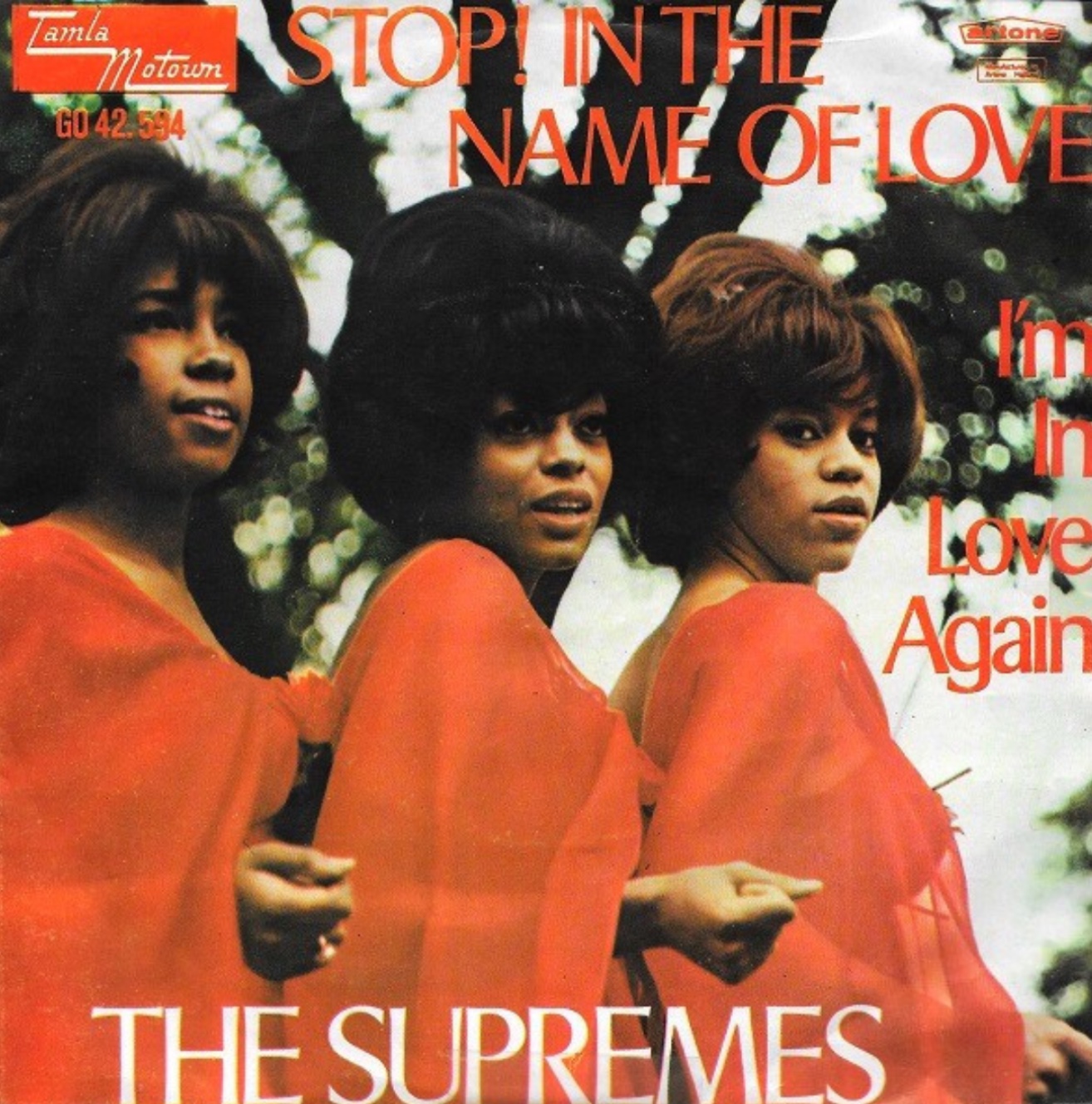
THE SUPREMES - STOP! IN THE NAME OF LOVE / BACK IN MY ARMS AGAIN / I HEAR A SYMPHONY 


STOP! IN THE NAME OF LOVE


Released : February 8, 1965

Charted:  UK: #7    US: #1 (2 weeks)


This was written by the Motown songwriting team Eddie Holland, Lamont Dozier and Brian Holland (Holland/Dozier/Holland). Dozier got the idea for the title after an argument with his girlfriend (she caught him cheating). In the heat of battle, he said, "Baby, please stop. In the name of love - before you break my heart."  He was trying to diffuse the situation, but it didn't help - she was still going to break up with him. So, he asked her to "think it over." Dozier knew these lines were a bit corny, but thought they would fit well into a song. He was right: "Stop! In the Name of Love" became a huge hit, and when it did, the girl came back to him.


Lamont Dozier added some detail to the story of how he came up with the title. He was cheating on his girlfriend and having a tryst at a "no-tell motel" when the girlfriend got word and started banging on the door around 2 a.m. Dozier sent his paramour out the bathroom window and opened the door. With his girlfriend "screaming and carrying on," Dozier tried to spin a story that he was working late at the studio and got the motel room because he was tired, but it didn't fly. That's when he said, "Stop, in the name of love."  The next day he went to the studio where Brian Holland was playing a slow melody. Dozier had him speed it up, and using his line from the night before as the title, they started putting the song together.


"Stop! In the Name of Love" is a powerful plea for loyalty and honesty in a relationship. A girl is aware of her partner's infidelity and has tried to wait patiently for him to stop, but she cannot bear the thought of losing him forever. She asks him to think it over before leaving her and running to his other lover's arms. The chorus serves as a warning to her partner, urging him to reconsider the consequences of his actions before causing any more pain. The woman is hurt and heartbroken, but she still harbors deep affection for her partner and hopes that he will choose to stay with her instead of risking everything for someone else.


The famous "talk to the hand" choreography the group performed for this song was thought up in a hurry. Soon after it was recorded, The Supremes joined other Motown acts on a tour of Europe, where the first gig was a one-hour TV special called The Sound of Motown, hosted by Dusty Springfield. When The Temptations saw The Supremes rehearsing the song, group member Paul Williams suggested some choreography and came up with the saucy gestures they used on the show and in subsequent performances.


Record World said "These girls can't be stopped. And so they have another one that is on their way to the top spot. Diana, Florence and Marie have the knack and so does their home base, Motown Records.”


BACK IN MY ARMS AGAIN


Released : April 15, 1965

Charted:  UK: #40    US: #1 (1 week) 


This was The Supremes' fifth consecutive #1 hit in the US, all five were written by the Motown team of Eddie Holland, Lamont Dozier and Brian Holland, known collectively as Holland-Dozier-Holland. "Back In My Arms Again" finds lead singer Diana Ross reunited with her man and determined to keep him, even if it means ignoring her friends' pleas to leave him.


Supremes Mary Wilson and Florence Ballard get a mention in the third verse, starring as two of the friends hectoring Ross to dump her man:


How can Mary tell me what to do

When she lost her love so true?

And Flo, she don't know

'Cause the boy she loves is a romeo


In real life, their friendship was strained around this time, with Wilson and Ballard frustrated because Ross had become the focal point of the group. They were happy to get their names mentioned though.


I HEAR A SYMPHONY


Released : October 6, 1965

Charted:  UK: #39    US: #1 (2 weeks)


In this song, The Supremes are so smitten that every time the guy comes around, it's like he has his own sweet theme music. Lamont Dozier, who wrote and produced the song with his partners Eddie and Brian Holland, told the story: "I used to go to the movies and I would see that the main stars had their own theme songs. When they appeared on the screen, you would hear this melody behind them - they had their own little melody each time they appeared in the movie. So the lyrics, 'Whenever you are near, I hear a symphony,' it was about this guy. Whenever he came around, in her mind she got this feeling and she heard this melody. He brought out the music in her."


Brian Holland, who wrote the song with his brother Eddie and their songwriting partner Lamont Dozier, had an affair with Diana Ross in the early '60s. It was a very emotional time for him, and a lot of those feelings came out in this song. In the book The Supremes: A Saga of Motown Dreams, Success and Betrayal, he revealed that the song never got to him until the '80s, when he was driving one day and the song came on the radio. "I hadn't had any emotional reaction to it before that. It took 25 years for it to sink in how good that song is," he said. "Things were happening in our lives by then, Eddie's and mine, that began to creep into the songs. Those songs were supposed to be about simple things. And at the beginning, they were. It was 'baby this, baby that.' But when I hear something like 'Symphony,' man, there ain't nothing simple about it."


Most of the Supremes previous hits had an element of heartbreak in the lyrics, but "Back in My Arms Again” and "I Hear A Symphony" are about happiness and the ecstasy of pure, true love.


MADNESS - EMBARRASSMENT

Publicació: 14 de novembre de 1980

Llistes: Regne Unit: #4


"Embarassment" és una cançó escrita principalment per Lee Thompson, però parcialment acreditada a Mike Barson, llançada com a segon senzill de l'àlbum "Absolutely". La cançó va ser remesclada per publicar-la com a single, i és una mica diferent a la versió de l'àlbum, tot i que totes dues tenen el mateix temps de durada. Encara que la gran majoria de les cançons de Madness són ximples i festives, "Embarassment" contradiu completament aquesta tendència i té una narrativa molt fosca i dolorosa.


La cançó escrita per Lee es basa en fets reals. La seva germana adolescent Tracy va quedar embarassada del fill d'un negre i, tot i que això no és gens sorprenent per als oients moderns, en aquells dies era força controvertit, ja que la lletra parla dels nombrosos membres de la família que van rebutjar la noia embarassada. Suggs va recordar a The Daily Mirror: "La germana de Lee Thompson va tenir un nadó amb un home negre i va causar consternació a la seva família. És una gran lletra, realment sensacional. No us podríeu creure que tal sensibilitat pogués venir d'un diamant en brut com en Lee, però és un dels millors lletristes de la seva època".


Tot i que la lletra potser no ho suggereix directament, la cançó estava pensada com una condemna de les actituds racistes que descriu, amb Suggs afirmant que va ser escrita per allunyar la banda de qualsevol associació amb grups d'odi. "Estàvem tenint problemes amb la gent que ens associava amb la NF (National Front), així que va ser bo establir d'una vegada per totes que no hi teniem res a veure." La polèmica sobre la relació de la banda amb grups racistes va sorgir d'una entrevista amb Chas a New Musical Express, que immediatament els membres de la banda van negar rotundament, per això la cançó oferia un subtil però poderós repudi al racisme i la ignorància. 


És interessant veure com el so habitualment divertit de ska de la banda s'utilitza per a una cançó amb un missatge tan fosc com el que s'inclou aquí, amb frases tan dures com “How can you show your face/ When you’re a disgrace to the human race?” (Com pots mostrar la teva cara/ Quan ets una desgràcia per a l'ésser humà?). Afortunadament, la història que va inspirar la cançó va tenir un final feliç, amb el naixement del nen i veient com la germana de Thompson era reacceptada per la seva família. Tracy va dir a la BBC que la seva família finalment va acceptar el seu fill de raça mixta. Va afegir: "Les actituds han canviat sens dubte. Tinc quatre fills mestissos i ara estic casada amb un home blanc. Ell els va acceptar sense pensar-s'ho dues vegades".


El vídeo musical del single va ser filmat a l'Embassy Club de Londres, i va ser especialment fosc per a ser de Madness, corresponent-se amb el contingut líric de la cançó. El vídeo presenta principalment a Suggs en un bar ombrívol, intercalat amb plans de la banda tocant diversos instruments de metall.


MADNESS - EMBARRASSMENT


Released: November 14, 1980

Charted:  UK: #4 


"Embarrassment" is a song predominantly written by Lee Thompson, but partially credited to Mike Barson, released as the second single of the album “Absolutely”. The song was remixed for issue as a single, which is different from the album version, although they both have the same running time. Whilst the vast majority of Madness songs are silly and celebratory, “Embarrassment”, completely bucks this trend and has a very dark and painfully old fashioned narrative.


The song written by Lee is based on true events. The track sees his teenage sister Tracy become pregnant with the child of a black guy and, whilst this isn’t remotely shocking to modern listeners, at the time this was clearly quite controversial since the lyrics discuss the numerous family members who have disowned the pregnant girl. Suggs recalled to The Daily Mirror: “Lee Thompson's sister had a baby with a black man and it caused consternation in his family. It's a great lyric, really sensational. You couldn't believe such sensitivity could come from such a rough diamond, but Lee is one of the best lyricists of his time.”


Although the lyrics might not immediately suggest it, it seems that the song was intended as a damnation of the racist attitudes it describes, with Suggs stating that it was written to distance the band from any association with hate groups. “We were having trouble with people associating us with the NF, so it was nice to establish once and for all that we weren't." The controversy over the band's relationship with racist groups came from an interview with Chas in New Musical Express, which the band members flatly denied. That is why the song offered a subtle but powerful repudiation of racism and ignorance. 


It is interesting to see how the band's usually fun ska sound is used for a song with a message as dark as the one included here, with phrases as sharp as “How can you show your face/ When you’re a disgrace to the human race?” Thankfully, the story which inspired the song has a happy ending, with the birth of the child seeing Thompson’s sister being re-accepted by her family. Tracy told the BBC that her family eventually came round to their new mixed-race addition "within a couple of years." She added: "Attitudes have changed without a doubt. I've got four mixed-race kids and am now married to a white man. He accepts them without a second thought."


The music video for the single was filmed in Embassy Club, London, and was particularly dark for Madness, corresponding to the lyrical content of the song. The video mainly features Suggs at a gloomy bar, interspersed with shots of the band playing various brass instruments.