Total de visualitzacions de pàgina:

6.1.24


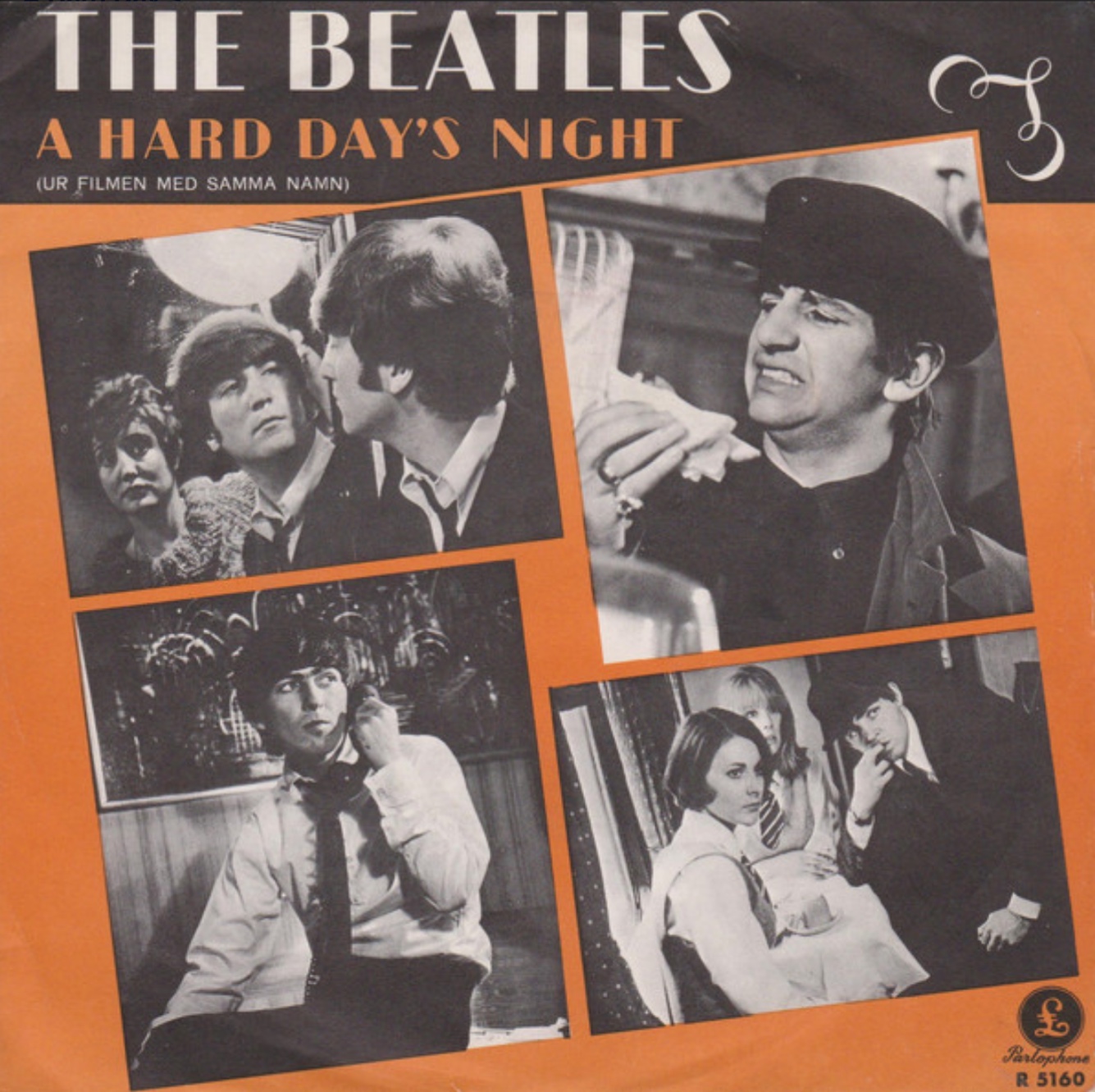
THE BEATLES - A HARD DAY’S NIGHT


Publicació: 10 de juliol de 1964 (Regne Unit) 13 de juliol de 1964 (EUA)

Llistes: Regne Unit: #1 (3 setmanes) EUA: #1 (2 setmanes)


"A Hard Day's Night" és una cançó dels Beatles, amb crèdits a Lennon-McCartney i escrita principalment per John Lennon. Es va publicar a la banda sonora de la pel·lícula del mateix nom el 1964 i també com a senzill al Regne Unit, amb "Things We Said Today" com a cara B, i als Estats Units, era "I Should Have Known Better" la cançó del revers.


El títol "A Hard Day's Night" va sorgir d'una expressió que va utilitzar Ringo Starr. En una entrevista del 1964, Ringo va explicar que després de treballar tot el dia i la nit, inicialment va pensar que encara era de dia i va dir: "Ha estat un dia dur..." i després, adonant-se que ja era nit, va afegir: "...nit!" John Lennon ja havia utilitzat la frase en el seu llibre "In His Own Write" abans que es convertís en el títol de la cançó i la pel·lícula.


"A Hard Day's Night" va servir com a cançó titular de la primera de les cinc pel·lícules dels Beatles. Malgrat les baixes expectatives inicials, la pel·lícula va resultar tenir tant valor cinematogràfic com comercial. A diferència de moltes pel·lícules liderades per músics d'aquell temps, va ser ben rebuda per la crítica i l'audiència, i va obtenir dues nominacions als Oscars. La decisió de mantenir el modest pressupost original i rodar-la en blanc i negre va ser un èxit, i la pel·lícula va continuar sent popular fins i tot en el seu llançament en DVD anys després.


La pel·lícula "A Hard Day's Night" va marcar un canvi en com es presentaven els Beatles, destacant les seves personalitats distintives en lloc de retratar-los com un grup unit. Aquest enfocament va canviar la manera com es comercialitzava la banda, i la concentració en trets individuals es va convertir en una tendència per promocionar grups musicals. Curiosament, la cançó titular de la pel·lícula, "A Hard Day's Night", va ser l'última cançó que es va compondre per a la banda sonora. Malgrat això, John Lennon va lliurar ràpidament la peça després d'una sol·licitud del productor de la pel·lícula, Walter Shenson, que va quedar impressionat amb la resposta immediata de Lennon.


Lennon feia la veu solista i Paul McCartney cantava les seqüències del mig. John va fer que Paul cantés la secció del mig perquè sentia que Paul tenia l'abast vocal més apropiat per a això. Sorprenentment, només un any abans, havia insistit a cantar una harmonització més alta a "From Me To You" perquè deia que podia cantar les parts més altes millor que Paul. És fascinant com les dinàmiques de les veus principals i harmonitzacions van canviar amb el temps entre John Lennon i Paul McCartney, amb cadascun adaptant-se als seus punts forts i preferències en diferents cançons.


El llançament de "A Hard Day's Night" el 1964 va marcar un moment clau en la carrera dels Beatles. El senzill i el seu àlbum homònim no només van encapçalar les llistes al Regne Unit i als Estats Units, sinó que també van establir un rècord com la primera vegada que un artista ocupava la primera posició tant a la llista d'àlbums com a la de senzills simultàniament als dos països. L'èxit de la cançó va ser part d'una impressionant ratxa de èxits número u de la banda, incloent "I Want to Hold Your Hand", "She Loves You", "Can't Buy Me Love", "Love Me Do", "I Feel Fine" i "Eight Days a Week". Aquesta sèrie sense precedents d'èxits número u en un any va demostrar l'impacte i el fenomen cultural mai vist que havien esdevingut els Beatles.


THE BEATLES - A HARD DAY’S NIGHT 


Released : July 10, 1964 (UK)  July 13, 1964 (US)

Charted:  UK: #1 (3 weeks)   US: #1 (2 weeks)


"A Hard Day's Night" is a song by the Beatles, credited to Lennon–McCartney and primarily written by John Lennon. It was released on the film soundtrack of the same name in 1964 and also as a single in the UK, with "Things We Said Today" as its B-side, and in the US, with "I Should Have Known Better" as its B-side.


The title "A Hard Day's Night" originated from an expression Ringo Starr used. In a 1964 interview, Ringo explained that after working all day and night, he initially thought it was still day and said, "It's been a hard day..." then realizing it was night, added, "...night!" John Lennon had previously used the phrase in his book "In His Own Write" before it became the title of the song and movie.


"A Hard Day's Night" served as the title song for the first of five Beatles movies. Despite low expectations initially, the film turned out to have both cinematic and commercial value. Unlike many musician-led movies of the time, it was well-received by critics and audiences, earning two Oscar nominations. The decision to keep the original modest budget and shoot it in black and white proved successful, and the movie continued to be popular even upon its DVD release years later.


The movie "A Hard Day's Night" marked a shift in how The Beatles were presented, highlighting their distinct personalities rather than portraying them as a unified group. This approach changed the way the band was marketed, and the focus on individual traits became a trend in promoting musical groups. Interestingly, the title track of the movie, "A Hard Day's Night," was the last song to be composed for the soundtrack. Despite this, John Lennon quickly delivered the song after a request from the movie's producer, Walter Shenson, who was impressed with Lennon's prompt response.


Lennon sang lead and Paul McCartney sang the middle sequences. John had Paul sing the middle section because he felt Paul had the more appropriate vocal range for it. Surprisingly, he insisted on singing a higher harmonization in "From Me To You" only a year earlier because he said he could sing the higher stuff better than Paul. It's fascinating how the dynamics of lead and harmony vocals changed between John Lennon and Paul McCartney over time, with each adapting to their strengths and preferences in different songs.


The release of "A Hard Day's Night" in 1964 marked a pivotal moment in The Beatles' career. The single and its eponymous album not only topped the charts in both the UK and the US but also set a record as the first time an artist held the number one position on both the album and singles charts simultaneously in both countries. The song's success was part of an impressive streak of chart-topping hits by the band, including "I Want to Hold Your Hand," "She Loves You," "Can't Buy Me Love," "Love Me Do," "I Feel Fine," and "Eight Days a Week." This unprecedented series of number-one hits within a year demonstrated the unparalleled impact and cultural phenomenon that The Beatles had become.






4.1.24


THE BEATLES - LUCY IN THE SKY WITH DIAMONDS / SHE’S LEAVING HOME


LUCY IN THE SKY WITH DIAMONDS

Estrena: 26 de maig de 1967


"Lucy in the Sky with Diamonds" és una cançó de l'àlbum de 1967, "Sgt. Pepper's Lonely Hearts Club Band". Va ser escrita principalment per John Lennon amb aportacions de Paul McCartney i es va acreditar a la col·laboració Lennon–McCartney.


Malgrat que la cançó va suscitar especulacions sobre referències a les drogues a causa de les inicials destacades "LSD" en el títol, John Lennon sempre va negar qualsevol connexió intencionada amb la droga psicodèlica. En entrevistes, Lennon va destacar que la inspiració per a la cançó provenia d'un dibuix fet pel seu fill, Julian, sobre una dona anomenada Lucy. John també va atribuir l'imaginari de la cançó a la seva lectura dels llibres "Alice al país de les meravelles" de Lewis Carroll. Lennon va reiterar que no va adonar-se de la possible connotació de les drogues fins després del llançament del disc. Malgrat les explicacions de Lennon, alguns, inclòs Paul McCartney, van afirmar que la inspiració de la cançó estava relacionada amb l'LSD.


La revelació de John Lennon que la "noia amb ulls de calidoscopi" resultava ser Yoko Ono, tot i que encara no la coneixia, afegeix una dimensió personal i retrospectiva a la cançó. Reflexa els sentiments i les experiències de Lennon, fent que la cançó sigui encara més significativa en el context de la seva relació amb Yoko. La frase "Yoko in the Sky with Diamonds" ofereix una connexió poètica i simbòlica en l'amor i la inspiració que va trobar en Ono.


És interessant veure com els artistes poden tenir diferents perspectives sobre la seva pròpia obra. L'apreciació de George Harrison per "Lucy in the Sky with Diamonds" i la seva satisfacció amb la seva contribució ofereix un contrast positiu amb la decepció de John Lennon amb l'arranjament i els seus nervis durant la gravació. Aquesta diversitat d'opinions reflecteix les dinàmiques complexes dins dels Beatles i el seu procés creatiu. 


La versió d'Elton John de "Lucy in the Sky with Diamonds" el 1974, amb la participació de John Lennon a la veu i la guitarra, va aconseguir arribar al número 1 als Estats Units la primera setmana de 1975. Aquesta interpretació va marcar un assoliment únic per a Elton John, ja que es va convertir en l'únic artista que liderava les llistes amb una versió dels Beatles. Tot i que es va adonar que Lennon oblidava alguns acords durant la gravació, la col·laboració i la seva posterior actuació sorpresa al concert de Thanksgiving d'Elton a Nova York van ser moments memorables i l'última actuació pública de Lennon.


SHE’S LEAVING HOME

Estrena: 26 de maig de 1967 


"She's Leaving Home" és una cançó commovedora de l'àlbum "Sgt. Pepper's Lonely Hearts Club Band", escrita per Paul McCartney i John Lennon. McCartney va escriure i cantar les estrofes, mentre Lennon va contribuir amb la tornada, que van cantar junts. Cal destacar que ni George Harrison ni Ringo Starr van participar en la gravació, i l'acompanyament instrumental va ser interpretat únicament per una petita orquestra de corda amb arranjaments de Mike Leander.


El dia abans que McCartney preveiés treballar en la partitura de "She's Leaving Home", va saber que George Martin, el seu habitual arranjador de cordes, no estava disponible. McCartney va contactar llavors amb Mike Leander, que va treballar en la cançó en el lloc de Martin. Això la va marcar com la primera cançó dels Beatles que no va ser arrangada per George Martin, causant inicialment algunes ferides sentimentals. Malgrat això, Martin va produir la cançó i va dirigir la secció de cordes durant una sessió el 17 de març de 1967, amb un resultat de sis gravacions de la peça.


Aquest tret distintiu la converteix en una de les poques cançons dels Beatles on cap dels membres de la banda va tocar un instrument musical. Les veus de John i Paul van ser duplicades per crear l'efecte d'un quartet, mentre músics de sessió es van encarregar dels components instrumentals. Sheila Bromberg, la primera dona músic que va tocar en un àlbum dels Beatles, va tocar l'arpa. Sense ser conscient que gravava per als Beatles, Bromberg es va trobar amb Paul McCartney, a qui va preguntar pel material de la partitura. L'orquestra, incloent Bromberg, va fer diverses gravacions tota la nit mentre McCartney buscava un so diferencial. Malgrat utilitzar la primera gravació, els enginyers van afegir un efecte de duplicació per aconseguir el resultat desitjat per McCartney.


"She's Leaving Home" va ser inspirada per un article del diari sobre una noia de 17 anys, Melanie Coe, que va fugir de casa. La història la va llegir McCartney al London Daily Mail el 27 de febrer de 1967. El titular, "Noia d’alt nivell abandona cotxe i desapareix", descrivia com Melanie havia marxat de casa, abandonant-ho tot. McCartney va trobar la història captivadora i la va utilitzar com a base per a la narrativa de la cançó. Quan va mostrar la lletra a John Lennon, aquest va contribuir a la tornada i va introduir notes llargues sostingudes, millorant la profunditat emocional de la composició. A McCartney li va agradar l'estructura de la cançó, destacant l'impacte durador dels acords.


LUCY IN THE SKY WITH DIAMONDS 

Released: May 26, 1967


"Lucy in the Sky with Diamonds" is a song from the Beatles' 1967 album “Sgt. Pepper's Lonely Hearts Club Band”. It was primarily written by John Lennon with input from Paul McCartney and credited to the Lennon–McCartney partnership.


While the song sparked speculation about drug references due to the prominent initials "LSD" in the title, John Lennon consistently denied any intentional connection to the hallucinogenic drug. In interviews, Lennon emphasized that the inspiration for the song came from a drawing made by his son, Julian, featuring a woman named Lucy. John also attributed the song's imagery to his reading of Lewis Carroll's Alice in Wonderland books. Lennon reiterated that he didn't realize the potential drug connotation until after the song's release. Despite Lennon's explanations, some, including Paul McCartney, found the song's inspiration to be connected to LSD.


John Lennon's revelation that the "girl with kaleidoscope eyes" turned out to represent Yoko Ono, though he hadn't met Yoko yet, adds a personal and retrospective dimension to the song. It reflects Lennon's feelings and experiences, making the song even more meaningful in the context of his relationship with Yoko. The line "Yoko in the Sky with Diamonds" offers a poetic and symbolic connection to the love and inspiration he found in Yoko Ono.


It's interesting to see how artists can have different perspectives on their own work. George Harrison's appreciation for "Lucy in the Sky with Diamonds" and his satisfaction with his contributions offer a positive contrast to John Lennon's disappointment with the arrangement and his nervousness during the recording. This diversity of opinions reflects the complex dynamics within the Beatles and their creative process.


Elton John's cover of "Lucy in the Sky with Diamonds" in 1974, featuring John Lennon on vocals and guitar, indeed reached #1 in the US in the first week of 1975. This rendition marked a unique achievement for Elton John, as he became the only artist to top the charts with a Beatles cover. Despite Lennon reportedly forgetting some chords during the recording, the collaboration and their subsequent surprise performance at Elton's Thanksgiving concert in New York turned out to be a memorable moment and Lennon's final public performance.


SHE’S LEAVING HOME 

Released: May 26, 1967


"She's Leaving Home" is a poignant song from the Beatles' “Sgt. Pepper's Lonely Hearts Club Band” album, written by Paul McCartney and John Lennon. McCartney wrote and sang the verses, while Lennon contributed to the chorus, which they sang together. Notably, neither George Harrison nor Ringo Starr participated in the recording, and the instrumental background was performed solely by a small string orchestra arranged by Mike Leander. 


The day before McCartney intended to work on “She's Leaving Home”'s score, he discovered that George Martin, their usual strings arranger, was unavailable. McCartney then contacted Mike Leander, who arranged the song in Martin's stead. This marked the first instance of a Beatles song not being arranged by Martin, causing some initial hurt feelings. Despite this, Martin still produced the song and conducted the string section during a session on March 17, 1967, resulting in six takes of the song.


This distinctive feature makes it one of the few Beatles songs where none of the band members played a musical instrument. John and Paul vocals were double-tracked to create the effect of a quartet, while session musicians handled the instrumental components. Sheila Bromberg, the first female musician to play on a Beatles album, played the harp. Unaware she was recording for the Beatles, Bromberg encountered Paul McCartney, who asked about the sheet music. The orchestra, including Bromberg, did multiple takes through the night as McCartney sought a distinctive sound. Despite using the first take, engineers added a doubling effect to achieve McCartney's desired result. 


"She's Leaving Home" was inspired by a newspaper article about a runaway girl, 17-year-old Melanie Coe, whose story McCartney read in the London Daily Mail on February 27, 1967. The headline, "A-Level Girl Dumps Car And Vanishes," described how Melanie had left home, abandoning everything. McCartney found the story compelling and used it as the basis for the song's narrative. When he showed the lyrics to John Lennon, Lennon contributed to the Greek chorus and introduced long sustained notes, enhancing the emotional depth of the composition. McCartney appreciated the song's structure, emphasizing the enduring impact of the chords.


THE BEATLES - YESTERDAY


Llançament: 13 de setembre de 1965 (single dels EUA) 5 de març de 1976 (single del Regne Unit)

Llistes: Regne Unit: #8  EUA: #1 (4 setmanes)


"Yesterday" és una cançó escrita principalment per Paul McCartney i acreditada a Lennon-McCartney. Inicialment llançada a l'àlbum “Help!” el 6 d'agost de 1965, va assolir el número u als Estats Units quan es va publicar com a single al setembre del mateix any. La cançó posteriorment va aparèixer a l'EP britànic "Yesterday" al març de 1966 i va fer el seu debut en àlbum als Estats Units amb "Yesterday and Today" al juny de 1966.


Paul McCartney va escriure i tocar "Yesterday", sent la primera vegada que un Beatle gravava sense els altres. Això va marcar un canvi cap a assoliments més independents dins del grup. Tot i que Lennon i McCartney van continuar acreditant totes les seves cançons com a Lennon/McCartney, cap al 1965, la majoria de les seves composicions estaven escrites principalment per un o l'altre.


La melodia de "Yesterday" li va venir a Paul McCartney en un somni. Despertant amb ella al cap, la va tocar en un piano a la vora del seu llit per recordar-la. Inicialment, McCartney pensava que podria haver-la pres inconscientment d'alguna altra banda, així que la va tocar a diverses persones de la indústria musical per assegurar-se'n de la seva originalitat. Convençut que era única, va començar a afegir-hi la lletra, utilitzant inicialment el títol provisional "Scrambled Eggs".


"Yesterday" és reconeguda com la cançó pop més versionada, amb més de 3.000 versions enregistrades. Tot i que va ser, en un moment, la cançó amb més reproduccions a les ràdios, posteriorment va ser superada per "You've Lost That Lovin' Feelin'". Malgrat això, "Yesterday" segueix sent una composició atemporal, sovint sonant en algun lloc del món. El tema melancòlic de la cançó explora el desig del narrador pel passat després que la seva estimada ha marxat, mostrant un canvi respecte a la naturalesa optimista dels èxits anteriors dels Beatles.


Un quartet de corda va ser introduït a "Yesterday", convertint-la en un dels primers exemples d'elements de música clàssica incorporats a una cançó pop. Inicialment recalcitrant, Paul McCartney, que subratllava que els Beatles eren una banda de rock 'n' roll, va oposar-se a la idea quan el productor George Martin va suggerir l'addició del quartet de corda.


John Lennon va fer referència a "Yesterday" a la seva cançó en solitari "How Do You Sleep?", amb la lletra "The only thing you've done was yesterday, and since you've gone you're just another day" (L’única cosa que vas fer va ser Yesterday, i des que vas marxar només has fet Another day). Aquesta frase és part de la crítica de Lennon a Paul McCartney a la cançó.


"Yesterday" també és el títol d'una pel·lícula del 2019 on un músic amb problemes, interpretat per Himesh Patel, es descobreix a ell mateix en un univers alternatiu on els Beatles mai van existir. La trama es desenvolupa mentre interpreta cançons dels Beatles, inclosa "Yesterday", i rep l'elogi com si les hagués escrit ell mateix.


THE BEATLES - YESTERDAY 


Released : September 13, 1965 (US single)  March 5, 1976 (UK single)

Charted:  UK: #8   US: #1 (4 weeks)


"Yesterday" is a song primarily written by Paul McCartney and credited to Lennon–McCartney. Initially released on the album Help! in August 1965, it became a number-one hit in the United States when issued as a single in September of the same year. The song later appeared on the UK EP "Yesterday" in March 1966 and made its US album debut on "Yesterday and Today" in June 1966.


Paul McCartney wrote and played "Yesterday" making it the first time a Beatle recorded without the others. This marked a shift to more independent accomplishments within the group. Although Lennon and McCartney continued to credit all their songs as Lennon/McCartney, by 1965, most of their compositions were primarily written by one or the other.


The melody for "Yesterday" came to Paul McCartney in a dream. Waking up with it in his head, he played it on a piano by his bed to remember it. Initially, McCartney thought he might have unconsciously borrowed it from somewhere, so he played it to various people in the music industry to ensure its originality. Convinced it was unique, he began adding lyrics, initially using the working title "Scrambled Eggs."


"Yesterday" is recognized as the most covered pop song, with over 3,000 recorded versions. While it was once the song with the most radio plays, it was later surpassed by "You've Lost That Lovin' Feelin'." Despite this, "Yesterday" remains a timeless composition, often being played somewhere around the world. The song's melancholic theme explores the narrator's longing for the past after his lover has departed, showcasing a departure from the upbeat nature of earlier Beatles hits.


A string quartet was introduced to "Yesterday," making it one of the earliest instances of classical music elements being incorporated into a pop song. Initially resistant, Paul McCartney, emphasizing the Beatles as a rock 'n' roll band, initially opposed the idea when producer George Martin suggested the addition of the string quartet.


John Lennon referred to "Yesterday" in his solo song "How Do You Sleep?" with the lyrics, "The only thing you've done was yesterday, and since you've gone you're just another day." This line is part of Lennon's critique of Paul McCartney in the song.


"Yesterday" is also the title of a 2019 film where a struggling musician, portrayed by Himesh Patel, discovers himself in an alternate universe where The Beatles never existed. The plot unfolds as he plays Beatles songs, including "Yesterday," and receives acclaim as if he wrote them.