Total de visualitzacions de pàgina:

6.4.24


THE CLASH - ROCK THE CASBAH


Released: June 11, 1982

Charted:  UK: #15   US: #8 


"Rock the Casbah" released in 1982 as the second single from the band’s fifth album, “Combat Rock”, made a significant impact on the charts. It reached number eight on the Billboard Hot 100 chart in the US, marking their only top 10 single in that country. Additionally, the track, along with "Mustapha Dance," achieved success on the dance chart, also peaking at number eight.


This track was composed musically by Clash drummer Topper Headon, who also wrote the original lyrics. In an interview, lead singer Joe Strummer credited Headon as the "real genius" behind the song, highlighting his role in creating the drum track and contributing to the piano and bass parts. However, the song's success was bittersweet as Headon had been dismissed from the band due to his struggles with drug addiction by the time it became a massive hit in the US. The irony continued in the music video where the original Clash drummer Terry Chimes appeared at the drum kit, having returned temporarily to replace Headon.


Joe Strummer's decision to change Topper Headon's original lyrics for "Rock the Casbah" took the song in a different direction. Former Clash co-manager Kosmo Vinyl recalled that Headon's original lyrics were explicit and pornographic, centered around his girlfriend. Strummer's rewrite of the lyrics was inspired by a comment from manager Bernie Rhodes during early Combat Rock sessions, where he expressed frustration with the length of the tracks. This led Strummer to write the first line, "The King told the boogie men You gotta get that raga drop," after recalling Rhodes' remark about the length of songs being as long as a raga. Additionally, Strummer remembered a conversation about the consequences of owning a disco album in Iran, which served as inspiration for the theme of defying the Arab ruler's ban on disco music in the song's lyrics, ultimately leading to the rebellious anthem "Rock the Casbah."


"Rock the Casbah" requires some historical context such as the US and Great Britain's intervention in Iran's politics, particularly the overthrow of the democratically elected prime minister and support for the Shah's regime. The song touches on the consequences of this intervention, including the rise of Islamic fundamentalism and the Iranian Revolution of 1979, which led to the capture of American diplomats. Joe Strummer's lyrics were inspired by this Iran's post-Islamic revolution and the ban on pop music. Strummer envisioned a scenario where the people would defy this restriction and rebel against the oppressive regime by "rocking the casbah." The term "casbah" refers to a traditional and cultural center in many North African cities, but in this context, it symbolizes a place where music and freedom are suppressed, and the act of "rocking" it signifies defiance and resistance.


The music video was shot in Austin, Texas by director Don Letts over two days in June 1982. It combines footage of The Clash miming the song's performance with a narrative following two characters traveling through Texas. The storyline features a Muslim hitchhiker and a Hasidic Jewish limo driver who form an unlikely friendship on the road, eventually dancing together through the streets to a Clash concert at Austin's City Coliseum. Throughout the video, symbolic imagery is used, including appearances by an armadillo and scenes of the characters eating hamburgers in front of a Burger King restaurant. Notably, there's a scene where the Muslim character is seen drinking a beer, which Letts explained was about breaking taboos.


Joe Strummer's contemplation of leaving The Clash after "Rock the Casbah" became a hit stemmed from a sense of conflict. He struggled to reconcile the band's newfound success and wealth with their earlier sincerity and rebellious spirit. The realization that their music was becoming more commercial and potentially losing its authenticity led him to question the band's direction.  When The Clash eventually disbanded in 1985, speculation arose about their motives. Some suggested that the band's goal was to break up after achieving success in America, which was evident with hits like "Rock the Casbah" and "Should I Stay or Should I Go?". This theory suggests that once the band had accomplished their objectives, they saw no reason to continue, leading to their eventual dissolution.


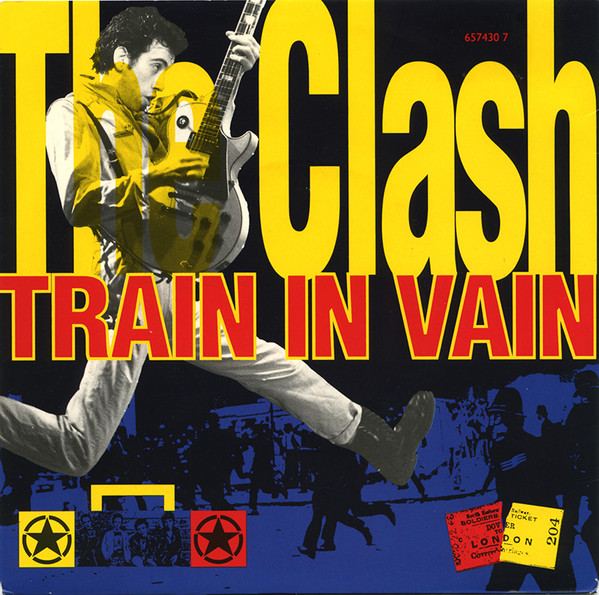


THE CLASH - TRAIN IN VAIN


Released: February 12, 1980

Charted:  US: #23 


"Train in Vain" is a track from the band’s "London Calling” album. originally hidden at the end of the record due to last-minute inclusion. The title was expanded to "Train in Vain (Stand by Me)" in the US to distinguish it from Ben E. King's iconic "Stand by Me." Despite its hidden status, the song became the band's first to break into the US Top 30 charts.


"Train in Vain" is often attributed to Mick Jones and is speculated to reflect his relationship with Ellen Foley, his girlfriend at the time. Jones delivers the vocals with a silky yet emotionally charged tone, enhanced by the double-tracking technique. Joe Strummer's harmonica complements the plaintive lyrics, evoking a sense of nostalgia and longing reminiscent of simpler ballads from British songwriters of the past. Despite being a departure from their usual punk sound, "Train in Vain" is regarded as the Clash's standout love song.


"Train in Vain" doesn't explicitly feature the phrase in its lyrics. Instead, the song revolves around the repeated refrain "stand by me," drawing a parallel with Ben E. King's famous track. The title likely stems from the rhythmic train motif in the song, coupled with the overarching theme of feeling lost or abandoned.


The backstory behind "Train in Vain" not being listed on the tracklisting of the original vinyl copy of the album was as we tell it below. Originally intended for an NME promotional flexi-disc, the song found itself homeless when the flexi-disc project fell through. In a last-minute decision, the band included it on the album just before vinyl pressing. Since the sleeve had already been designed, there was no time to update the tracklisting. As a result, "Train in Vain" was left off the list, only hinted at by its carving into the vinyl's run-out groove. Subsequent releases, including CD copies, rectified this omission by properly including it in the tracklisting.


"Train in Vain" quickly became a staple in The Clash's live performances after its introduction to their setlist in December 1979. The band consistently played it until Mick Jones departed in 1983. The music video for the song was compiled from one of these live performances, specifically from a show in Lewisham in February 1980. The video was filmed by Don Letts and includes a humorous introduction from Joe Strummer, inviting the audience to join them on the "soul train" and jokingly suggesting an alternative route for those who might not be interested: "We'd like to take the soul train from platform one... and if you don't want to come, there's always the toilet!"


THE CLASH - I FOUGHT THE LAW


Released: May 11, 1979 (UK)  July 26, 1979 (US) 

Charted:  UK: #29 


"I Fought the Law" is a song originally written by Sonny Curtis of the Crickets and later popularized by a cover by the Bobby Fuller Four, reaching the top ten in 1966. The Clash recorded their version in 1979, after reportedly hearing the Bobby Fuller Four original on a studio jukebox in San Francisco while recording "Give 'Em Enough Rope." Despite the different writing credits, The Clash's rendition of the song became a trademark hit for the band, characterized by its outlaw rebel posturing and Topper Headon's distinctive drumming.


The Clash transformed "I Fought the Law" into one of rock and roll's greatest covers, channeling the original's keening pain while infusing it with a sense of triumph and defiance. Joe Strummer's fiery vocals shine, but the entire band delivers a stellar performance. The song was initially released on the “Cost of Living” EP in the UK, and later was included on the US version of The Clash's first album.


The Clash's cover version of "I Fought the Law" played a significant role in gaining the band their first airplay in the United States. A live recording of the song, performed at the Lyceum Theatre in London on December 28, 1978, was featured as the final piece in the 1980 film "Rude Boy," directed by Jack Hazan and David Mingay. Dressed all in black for the gig, the song was considered the film's title track at that stage.


The unique percussive sounds on the record, including the "clang! clang!" resembling a chain gang and the "sssszzhhh!" at the end like flushing, were created by hitting the pipes on a urinal with hammers. Mick Jones revealed this detail in a 2015 interview with Uncut magazine.