"I Found Someone" is a single originally penned for Laura Branigan by Michael Bolton and Touch keyboardist Mark Mangold. It became a significant hit for Cher in 1987, reaching the top 10. Produced by Michael Bolton, Cher's rendition of this power ballad garnered attention with a cover photo by fashion photographer Matthew Rolston. The image features Cher in a close-up, her face slightly overexposed against a bright blue backdrop. This song celebrates the uplifting feeling of finding love.
By 1987, Cher had established herself as a leading lady in films like the critically acclaimed "Mask." Despite her success in acting, John Kalodner from Geffen Records convinced her that she could still thrive as a singing star. Reluctantly, she eventually accepted his offer, signed with the label, and released "I Found Someone" as her comeback single. The song was a hit, followed by another successful single, "We All Sleep Alone." Cher's subsequent album, "Heart Of Stone," released in 1989, achieved even greater success with hits like "If I Could Turn Back Time" and "Just Like Jesse James." This resurgence in her music career made her a top draw on tours, attracting a mature audience willing to buy tickets.
Cher's "I Found Someone" was accompanied by a lavish music video featuring her then-boyfriend Rob Camilletti, who began dating her in 1986 while working at a bagel shop. Their relationship, notable for its substantial age gap, drew considerable tabloid attention. This relationship lasted until 1989, which was longer than most of her relationships after divorcing Sonny Bono.
The video, which also served as Camilletti's debut, received extensive airplay on MTV. An alternate concert video showcased Cher in a dress previously worn in The Black Rose Show, with actress Virginia Madsen portraying Cher's romantic rival in the narrative.
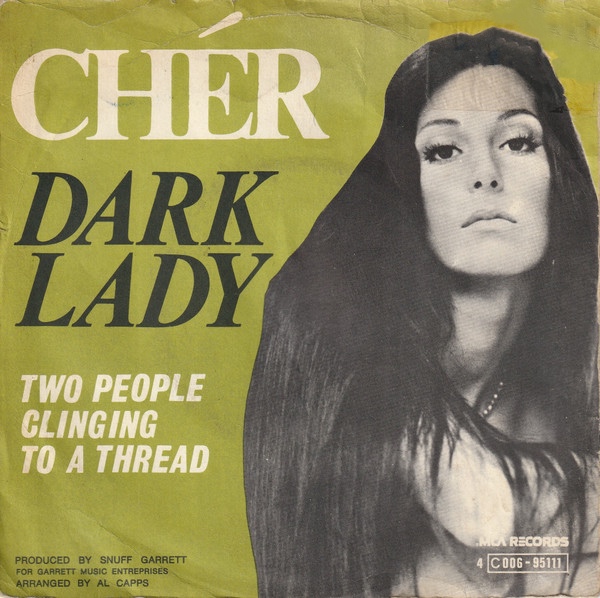
CHER - DARK LADY
Released: December 1973
Charted: UK: #36 US: #1 (1 week)
"Dark Lady" is a song recorded by Cher, released as the lead single from her eleventh studio album, “Dark Lady”, in December 1973. It was written by John Robert "Johnny" Durrill and produced by Snuff Garrett. The song reached number 1 on the Billboard Hot 100 chart on March 23, 1974, marking Cher's third solo number one hit in the United States.
"Dark Lady" explores themes of betrayal, jealousy, and revenge. In this narrative song the protagonist visits a fortune teller known as the "dark lady." The fortune teller advises her to leave her boyfriend. Later, the protagonist realizes the fortune teller's perfume was on her lover's bed, suggesting they were together. Distraught, she returns to the fortune teller and finds her lover with her. In a moment of rage, she shoots and kills the dark lady.
The song has two distinct music video versions. The first is a live performance aired during the third season of The Sonny & Cher Comedy Hour in 1973. In this version, Cher is dressed in black with a veil on her head. The second video is an animated cartoon created by John David Wilson's animation studio, which narrates the entire story of the song visually.
In 2002, a special remix medley was created by Dan-O-Rama for a video montage used during Cher's Living Proof: The Farewell Tour. This medley included videos of several of Cher's hits, including "All I Really Want to Do", "Gypsies, Tramps and Thieves", "Half-Breed", and "Dark Lady". What made the "Dark Lady" segment unique was that it combined both the live-action and animated versions of the song's videos.
"Come On Eileen," llançada al juny de 1982 des de l'àlbum "Too-Rye-Ay", va esdevenir un gran èxit tant al Regne Unit com als Estats Units. Produïda per Clive Langer i Alan Winstanley, la cançó va encapçalar les llistes a ambdós països, significant el segon número u al Regne Unit després de "Geno". També va arribar al número 1 a Austràlia, Nova Zelanda, Sud-àfrica, Suïssa, Irlanda i Bèlgica, i va ser número 2 al Canadà, número 4 als Països Baixos, número 5 a França i número 6 a Alemanya.
"Come On Eileen" es basa en les experiències reals de Kevin Rowland amb una noia anomenada Eileen amb qui va créixer. La seva relació va evolucionar romànticament quan eren adolescents, eventualment esdevenint sexual malgrat els tabús socials i la educació catòlica de Rowland, que veia el sexe com un tema prohibit i brut. La lletra reflecteix els records i les emocions de Rowland d'aquell temps, capturant la tensió entre l'amor juvenil i la luxúria, i expressant un desig d'alliberar-se de les restriccions socials.
Kevin "Al" Archer, guitarrista als primers dies de Dexys Midnight Runners, va deixar el grup després del seu primer àlbum a causa de conflictes amb l'estil de lideratge de Kevin Rowland. En una entrevista amb la revista Mojo al juliol de 2009, Archer va explicar que Rowland governava el grup amb un control estricte i mancava de comunicació personal amb els membres del grup. Inicialment acreditada a Kevin Rowland, Jim Paterson i Billy Adams, Rowland va reconèixer més tard la significativa contribució de Kevin Archer a l'essència de "Come On Eileen".
El ritme va ser inspirat per discos com "Concrete and Clay" i "It's Not Unusual", amb un distingit ritme de "Bomp ba bomp" que a Rowland i la seva banda els agradava. Van desenvolupar la seqüència d'acords ells mateixos i van començar a improvisar melodies. Rowland va recordar que sentien que havien trobat alguna cosa especial mentre la cançó prenia forma, especialment amb la memorable tornada "Too ra loo ra". Va destacar el procés d'escriptura de cançons, on les idees fluïen naturalment fins que la cançó es completa a.
El vídeo musical dirigit per Julien Temple va ser filmat al suburbi de Kennington, al sud de Londres, específicament al voltant del carrer Brook Drive i Hayles Street, després es va traslladar a Austral Street i Holyoak Road. El personatge d'"Eileen" en el vídeo i a la portada del single va ser interpretat per Máire Fahey, germana de Siobhan Fahey de Bananarama. A més, el vídeo va incloure imatges d'arxiu de Johnnie Ray arribant a l'aeroport de Londres Heathrow el 1954.
DEXYS MIDNIGHT RUNNERS - COME ON EILEEN
Released: June 25, 1982
Charted: US: #1 (1 week) UK: #1 (4 weeks)
"Come On Eileen" released in June 1982 from the album Too-Rye-Ay, became a major hit in both the UK and the US. Produced by Clive Langer and Alan Winstanley, the song topped the charts in both countries, marking their second number one hit in the UK after "Geno." It also went to #1 in Australia, New Zealand, South Africa, Switzerland, Ireland, and Belgium, and was #2 in Canada, #4 in the Netherlands, #5 in France, and #6 in Germany.
"Come On Eileen" is based on Kevin Rowland's real-life experiences with a girl named Eileen whom he grew up with. Their relationship evolved romantically when they were teenagers, eventually becoming sexual despite the societal taboos and Rowland's Catholic upbringing, which viewed sex as a forbidden and dirty subject. The lyrics of the song reflect Rowland's memories and emotions from that time, capturing the tension between youthful love and lust, and expressing a longing to break free from societal constraints.
Kevin "Al" Archer, a guitarist in the early days of Dexys Midnight Runners, left the group after their first album due to conflicts with Kevin Rowland's leadership style. In an interview with Mojo magazine in July 2009, Archer explained that Rowland ruled the group with strict control and lacked personal communication with band members. Initially credited to Kevin Rowland, Jim Paterson, and Billy Adams, Rowland later acknowledged Kevin Archer's significant contribution to the song's "Come On Eileen" essence.
The song's rhythm was inspired by records like "Concrete and Clay" and "It's Not Unusual," with a distinctive "Bomp ba bomp" beat that Rowland and his band liked. They developed the chord sequence themselves and began improvising melodies. Rowland recalled feeling they had struck something special as the song took shape, particularly with the memorable "Too ra loo ra" chorus. He emphasized the organic process of songwriting, where ideas flowed naturally until the song felt complete.
The music video directed by Julien Temple, was filmed in the inner south London suburb of Kennington, specifically around the corner of Brook Drive and Hayles Street, then moving to Austral Street and Holyoak Road. The character of "Eileen" in the video and on the single cover was portrayed by Máire Fahey, sister of Siobhan Fahey from Bananarama. Additionally, the video included archival footage of Johnnie Ray arriving at London Heathrow Airport in 1954.
14.8.24
MEAT LOAF & CHER - DEAD RINGER FOR LOVE
Estrena: 20 de novembre de 1981
Llistes: Regne Unit: #5
"Dead Ringer for Love" és un duet enèrgic de rock que serveix com a continuació espiritual de "Paradise By The Dashboard Light", amb Meat Loaf i Cher. Es destaca com el tema més exitós comercialment de l'àlbum de Meat Loaf, "Dead Ringer". La cançó, escrita per Jim Steinman, és una de les dues pistes de l'àlbum produïdes per Steinman al costat de Jimmy Iovine. El single es va llançar al Regne Unit al novembre de 1981. Inicialment va debutar al número 63 a la llista de singles, i va anar guanyant popularitat de manera constant fins a assolir el número cinc a principis de febrer de 1982.
La interpretació de Meat Loaf irradia una energia vibrant des del principi. Comença amb un riff ferotge de guitarra de Davey Johnstone, conegut pel seu treball amb Elton John, superposat a un batec de bateria robust. L'arranjament es veu enriquit per ràfegues de vents i cors de veus de tipus doo-wop amb molt empenta. Un gir inesperat arriba amb una trencadissa d'estil llatí que presenta els vents.
No obstant això, el veritable punt àlgid de la gravació és el duet electritzant entre Meat Loaf i Cher. Tots dos cantants interpreten la cançó amb un esperit desenfrenat de rock and roll, mostrant la seva habilitat vocal i la seva química. La interpretació irradia un sentit d'abandonament i intensitat, recordant la incursió posterior de Cher en el hard rock a finals dels anys 1980.
La lletra narra de manera divertida la història d'un home que s’adona que no pot sustentar-se només amb "rock 'n' roll i cervesa", fet que el porta a perseguir amb fervor la seva dona ideal. Ell la descriu com una "doble de l'amor", malgrat no saber gaire sobre ella. La cançó equilibra la seva narrativa destacant també els desitjos de la dona per una "satisfacció anònima i efímera".
La cançó té els seus orígens com una composició escrita per Jim Steinman, Tony Hendra i Sean Kelly, interpretada inicialment per Michael Simmons per a la sèrie de comèdia televisiva de curta durada, "Delta House". Jim Steinman posteriorment va adaptar la melodia a la cançó "Dead Ringer for Love" per a l'àlbum de Meat Loaf "Dead Ringer". Parts de la lletra de la composició original van ressorgir més endavant en la obra de Steinman "Tonight Is What It Means to Be Young” per a la banda sonora de “Streets of Fire”.
MEAT LOAF & CHER - DEAD RINGER FOR LOVE
Released: November 20, 1981
Charted: UK: #5
"Dead Ringer for Love" is an energetic rock duet that serves as a spiritual successor to "Paradise By The Dashboard Light," featuring Meat Loaf and Cher. It stands out as the most commercially successful track from Meat Loaf's album, “Dead Ringer”. The song, penned by Jim Steinman, stands out as one of only two tracks on the album produced by Steinman alongside Jimmy Iovine. The single was released in the United Kingdom in November 1981. Initially debuting at number 63 on the UK Singles Chart, it steadily gained popularity and eventually peaked at number five in early February 1982.
Meat Loaf's rendition of "Dead Ringer For Love" bursts with vibrant energy right from the start. It kicks off with a fierce, metallic guitar riff by Davey Johnstone, known for his work with Elton John, layered over a robust drumbeat. The arrangement is further enriched by lively bursts of horns and spirited doo-wop style backing vocals. An unexpected twist comes with a Latin-inspired breakdown featuring the horns.
However, the true highlight of the recording is the electrifying duet between Meat Loaf and Cher. Both singers deliver the song with unrestrained rock and roll spirit, showcasing their vocal prowess and chemistry. Their performance exudes a sense of abandon and intensity, reminiscent of Cher's later venture into hard rock during the late 1980s.
The lyrics playfully narrate the story of a man who realizes he can't sustain himself solely on "rock 'n' roll and brew," prompting him to pursue his ideal woman with fervor. He describes her as a "dead ringer for love," despite not knowing much about her. The song balances its narrative by also highlighting the woman's desires for "anonymous and fleeting satisfaction".
The song had its origins as a composition written by Jim Steinman, Tony Hendra, and Sean Kelly, initially performed by Michael Simmons for the short-lived television comedy series, Delta House. Jim Steinman later adapted the melody into the song "Dead Ringer for Love" for Meat Loaf's album "Dead Ringer." Portions of the lyrics from the original composition eventually resurfaced in Steinman's work "Tonight Is What It Means to Be Young” for the “Streets of Fire” soundtrack.




.jpeg)


