"Pink" is a song released as the third single from the 1997 album “Nine Lives”. The song won the Grammy for Best Rock Performance by a Duo or Group with Vocal in 1999, marking the band's fourth win in that category.
It was written by Steven Tyler, along with Richie Supa and Glen Ballard, making it one of the few Aerosmith songs not co-written by guitarist Joe Perry. Supa had previously co-written the hit "Amazing," while Ballard co-wrote another “Nine Lives” track, "Falling in Love (Is Hard on the Knees)." During the recording of the album the band was sober and fueled by espresso, according to Ballard.
The song features a distinctive harmonica intro played by lead singer Steven Tyler, paired with a strong bass rhythm and a blend of acoustic and electric guitars. Many of the lyrics in the verses revolve around the word "pink," with lines such as "Pink, it's my new obsession" and "Pink, on the lips of your lover." The song is filled with playful and suggestive innuendos, hinting at the admiration of sexual and intimate aspects of a relationship. The fascination with the color pink is symbolic, with subtle references to both male and female anatomy.
The music video featured innovative CGI effects, showing various characters' faces morphing into different bodies as they moved toward the camera. Band members, including Joe Perry, Brad Whitford, and Steven Tyler, were transformed into fantastical versions of themselves, such as a centaur, a little boy, a skeleton, and more. Directed by Doug Nichol, the video premiered on November 11, 1997.
Two versions of the video exist: an uncensored one that shows brief nudity in two scenes, where a woman’s breast is exposed and another woman, painted blue and green, is shown spinning. The uncensored version sparked minor controversy, leading some networks to require a censored version for daytime airings. In the edited version, these moments were either removed or altered, and an additional scene featuring Tyler and Perry as a two-headed man was included to cover up the nudity.
AEROSMITH - SWEET EMOTION
Released: May 19, 1975
Charts: US: #36 UK: #74
"Sweet Emotion" is a 1975 song released on the third studio album “Toys in the Attic”. Written by lead singer Steven Tyler and bassist Tom Hamilton, and produced by Jack Douglas, the track was recorded at Record Plant studio. Released as a single on May 1975, it became the band's breakthrough hit, peaking at No. 36 on the US Billboard Hot 100, marking their first entry into the Top 40. The success of "Sweet Emotion" began a streak of popular hits that propelled Aerosmith to large-scale success throughout the rest of the 1970s.
Steven Tyler wrote the song as an expression of frustration with his band, particularly stemming from the heavy drug use and rising tensions between him and guitarist Joe Perry. The lyrics reflect Tyler's anger and feelings of isolation, with the opening lines, "Talk about things that nobody cares, wearing out things that nobody wears," reportedly directed at Perry's girlfriend, Elissa, due to their strained relationship. Tyler recalls a specific incident where he was turned away from Perry's hotel room while seeking heroin, which deepened the conflict. The song serves as a declaration of independence and doing one's own thing despite external pressures and frustrations. In Aerosmith's autobiography “Walk This Way”, Tyler reflects on the line, "Can't say baby where I'll be in a year," as a desire to be far away from the drama and conflicts he was experiencing at the time.
"Sweet Emotion" originated from a bass line created by Tom Hamilton, which became the foundation of the song. Producer Jack Douglas played a pivotal role by encouraging Hamilton to bring forward any unused riffs near the end of recording for the “Toys in the Attic” album. Hamilton crafted the arrangement and guitar parts, while Tyler made changes to the intro and key. After some overdubs and the addition of vocals, the final version of the song amazed Hamilton, who was thrilled with the results.
In 1991 the song was remixed by David Thoener and released as a single to promote their box set “Pandora's Box”. Although the remix wasn't included in the box set, a new music video was created, directed by Marty Callner. The video depicts a phone sex conversation between a young man and an operator, with the band performing in a basement, which was filmed in an old warehouse in Boston's Charlestown Navy Yard. The story reveals a twist at the end, showing that both characters are not what they seem: the operator is an older woman with a baby, and the man is a teenage boy. Throughout the video, Joe Perry switches between playing a Gibson Les Paul and a Fender Stratocaster for the guitar solo.
There is a hidden message in "Sweet Emotion," but its meaning is debated. The band created a sucking noise in the song by playing backward clapping and chanting. The chant refers to their former manager, Frank Connelly, who had sold the rights to manage the band due to a cancer diagnosis. According to Steven Tyler, the chant was, "F--k you, Frank," expressing frustration. However, their producer Jack Douglas insists that it was actually "Thank you, Frank," as a gesture of gratitude. The true message remains ambiguous depending on who you ask.
AEROSMITH - SEASONS OF WITHER
Released: March 15, 1974
Album: Get your Wings
"Seasons of Wither" is a power ballad featured on the 1974 album “Get Your Wings”. Written by lead singer Steven Tyler, the song was inspired by the cold and desolate winter landscape around his home in Needham, Massachusetts. Tyler reflected on how the bleakness of the season influenced the melancholy tone of the song. He shared in the band's autobiography “Walk This Way” that he composed the song one night in 1973 while in a reflective and frustrated mood. In the basement of the house he shared with drummer Joey Kramer, Tyler used a discarded guitar, lit incense, and, under the influence of Tuinals and Seconals, crafted the haunting piece that became "Seasons of Wither."
Tyler shared some insights into the financial pressures he faced during Aerosmith's rise to fame. Despite their success, the tax bills were staggering. Tyler recounted that his tax bill for 1976 alone was $680,000, a massive burden that hit him hard as the band started making serious money.
Tyler also expanded on an earlier story involving guitarist Joe Perry. Perry had rescued a guitar from the trash, and Tyler humorously remarked on its poor condition: "It could only take four strings because the neck was bowed. You could shoot arrows with it."
The song, which features lyrics about a relationship, is one of Steven Tyler's favorite Aerosmith tracks. It combines acoustic guitars, haunting vocals, and a strong rhythm. The version from the album “Get Your Wings” begins with the sound of a cheering crowd that fades into howling wind and Tyler's acoustic guitar, creating a seamless transition from the previous track, "Train Kept A-Rollin'." Even guitarist Joe Perry, typically averse to ballads, considers it his favorite slow jam in Aerosmith's catalog.
6.10.24
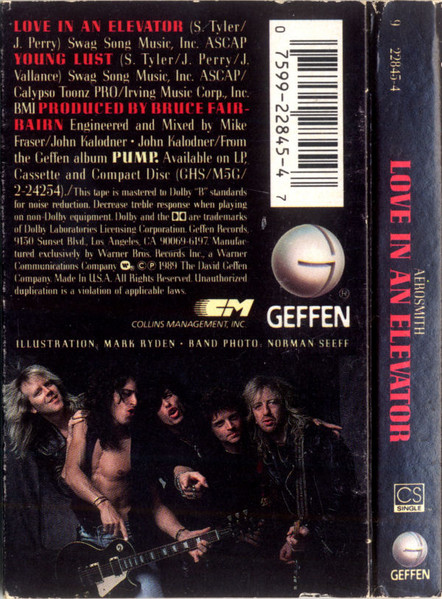
AEROSMITH - LOVE IN AN ELEVATOR
Released: August 15, 1989
Charts: US: #5 UK: #13
"Love in an Elevator" is a song written by Steven Tyler and Joe Perry. Released in August 1989 as the lead single from the “Pump” album, the track became a significant hit. It peaked at No. 5 on the Billboard Hot 100 and topped the Hot Mainstream Rock Tracks chart. This is a playful and provocative song about love, elevators, and the combination of the two. While Aerosmith often explores deeper themes in their music, this song is more lighthearted and fun, with lyrics that focus on humor and innuendo.
"Love in an Elevator" was inspired by one of Steven Tyler's pre-sobriety experiences. He recounts a night in a hotel hot tub with several women, which escalated to a party in his room. When they entered the elevator wearing only towels and bathrobes, one woman playfully pushed all the buttons. As the elevator descended to the lobby, she opened her robe to reveal herself, resulting in an unexpected show for the crowded lobby when the doors opened. This amusing incident provided the perfect inspiration for the song's playful lyrics about love and the thrill of elevator encounters.
Steven Tyler co-wrote it with guitarist Joe Perry, drawing from a fusion of ideas generated during a jam session, with Buddy Miles being a notable influence. While Tyler initially worried that the title seemed too juvenile, Perry reminded him of their successful song "Dude (Looks Like a Lady)," encouraging him to embrace the playful title.
The music video directed by Marty Callner, opens with Aerosmith walking through a posh department store. The scene features an elevator operator, played by former Playboy model Brandi Brandt, who flirtatiously asks lead singer Steven Tyler if he is "going down." Tyler then jumps into the elevator, and the band starts performing the song on stage, interspersed with quick cuts back to the department store scenes.
AEROSMITH - DREAM ON
Publicació: 27 de juny de 1973
Llistes: EUA: #6
"Dream On" és una balada de l'àlbum debut homònim d'Aerosmith, llançada el 1973. Escrita pel cantant Steven Tyler, va ser el primer gran èxit de la banda i s'ha convertit en un clàssic del rock. Inicialment llançada el juny de 1973, la cançó va arribar al número 59 del Billboard Hot 100. Quan es va re-lançar el 1975 amb la versió completa de l'àlbum, va debutar al número 81 i va arribar fins al número 6 l'abril de 1976.
"Dream On" va ser el primer senzill d'Aerosmith i va tenir un paper clau en el llançament de la seva carrera. Steven Tyler va estar treballant-hi intermitentment durant uns sis anys, desenvolupant la cançó en fragments. El mànager de la banda els va fer viure junts en una casa per centrar-se en escriure les cançons del seu àlbum debut. Amb les contribucions de la resta de la banda, Tyler finalment va poder completar-la.
Steven Tyler va explicar que "Dream On" tracta del desig d'aconseguir l'èxit i la determinació de perseverar fins a fer realitat els somnis. Va descriure la cançó com un reflex de les lluites de ser una banda nova, especialment amb les crítiques que van rebre acusant-los d'imitar els Rolling Stones. Tyler va començar a escriure-la quan tenia uns 17 o 18 anys, sense ser conscient que es convertiria en una cançó important. Per a ell, va començar com un simple sonet tocat al piano, sense esperar que esdevingués un èxit.
"Dream On" va ser la cançó que va salvar Aerosmith de ser acomiadats per Columbia Records. El seu àlbum debut, “Aerosmith”, no es va vendre gaire al principi, principalment per la falta de promoció. La banda estava en perill de perdre el contracte, però la seva gestió va convèncer Columbia de llançar "Dream On" com a single. La cançó va arribar al número 59 a les llistes dels Estats Units amb una versió més curta i apta per a la ràdio. El seu èxit, especialment a la zona de Boston, va convèncer Columbia de mantenir la banda, que acabarien convertint-se en uns dels artistes més grans del segell.
Al guitarrista Joe Perry inicialment no li agradava "Dream On" perquè era una balada, que contrastava amb la seva preferència per actuacions de rock energiques. En una entrevista de 2002, Perry va explicar que en aquell moment el rock consistia en energia i espectacle, i les balades com "Dream On" no encaixaven en aquest estil. Tot i reconèixer-ne la qualitat musical, no li entusiasmava tocar-la en directe, especialment quan els repertoris de la banda eren curts. Tanmateix, va entendre que les balades eren claus per aconseguir èxit a la ràdio i entrar al Top 40. Només després que "Dream On" es convertís en un single d'èxit, la banda va començar a tocar-la amb més freqüència als seus concerts en directe.
AEROSMITH - DREAM ON
Released: June 27, 1973
Charts: US: #6
"Dream On" is a ballad from the 1973 self-titled debut album. Written by lead singer Steven Tyler, it was the band's first major hit and has since become a staple of classic rock radio. Initially released in June 1973, the single peaked at number 59 on the Billboard Hot 100. The song was re-released in 1975 with the full album version, which debuted at number 81 on the Hot 100 in January 1976, eventually reaching number 6 in April of that year.
"Dream On" was Aerosmith's first single, and it played a key role in launching their career. The song had been a long time in the making, as Steven Tyler worked on it intermittently for about six years, developing it in fragments. The band's manager had them live together in a shared house to focus on writing songs for their debut album. With contributions from the rest of the band, Tyler was able to finally complete the song.
Steven Tyler explained that "Dream On" is about the desire to achieve success and the determination to persevere until dreams are realized. He described the song as reflecting the struggles of being in a new band, especially dealing with critics who panned their debut album and accused them of imitating the Rolling Stones. Tyler began writing "Dream On" when he was around 17 or 18, unaware it would eventually become a fully developed song. For him, it began as a simple sonnet played on the piano, never expecting it to evolve into a hit.
"Dream On" was the song that saved Aerosmith from being dropped by their record label, Columbia Records. Their debut album, “Aerosmith”, sold poorly at first, largely due to lack of promotion. The band was in danger of losing their contract, but their management persuaded Columbia to release "Dream On" as a single. The song reached #59 on the US charts, with a more radio-friendly edit than the album version. Its success, particularly in the Boston area, convinced Columbia to keep the band, who went on to become one of the label's biggest acts.
Aerosmith guitarist Joe Perry initially didn't like "Dream On" because it was a ballad, which contrasted with his preference for energetic, live rock performances. In a 2002 interview Perry explained that, at the time, rock was all about energy and putting on a show, and ballads like "Dream On" didn't fit that mold. While Perry acknowledged its musical quality, he wasn't enthusiastic about playing it live, especially when the band's setlists were short. However, he understood that ballads were key to getting radio play and achieving Top 40 hits. It was only after "Dream On" became a successful single that the band started playing it more often in their live shows.