"Let's Hear It for the Boy" és una cançó de Deniece Williams que va aparèixer a la banda sonora de Footloose. Llançada com a senzill, la cançó va guanyar ràpidament popularitat. Escrita per Tom Snow i Dean Pitchford, i produïda per George Duke, va assolir el primer lloc de la llista dels èxits dels Estats Units, el Billboard Hot 100, el 26 de maig de 1984, marcant el segon número u de Williams. La cançó també va arribar al cim de les llistes de música dance i R&B.
Tot i que va arribar al número dos a la UK Singles Chart, darrere de "Wake Me Up Before You Go-Go" de Wham!, va gaudir d'un gran èxit internacional. "Let's Hear It for the Boy" va rebre una nominació als premis de l'Acadèmia a la millor cançó original i va aconseguir la certificació de platí als Estats Units, així com la certificació d'or al Canadà i al Regne Unit, per part de la Recording Industry Association of America, Music Canada, i la British Phonographic Industry, respectivament.
La col·laboració de Dean Pitchford amb Tom Snow en "Let's Hear It for the Boy" per a la pel·lícula Footloose va marcar un altre èxit per al compositor, conegut pel seu treball a Fame. La primera cançó per a l'escena, "Somebody's Eyes", no connectava, la qual cosa va portar Pitchford a crear una peça més animada centrada en la línia "Let's hear it for the boy". Deniece Williams, amb el seu bagatge i afecte per la narrativa de la petita ciutat a Footloose, va trobar la cançó fascinant.
George Merrill i Shannon Rubicam de Boy Meets Girl van proporcionar les veus de suport per a la interpretació de Deniece Williams. El duo va gaudir de l’èxit amb la seva pròpia cançó "Waiting for a Star to Fall" el 1988. A més, van escriure les cançons de Whitney Houston "How Will I Know" i "I Wanna Dance with Somebody (Who Loves Me)". La sessió va ser supervisada pel teclista de jazz/funk George Duke, amb els compositors Tom Snow i Dean Pitchford també presents.
El videoclip presenta Deniece Williams al costat de diversos joves, incloent-hi el cantant Aaron Lohr, que interpreta el jove al videoclip. A la pel·lícula, la cançó s'utilitza en una escena on el personatge de Kevin Bacon intenta ensenyar a ballar al personatge de Christopher Penn, amb Penn lluitant per seguir el ritme.
DENIECE WILLIAMS - LET’S HEAR IT FOR THE BOY
Released: February 14, 1984
Charted: UK: #2 US: #1 (2 weeks)
"Let's Hear It for the Boy" is a song by Deniece Williams that featured on the Footloose soundtrack. Released as a single the song quickly gained popularity. Written by Tom Snow and Dean Pitchford, and produced by George Duke, it soared to the top of the US Billboard Hot 100 on May 26, 1984, marking Williams' second number one hit. The song also reached the pinnacle of the dance and R&B charts.
Although it peaked at number two on the UK Singles Chart, behind "Wake Me Up Before You Go-Go" by Wham!, it still enjoyed significant success internationally. "Let's Hear It for the Boy" received an Academy Award nomination for Best Original Song, and achieved platinum certification in the US, as well as gold certification in Canada and the UK, by the Recording Industry Association of America, Music Canada, and the British Phonographic Industry, respectively.
Dean Pitchford's collaboration with Tom Snow on "Let's Hear It for the Boy" for the movie Footloose marked another success for the songwriter, known for his work on Fame. The initial song for the scene, "Somebody's Eyes," wasn't resonating, prompting Pitchford to craft a more uplifting piece centered around the line "Let's hear it for the boy." Deniece Williams, with her background and affinity for the small-town narrative in Footloose, found the song compelling.
George Merrill and Shannon Rubicam of Boy Meets Girl provided backup vocals for Deniece Williams' rendition of "Let's Hear It for the Boy." The duo later found success with their own hit "Waiting for a Star to Fall" in 1988. Additionally, they penned Whitney Houston's songs "How Will I Know" and "I Wanna Dance with Somebody (Who Loves Me)." The session was overseen by jazz/funk keyboardist George Duke, with songwriters Tom Snow and Dean Pitchford also present.
The music video features Deniece Williams alongside several young men, including the singer Aaron Lohr, who portrays the young boy in the video. In the film the song is used in a scene where Kevin Bacon's character tries to teach Christopher Penn's character how to dance, with Penn's character struggling to keep up.
ROSE ROYCE - CAR WASH
Llançament: setembre de 1976
Llistes: Regne Unit: #9 Estats Units: #1 (1 setmana)
"Car Wash" de Rose Royce és una cançó icòna de l'era disco dels anys 1970, escrita i arranjada pel productor ex-Motown Norman Whitfield. Servint com a cançó principal de la pel·lícula "Car Wash" del 1976, el tema va marcar el debut de Rose Royce com a grup i es va convertir en el seu llançament més exitós. La cançó va encapçalar les llistes dels èxits Billboard Hot 100 i Hot Soul Singles dels Estats Units, consolidant el seu lloc com número u. A més, "Car Wash" va arribar al número tres a la llista National Disco Action Top 30 i va arribar al número nou a la UK Singles Chart al febrer de 1977.
La inspiració de Norman Whitfield per a "Car Wash" va sorgir en un moment inesperat mentre gaudia d'un àpat de Kentucky Fried Chicken i veia un partit de bàsquet. Va escriure la lletra de la cançó a la bossa que contenia el pollastre. Aquesta explosió espontània de creativitat va resultar en una cançó que complementava perfectament l'ambient de la pel·lícula "Car Wash", que es centrava en un ambient sobre un rentat d'automòbils amb ritmes funky. El talent de Whitfield per a crear clàssics de Motown es va traduir perfectament en l'energia enganxosa i contagiosa de "Car Wash", contribuint al seu èxit perdurable com a icona de l'era disco.
"Car Wash" captura l'essència de l'ambient alegre i despreocupat que es mostra en la comèdia cinematogràfica per a la qual va ser creada. Cantada per la vocalista principal de Rose Royce, Rose Norwalt (Gwen Dickey), la cançó retrata un negoci de rentat d'automòbils animat i relaxat, on divertir-se és part del treball.
A la llista Billboard Hot 100, "Car Wash" va restar al primer lloc durant una setmana al gener de 1977, desplaçant "I Wish" de Stevie Wonder i obrint pas a "Torn Between Two Lovers" de Mary MacGregor. L'àlbum de la banda sonora de Car Wash, totalment creat per Rose Royce i Norman Whitfield, va donar lloc a dos senzills més d'èxit: "I Wanna Get Next to You" i "I'm Going Down". La banda sonora va rebre reconeixement per la seva excel·lència en la indústria musical, guanyant el prestigiós premi Grammy al Millor Àlbum de Banda Sonora del 1977.
ROSE ROYCE - CAR WASH
Released: September 1976
Charted: UK: #9 US: #1 (1 week)
"Car Wash" by Rose Royce is an iconic song from the 1970s disco era, written and arranged by the esteemed ex-Motown producer Norman Whitfield. Serving as the theme song for the 1976 film "Car Wash," the track marked Rose Royce's debut single and became their most successful release. The song topped the US Billboard Hot 100 and Hot Soul Singles charts, solidifying its place as a chart-topping hit. Additionally, "Car Wash" reached number three on the National Disco Action Top 30 chart and peaked at number nine on the UK Singles Chart in February 1977.
Norman Whitfield's inspiration for "Car Wash" struck in an unexpected moment while he was enjoying a meal of Kentucky Fried Chicken and watching a basketball game. He penned the lyrics for the song on the bag containing the chicken. This spontaneous burst of creativity resulted in a track that perfectly complemented the vibe of the movie "Car Wash," which centered around a funky car wash setting. Whitfield's knack for crafting Motown classics translated seamlessly into the catchy and infectious energy of "Car Wash," contributing to its enduring success as a disco-era hit.
"Car Wash" captured the essence of the upbeat and carefree atmosphere depicted in the comedy film it was created for. Sung by Rose Royce's lead singer Rose Norwalt (Gwen Dickey), the song portrays a lively and relaxed car washing business, where having fun is part of the job description.
The Car Wash soundtrack marked Rose Royce's debut album, and "Car Wash" served as their inaugural single. Its immense popularity propelled the album to great success, with "Car Wash" selling over 2 million copies and reaching number one on both the Billboard popular and R&B charts in the United States. In the United Kingdom, the song achieved top ten status.
On the Billboard Hot 100 chart, "Car Wash" claimed the number one spot for one week in January 1977, displacing Stevie Wonder's "I Wish" and making way for Mary MacGregor's "Torn Between Two Lovers." The Car Wash soundtrack album, entirely crafted by Rose Royce and Norman Whitfield, spawned two additional hit singles: "I Wanna Get Next to You" and "I'm Going Down." The Car Wash soundtrack received recognition for its excellence in the music industry, earning the prestigious Grammy Award for Best Score Soundtrack Album in 1977.
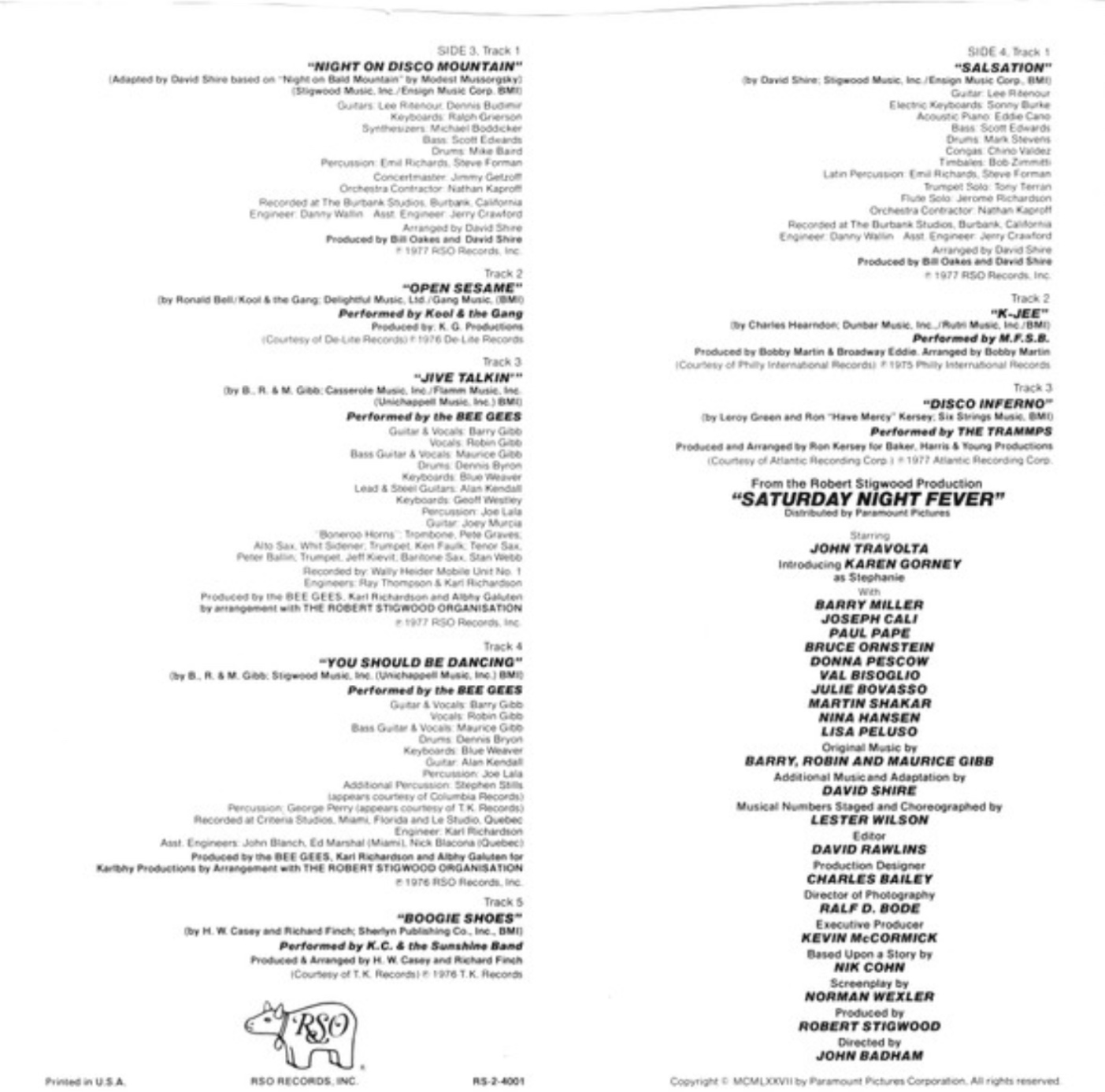
La pel·lícula "Saturday Night Fever" i la seva banda sonora es van convertir en fenòmens culturals durant els anys 70 i més enllà. Els Bee Gees, juntament amb altres artistes, van contribuir a aquesta banda sonora icònica, que incloïa èxits com "Stayin' Alive", "Night Fever", "How Deep Is Your Love?" i "More than a Woman". "If I Can't Have You", interpretada per Yvonne Elliman, va ser una altra cançó notable escrita pels Gibb. L'àlbum també incloïa èxits anteriors dels Bee Gees com "Jive Talkin'" i "You Should Be Dancing".
L'impacte de la banda sonora va ser immens, el que va portar a la seva inclusió al Registre Nacional de Gravacions de la Biblioteca del Congrés el 2012. Els Bee Gees i el compositor David Shire van rebre nominacions al Globus d'Or per Millor Banda Sonora Original i Millor Cançó Original. A més, l'àlbum va guanyar el Premi Grammy a l'Àlbum de l'Any i va mantenir el títol de l'àlbum més venut fins que va ser superat per "Thriller" de Michael Jackson. Va romandre la banda sonora més venuda fins que va ser superada per la banda sonora de "The Bodyguard".
Robin Gibb va proporcionar informació sobre la gènesi de "Saturday Night Fever" i la seva banda sonora en una entrevista al Observer Music Monthly el gener del 2008. El concepte de la pel·lícula va sorgir d'un article titulat "Tribal Rites of the New Saturday Night" de Nik Cohn a la revista New York, que explorava els adolescents que assistien a competicions de ball. Robert Stigwood, el manager dels Bee Gees, va veure potencial en l'article i va iniciar el projecte.
Durant els assajos de ball amb John Travolta per a la pel·lícula, els Bee Gees inicialment van utilitzar la seva cançó "You Should Be Dancing", llançada l'any anterior. No obstant això, Stigwood va preguntar si tenien altres cançons per contribuir. Finalment, els Bee Gees van proporcionar cinc noves pistes juntament amb "Jive Talkin'" i "You Should Be Dancing". La decisió de posar el nom de la pel·lícula "Saturday Night Fever" també va ser una suggerència dels Bee Gees, reflectint les competicions de dissabte a la nit i la seva cançó "Night Fever".
L'èxit de la pel·lícula va transformar la percepció de la música disco, particularment al Regne Unit, on tenia una connotació diferent abans de l'estrena de la pel·lícula. Malgrat no tenir la intenció de convertir-se en icones d’aquest estil, els Bee Gees es van trobar associats amb el gènere. L'estrena al Chinese Theatre de Los Angeles va revelar la sinergia entre la pel·lícula i la seva banda sonora, però l'abast del seu impacte els va sorprendre.
L'èxit comercial de la banda sonora de Saturday Night Fever és realment notable. Amb més de 50 milions de còpies venudes, es posiciona com un dels àlbums més venuts de tots els temps. Durant la primera meitat del 1978, les contribucions dels Bee Gees a la banda sonora van dominar les llistes de singles del Billboard Hot 100 als Estats Units, passant un total de 14 setmanes al número u.
Quan es consideren els singles escrits o produïts pels Bee Gees que també van arribar al número u durant aquest període, el seu total de setmanes al cim s'estenia a 19 de 26 setmanes. Al març d'aquell any, els Bee Gees van aconseguir un èxit que només havia assolit abans els Beatles: tenir cinc cançons alhora a les deu primeres posicions del Billboard.
Barry Gibb va assolir un honor únic escrivint quatre èxits consecutius al número u. La ratxa va començar amb "Stayin' Alive", que va romandre al capdavant de les llistes dels Estats Units durant quatre setmanes. Després, el germà més jove dels Bee Gees, Andy Gibb, va aconseguir el número u amb el seu èxit "Love is Thicker Than Water", que Barry va coescriure amb Andy. "Night Fever" va dominar les llistes durant vuit setmanes, seguit de la interpretació d’Yvonne Elliman de "If I Can't Have You", que també va arribar al número u.
La banda sonora de Saturday Night Fever presentava un equilibri entre peces instrumentals originals del compositor nord-americà David Shire, juntament amb cançons conegudes com "Disco Inferno" de The Trammps i "Open Sesame" de Kool and the Gang, que havien estat èxits a les llistes els anys anteriors. Tot i que els artistes probablement van beneficiar-se de l'exposició a la pel·lícula i a la banda sonora, potser no van recollir completament les recompenses de les immenses vendes de l'àlbum.
El productor Albhy Galuten va descriure l'àlbum com potencialment un dels discos més aprofitables mai creats. Va suggerir que algunes de les peces instrumentals com "Night On Disco Mountain", s'incloïen per omplir l'àlbum però no eren necessàriament grans èxits. A més, cançons com "Boogie Shoes" de KC and the Sunshine Band es van escollir estratègicament per equilibrar l'àlbum amb èxits i pistes menys costoses.
Galuten va especular que Robert Stigwood, el productor, probablement va negociar acords de llicència favorables per a moltes de les cançons de l'àlbum, incloent-hi cançons d'artistes com Ralph MacDonald i Tavares. Mentre els artistes principals com els Bee Gees rebien quantitats fixes, els altres podrien haver rebut imports més baixos per la llicència a causa del seu estatus menys conegut en aquell moment.
Com suggereix Albhy Galuten, la música que la gent escoltava durant els seus anys de formació, especialment a l'institut i a la universitat, té un lloc especial als seus cors. L'impacte emocional de la música dels anys adolescents roman profund al llarg de la vida, provocant respostes emocionals com cap altra música posterior. A través de diferents edats, la gent sovint cita la música popular durant la seva joventut com la seva preferida, destacant la importància d'aquell període en la formació de les seves preferències musicals i els seus records.
Per aquells que van créixer durant l'època de Saturday Night Fever, la banda sonora i la pel·lícula tenen una importància immensa. Evoquen records d'un moment particular a les seves vides i serveixen com a banda sonora de les seves experiències i emocions.
SATURDAY NIGHT FEVER ORIGINAL SOUNDTRACK
Released : November 15, 1977
Charted: UK: #1 (18 weeks) US: #1 (24 weeks)
The film "Saturday Night Fever" and its soundtrack became cultural phenomena in the 1970s and beyond. The Bee Gees, along with other artists, contributed to this iconic soundtrack, which included hits like "Stayin' Alive," "Night Fever," "How Deep Is Your Love?," and "More than a Woman." "If I Can't Have You," performed by Yvonne Elliman, was another notable track penned by the Bee Gees. The album also featured previous Bee Gees hits like "Jive Talkin'" and "You Should Be Dancing."
The soundtrack's impact was immense, leading to its inclusion in the National Recording Registry in the Library of Congress in 2012. The Bee Gees and composer David Shire received nominations for Best Original Score and Best Original Song at the Golden Globe Awards. Furthermore, the album won the Grammy Award for Album of the Year and held the title of the best-selling album until it was surpassed by Michael Jackson's "Thriller." It remained the best-selling soundtrack until it was overtaken by "The Bodyguard" soundtrack.
Robin Gibb provided insight into the genesis of "Saturday Night Fever" and its soundtrack in a January 2008 interview with Observer Music Monthly. The film's concept stemmed from an article titled "Tribal Rites of the New Saturday Night" by Nik Cohn in New York magazine, which explored teenagers attending dancing competitions. Robert Stigwood, the Bee Gees' manager, saw potential in the article and initiated the project.
During dance rehearsals for the film with John Travolta, the Bee Gees initially used their song "You Should Be Dancing," released the previous year. However, Stigwood asked if they had additional songs to contribute. Ultimately, the Bee Gees provided five new tracks along with "Jive Talkin'" and "You Should Be Dancing." The decision to name the film "Saturday Night Fever" was also the Bee Gees' suggestion, reflecting the Saturday night competitions and their song "Night Fever."
The film's success transformed the perception of disco, particularly in the UK, where it had a different connotation before the movie's release. Despite not intending to become disco icons, the Bee Gees found themselves associated with the genre. The premiere at the Chinese Theatre in Los Angeles revealed the synergy between the film and its soundtrack, but the extent of its impact surprised them.
The commercial success of the Saturday Night Fever soundtrack is indeed remarkable. With sales exceeding 50 million copies, it stands as one of the best-selling albums of all time. During the first half of 1978, the Bee Gees' contributions to the soundtrack dominated the Billboard Hot 100 singles charts in the US, spending a total of 14 weeks at number one.
When considering the singles penned or produced by the Bee Gees that also reached number one during this period, their total weeks at the top extended to 19 out of 26 weeks. In March of that year, the Bee Gees accomplished a feat previously achieved only by the Beatles: having five songs simultaneously charting in Billboard's top ten.
Barry Gibb achieved a unique honor with this album, penning four consecutive number one hits. The streak began with "Stayin' Alive," which remained at the top of the US charts for four weeks. Following this, the Bee Gees' youngest brother, Andy Gibb, claimed the number one spot with his hit "Love is Thicker Than Water," which Barry co-wrote with Andy. "Night Fever" then dominated the charts for eight weeks, followed by Yvonne Elliman's rendition of "If I Can't Have You," which also reached number one.
The Saturday Night Fever soundtrack album featured a balance of original score pieces by American composer David Shire, along with well-known tracks such as The Trammps' "Disco Inferno" and Kool and the Gang's "Open Sesame," which had been chart hits in the preceding years. While the artists likely benefited from the exposure in the film and on the soundtrack, they may not have fully reaped the rewards of the album's immense sales.
Producer Albhy Galuten described the album as potentially one of the most profitable records ever created. He suggested that some of the orchestral pieces, like "Night On Disco Mountain," were included to fill out the album but were not necessarily major hits. Additionally, songs like KC and the Sunshine Band's "Boogie Shoes" were strategically chosen to balance the album with hits and less expensive tracks.
Galuten speculated that Robert Stigwood, the producer, likely negotiated favorable licensing deals for many of the songs on the album, including tracks by artists like Ralph MacDonald and Tavares. While major artists such as the Bee Gees received fixed royalties, others may have received lower licensing fees due to their lesser-known status at the time.
As Albhy Galuten suggests, the music that people listened to during their formative years, particularly in high school and college, holds a special place in their hearts. The emotional impact of music from one's teenage years remains profound throughout life, eliciting visceral and emotional responses unlike any later music. Across different ages, people often cite the music popular during their youth as their favorite, highlighting the importance of that period in shaping their musical preferences and memories.
For those who grew up during the era of "Saturday Night Fever," the soundtrack and the film hold immense significance. They evoke memories of a particular time in their lives and serve as a soundtrack to their experiences and emotions. This enduring connection speaks to the timeless appeal and cultural impact of the music from "Saturday Night Fever."