"Janie's Got a Gun" is a song co-written by Steven Tyler and Tom Hamilton. Released as the second single from the album “Pump”, the song achieved significant commercial success, peaking at number four on the US Billboard Hot 100 and number two on the Billboard Album Rock Tracks chart in 1990. It also topped the charts in Australia, marking Aerosmith's first number-one single there, and reached number two in Canada, number 12 in Sweden, and number 13 in New Zealand.
Steven Tyler began writing "Janie's Got a Gun" in his basement, originating the line "Janie's got a gun." After several months of development, the song's theme evolved into one addressing child abuse, inspired by an article he saw in Time magazine detailing handgun deaths in the U.S. Tyler was particularly struck by a woman's account of the alarming rates of child abuse, leading him to feel compelled to write about the issue. This realization marked the turning point for the song, as he aimed to shed light on the frightening reality of child abuse in his lyrics.
In an interview with Rolling Stone, Steven Tyler discussed his complex feelings regarding fatherhood and attraction, particularly in relation to his daughter, Liv. He stated, "How can a father not be attracted to his daughter, especially when she's a cross between the girl he married and himself?" Tyler emphasized that while it's natural for a father to recognize his daughter's beauty, it's crucial to maintain appropriate boundaries. He expressed that "the real man knows that's just a place to never go" and instead honors his daughter by celebrating her as a "precious child of God." He clarified that "Janie's Got a Gun" addresses fathers who fail to understand this distinction.
The music video directed by David Fincher, is a cinematic depiction of a girl named Janie who kills her father, showcasing the aftermath of the crime. Recognized as one of the most impactful videos on MTV, Fincher’s expertise in building tension is evident throughout, employing lighting and composition techniques that would later feature in his acclaimed films like “Se7en”, “Alien III”, and “Panic Room”. The video stars Kristin Dattilo as Janie and Lesley Ann Warren as her mother, effectively illustrating the song's dark narrative.
DARYL HALL & JOHN OATES - SAY IT ISN’T SO
Publicació: octubre de 1983
Llistes: EUA: #2 Regne Unit: #69
"Say It Isn't So" és una cançó escrita per Daryl Hall, llançada l'octubre de 1983 com a part del seu àlbum recopilatori “Rock 'n Soul Part 1”. La cançó va ser remesclada per John "Jellybean" Benitez i va arribar al número 1 a la llista Billboard Hot Dance Club Play. A la llista Billboard Hot 100, va arribar al número 2 on hi va romandre durant quatre setmanes consecutives, sense poder desbancar “Say Say Say” de Paul McCartney i Michael Jackson del primer lloc. Malgrat tenir sis cançons número 1, “Say It Isn't So” és l'única de Hall & Oates que va quedar-se al número 2.
Daryl Hall la va escriure mentre Hall & Oates estaven de gira amb el seu àlbum “H2O” i va ser la primera de dues noves cançons enregistrades per a aquest recopilatori. Les sessions d'enregistrament van tenir lloc al setembre de 1983 a l'estudi Electric Lady Studio A a Nova York, i va ser coproduïda per Hall, John Oates i l'enginyer Bob Clearmountain. L'arranjament, desenvolupat a l'estudi, va comptar amb les contribucions de Tom "T-Bone" Wolk al baix, Charles DeChant al saxofon, G. E. Smith a la guitarra, Mickey Curry a la bateria i Jimmy Bralower a la percussió. Els cors es van inspirar en la versió dels Flamingos de “I Only Have Eyes for You”, i Bralower va ajudar a resoldre un problema estructural.
Per al 1983, Hall & Oates ja havien aconseguit un èxit massiu amb cinc número 1, convertint-se en estrelles de la ràdio i de MTV. No obstant això, aquest èxit també els va portar a sentiments d'aïllament, especialment durant les actuacions davant grans audiències. Daryl Hall va explicar que aquest sentiment de separació va ser la inspiració darrere d'aquesta cançó. Va descriure com ell i John Oates se sentien com a forasters, capturant-ho en la frase "We like to be the strangers at the party, two rebels in a shell" (Ens agrada ser els estranys de la festa, dos rebels en una closca), reflectint la seva percepció de desconnexió amb el món exterior mentre vivien dins de la bombolla de les gires constants i l'èxit.
"Say It Isn't So" va tenir dues versions de videoclips. La primera es va emetre a MTV durant un especial titulat “The Greatest & The Latest”, amb el duet. La segona, més popular, es va filmar a localitzacions de Nova York i va ser un element clau durant els anys d'or de MTV, rebent una rotació constant al canal.
DARYL HALL & JOHN OATES - SAY IT ISN’T SO
Released: October 1983
Charts: US: #2 UK: #69
"Say It Isn't So" is a song written by Daryl Hall and released in October 1983 as part of their compilation album “Rock 'n Soul Part 1”. The song was remixed by John "Jellybean" Benitez and topped the Billboard Hot Dance Club Play chart. On the Billboard Hot 100, it peaked at #2 for four consecutive weeks, unable to reach the top spot due to Paul McCartney and Michael Jackson's "Say Say Say." Despite having six #1 singles, "Say It Isn't So" is Hall & Oates' only song to peak at #2.
Daryl Hall wrote it while Hall & Oates were on their “H2O” tour and was the first of two new songs recorded for their 1983 compilation. The recording sessions took place in September 1983 at Electric Lady Studio A in New York City, and the song was co-produced by Hall, John Oates, and engineer Bob Clearmountain. The arrangement developed in the studio featured contributions from Tom "T-Bone" Wolk on bass, Charles DeChant on saxophone, G. E. Smith on guitar, Mickey Curry on drums, and Jimmy Bralower on percussion. The backing vocals were inspired by the Flamingos' rendition of "I Only Have Eyes for You," and Bralower helped solve a structural issue with the break in the song.
By 1983, Hall & Oates had achieved massive success with five #1 hits, becoming stars of both radio and MTV. However, this success also led to feelings of alienation, particularly as they performed to large audiences. Daryl Hall explained that this sense of separation was the inspiration behind this song. He described how he and John Oates felt like outsiders, captured in the line, "We like to be the strangers at the party, two rebels in a shell." This reflected their perception of being disconnected from the outside world while living in the "bubble" of constant touring and success.
"Say It Isn't So" had two music video versions. The first version was aired on MTV during a special titled “The Greatest & The Latest”, featuring the duo. The second, more popular version, was filmed on location in New York City and became a staple during MTV's peak years, receiving heavy rotation on the channel.
PAUL YOUNG – EVERY TIME YOU GO AWAY
Estrena: 25 de febrer de 1985
Llistes: EUA: #1 (1 setmana) Regne Unit: #4
"Everytime You Go Away" és una cançó escrita per Daryl Hall, inclosa al seu àlbum de 1980, *"Voices", amb el duo Hall and Oates. Tot i que no es va llançar com a single, és una balada commovedora que va esdevenir una de les preferides dels fans i va ser inclosa al seu àlbum en directe de 1985, "Live at the Apollo".
El cantant britànic Paul Young va enregistrar la seva versió (lleugerament retitulada com "Every Time You Go Away") l'any 1985, inclosa en el seu segon àlbum, "The Secret of Association". Aquesta versió no només va esdevenir el primer gran èxit de Paul Young als Estats Units, sinó que va arribar al número u de la llista Billboard Hot 100. Això el va situar entre dos altres èxits anglesos: "A View to a Kill" de Duran Duran i "Shout" de Tears for Fears, durant un estiu gloriós en què artistes del Regne Unit van dominar les llistes americanes. Des de mitjans de maig fins a mitjans d'octubre de 1985, onze senzills van arribar al número u, amb només un, "The Power of Love" de Huey Lewis, provinent d'artistes americans.
Paul Young és un vocalista anglès conegut pel seu estil vocal suau i soul. Va començar com a cantant amb Streetband (amb qui va tenir un èxit amb la cançó còmica "Toast" el 1979) i posteriorment amb The Q-Tips, una banda que es va guanyar una bona reputació en directe, recolzant artistes com J. Geils Band, Bob Marley, The Who, Thin Lizzy i Average White Band, tot i que mai va aconseguir grans vendes de discos. Quan The Q-Tips es van dissoldre el 1982, Columbia Records va mantenir Paul Young amb un contracte en solitari. L'estiu de 1983, Young va arribar al cim de les llistes britàniques amb la seva versió de "Wherever I Lay My Hat (That’s My Home)" de Marvin Gaye, seguit per altres èxits com "Come Back and Stay" (número 4 al Regne Unit) i "Love of the Common People" (número 2 al Regne Unit). Això el va convertir en una de les noves estrelles del Regne Unit de 1983 i el va fer un dels preferits de moltes adolescents. El seu primer àlbum, "No Parlez", va encapçalar les llistes d'àlbums al Regne Unit i va vendre un milió de còpies.
El 1984, la veu de Paul Young va ser la primera a escoltar-se en la cançó benèfica "Do They Know It’s Christmas?" (en substitució de David Bowie, que no va poder participar en la gravació), i també va actuar al Live Aid l'estiu següent. A aquest punt, el seu segon àlbum, "The Secret of Association", ja havia estat llançat, incloent-hi èxits com "I'm Gonna Tear Your Playhouse Down" (número 9 al Regne Unit, número 13 als Estats Units), "Every Time You Go Away" (número 4 al Regne Unit, número 1 als Estats Units) i "Everything Must Change" (número 9 al Regne Unit). L'àlbum també va arribar al número u a les llistes britàniques.
Després d'aquest èxit, la popularitat de Young va començar a disminuir una mica, però encara va aconseguir un altre èxit als Estats Units amb una versió de "Oh Girl" de The Chi-Lites que va arribar al número 8 el 1990, i un últim èxit al top 10 al Regne Unit el 1991, amb la col·laboració amb el cantant italià Zucchero a "Senza una Donna (Without a Woman)", que va arribar al número 4. Paul Young,segueix sent una de les veus més reconeixibles dels anys vuitanta i un dels cantants més perdurables de Blue-Eyed Soul del Regne Unit.
PAUL YOUNG – EVERY TIME YOU GO AWAY
Released: February 25, 1985
Charts: US: #1 (1 week) UK: #4
“Everytime You Go Away” is a Daryl Hall written, Hall and Oates song, taken from the duo’s 1980 album, “Voices”. Although it wasn’t released as a single, it’s a plaintive ballad, that became a fan favourite, and was included on their 1985 live album, “Live at the Apollo”.
British singer Paul Young recorded his version of the song (subtly retitled “Every Time You Go Away”) in 1985, lifted from his sophomore album, “The Secret of Association”. The song did not only become Young's debut Billboard top ten hit, it climbed all the way to number one, providing the meat in an all-English number one sandwich, between Duran Duran’s “A View to a Kill” and Tears for Fears' “Shout” (it was a glorious summer where the UK ruled the American charts. From mid-May to mid-October, of eleven number one singles, only one (Huey Lewis' “The Power of Love”) was American. Happy days!).
Paul Young is an English vocalist known for his smooth, soulful vocal style. He started out as singer with Streetband (with who he had a novelty top twenty hit with in 1979, called “Toast”) and later The Q-Tips. The Q-Tips gained a good live reputation, supporting acts like J. Geils Band, Bob Marley, The Who, Thin Lizzy and the Average White Band, but it never progressed to record sales. The Q-Tips broke up in 1982, with Columbia Records retaining Young on a solo contract. By the summer of 1983, Young was atop of the UK charts with his cover of Marvin Gaye's “Wherever I Lay my Hat (That’s my Home)”, and followed it with “Come Back and Stay” (UK #4) and a cover of “Love of the Common People” (UK #2), making him one of the hottest new UK acts of 1983, and poster boy of many a teen girl's bedroom. His debut album, “No Parlez” reflected his success, topping the album charts and selling a million copies in the UK.
In 1984, Paul Young's voice is the first you hear on “Do They Know It’s Christmas?”, (Albeit as a replacement for David Bowie, who the opening lines were written for, but was unavailable when the song was recorded) and the subsequent Live Aid concert the following summer. By this point, his second album, “The Secret of Association” was released, featuring the hit singles, “I’m Gonna Tear Your Playhouse Down” (UK #9, US #13), “Every Time You Go Away” (UK #4, US #1) and “Everything Must Change” (UK #9, US #56). The album also topped the UK charts.
The success begun to wane a little after that, although he managed a final US hit with a cover of The Chi-Lites “Oh Girl” made #8 in 1990, and a final top ten entry in the UK the following year, alongside Italian singer Zucchero, “Senza una Donna (Without a Woman)” (UK #4). Paul Young remains one of the most instantly recognisable voices of the eighties, and one of my countries most enduring Blue-Eyed Soul singers.
17.10.24
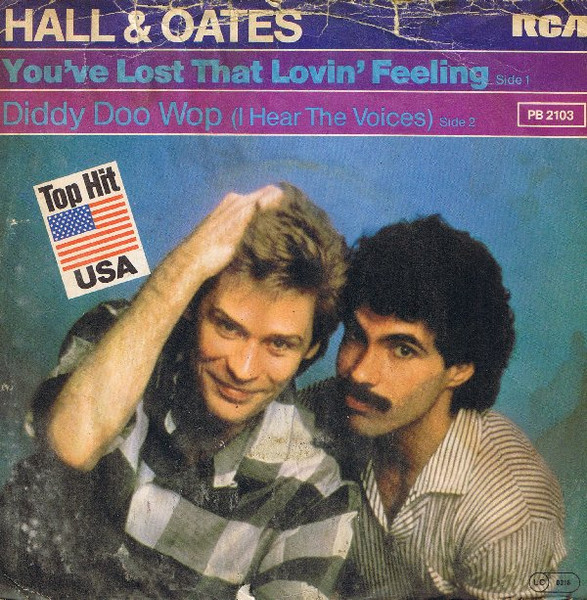
DARYL HALL & JOHN OATES - YOU’VE LOST THAT LOVIN’ FEELING
Estrena: 27 de setembre de 1980
Llistes: EUA: #12 Regne Unit: #55
"You've Lost That Lovin' Feelin'" és una cançó escrita per Phil Spector, Barry Mann i Cynthia Weil, gravada per primera vegada el 1964 pel duo vocal americà The Righteous Brothers. Produïda per Spector, la peça sovint és citada com l'exemple definitiu de la seva tècnica de gravació Wall of Sound. Quan es va llançar, va aconseguir un gran èxit comercial i crític, arribant al número u tant als Estats Units com al Regne Unit a principis de febrer de 1965. Els crítics musicals han descrit la versió dels Righteous Brothers com "un dels millors discos mai fets".
L'any 1980, Hall & Oates van enregistrar una versió de "You've Lost That Lovin' Feelin'" per al seu novè àlbum d'estudi, “Voices”. La seva versió, produïda pel duet, comptava amb un arranjament minimalista que contrastava fortament amb el so exuberant de la gravació original dels Righteous Brothers. Segons John Oates, aquesta versió va ser l'última cançó afegida a l'àlbum, que ja es considerava complet amb deu temes, però sentint que faltava alguna cosa, el duet es va inspirar per fer una versió de la cançó després d'escoltar-la en una màquina de discos mentre estaven fora per menjar. Van tornar a l'estudi, van gravar la peça en només quatre hores i la van incloure a l'àlbum.
Hall & Oates van llançar la seva versió de "You've Lost That Lovin' Feelin'" com a segon single de l'àlbum, després del senzill original "How Does It Feel to Be Back", que va arribar al número 30 al Billboard. La versió va arribar al número 12 al Hot 100 el novembre, sent el primer single de Hall & Oates que va superar el lloc 18 des del seu número u "Rich Girl" la primavera de 1977. A més, la cançó va escalar fins al número 15 a la llista Adult Contemporary de Billboard i va debutar al número 30 a la llista de reproducció Radio & Records, assolint finalment el número 4 i mantenint-se entre els deu primers durant sis setmanes. També va arribar al número 55 a la llista de singles del Regne Unit.
DARYL HALL & JOHN OATES - YOU’VE LOST THAT LOVIN’ FEELING
Released: September 27, 1980
Charts: US: #12 UK: #55
"You've Lost That Lovin' Feelin'" is a song written by Phil Spector, Barry Mann, and Cynthia Weil, first recorded in 1964 by the American vocal duo the Righteous Brothers. Produced by Spector, the track is often cited as the definitive example of his Wall of Sound recording technique. Upon its release, it achieved significant commercial and critical success, reaching number one on the charts in both the United States and the United Kingdom in early February 1965. Music critics have described the Righteous Brothers' rendition as "one of the best records ever made."
In 1980, Hall & Oates recorded a cover of "You've Lost That Lovin' Feelin'" for their ninth studio album, “Voices”. Their version, produced by the duo, featured a sparse arrangement that contrasted sharply with the lush sound of the original Righteous Brothers recording. According to John Oates, this cover was the last song added to the album, which was already considered complete with ten tracks. However, feeling that something was missing, the duo was inspired to cover the song after hearing it on a jukebox while out for food. They returned to the studio, recorded the track in just four hours, and included it on the album.
Hall & Oates released their cover of "You've Lost That Lovin' Feelin'" as the second single from the album, following the original single "How Does It Feel to Be Back," which peaked at No. 30 on the Billboard Hot 100. The cover reached No. 12 on the Hot 100 in November, marking Hall & Oates' first single to chart higher than No. 18 since their number-one hit "Rich Girl" in spring 1977. Additionally, the song climbed to No. 15 on the Billboard Adult Contemporary chart and debuted at No. 30 on the Radio & Records Airplay chart, eventually peaking at No. 4 and remaining in the top 10 for six weeks. It also charted at No. 55 in the UK Singles Chart.