“Sailing on the Seven Seas” va marcar un retorn enèrgic i valent per a OMD el 1991, després d’un període de transició arran de la marxa de Paul Humphreys del grup. La cançó va ser el primer single de l’àlbum “Sugar Tax” i es va convertir en un dels seus temes més exitosos comercialment, igualant l’èxit de “Souvenir” a la llista britànica una dècada abans, i demostrant que Andy McCluskey podia navegar sol.
Estilísticament, la cançó fusionava les arrels electròniques d’OMD amb un so més influït pel rock. Andy McCluskey va retre homenatge a diversos grups clàssics de rock: la frase “people try to drag us down” (la gent intenta arrossegar-nos cap avall) reflecteix l’esperit rebel de “My Generation” de The Who, mentre que es fa una menció directa a “Sister Ray” de The Velvet Underground. Els contundents ritmes de bateria de la peça estaven intencionadament inspirats en The Glitter Band, donant-li un toc de glam-rock.
“Sailing on the Seven Seas” no va ser només un retorn —va ser una reivindicació. Per a Andy McCluskey, OMD renaixia, reconfigurat i revitalitzat. Amb la marxa de Paul Humphreys i la dissolució de la seva sòlida associació creativa, McCluskey es trobava en una cruïlla. Però en lloc de recular, va avançar amb determinació, tot i la incertesa.
OMD - SAILING ON THE SEVEN SEAS
Released: March 18, 1991
Charts: UK: #3
“Sailing on the Seven Seas” marked a bold and energetic comeback for OMD in 1991, following a period of transition after Paul Humphreys departed the band. The track was the first single from the “Sugar Tax” album and became one of their most commercially successful songs, matching the success of “Souvenir” on the UK Singles Chart a decade earlier, and proved that McCluskey could sail solo.
Stylistically, the song fused OMD’s electronic roots with a more rock-influenced sound. Andy McCluskey paid tribute to a number of classic rock acts: the line “people try to drag us down” echoes the rebellious spirit of The Who’s “My Generation”, while “Sister Ray” by The Velvet Underground is name-dropped directly. The pounding drums throughout the track were intentionally styled after The Glitter Band, giving it a glam-rock edge.
“Sailing on the Seven Seas” wasn’t just a comeback—it was a reclamation. For Andy McCluskey, this was OMD reborn, retooled, and recharged. With Paul Humphreys gone and the familiar creative partnership dissolved, McCluskey found himself at a crossroads. But instead of retreating, he charged forward—nervous but determined.
2.5.25
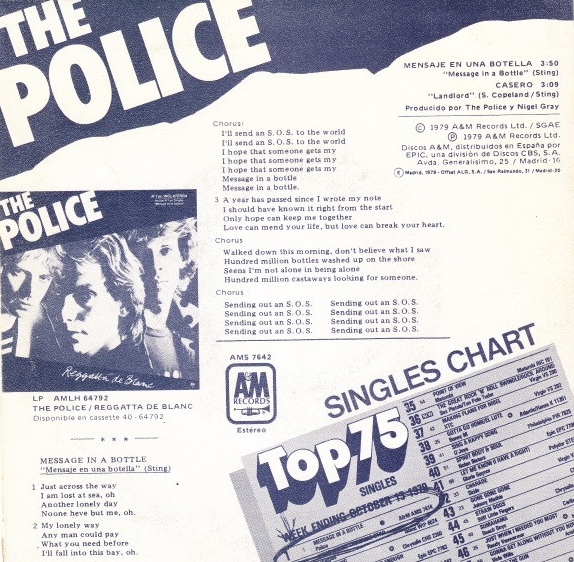
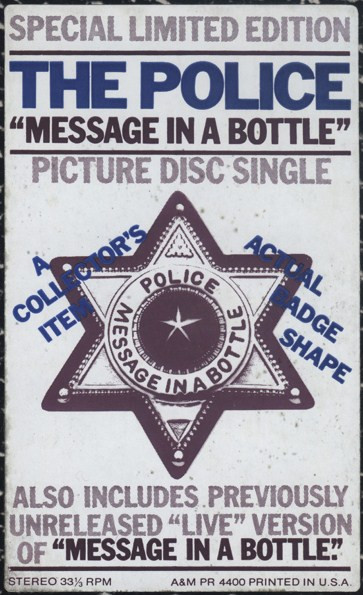
THE POLICE - MESSAGE IN A BOTTLE
Llançament: 7 de setembre de 1979
Posicions a les llistes:EUA: #74 Regne Unit: #1 (3 setmanes)
“Message in a Bottle” és una cançó de 1979 de The Police, escrita pel cantant i baixista Sting. Va ser llançada com a single principal del seu segon àlbum, “Reggatta de Blanc”, i es va convertir en el primer número 1 de la banda al Regne Unit, així com el primer senzill a encapçalar les llistes de la discogràfica A&M. Això va donar inici a una ratxa d’èxits al Regne Unit, que va continuar amb “Walking on the Moon” també arribant al número 1, i una reedició de “So Lonely” arribant al número 6. Als EUA, la cançó va tenir un èxit més moderat, assolint el lloc 74 a les llistes de Billboard.
La cançó explica la història d’un nàufrag que envia un missatge dins d’una ampolla buscant rescat i connexió. Inicialment, el protagonista es desespera perquè no rep cap resposta durant un any, creient que està destinat a romandre sol, però un matí descobreix que “un centenar de milers de milions d’ampolles” han arribat a la costa, revelant que moltes altres persones comparteixen el seu sentiment de solitud. La peça funciona com una metàfora sobre l’aïllament i la comprensió que la soledat és una experiència universal.
“Message in a Bottle” representa un moment clau en l’evolució de la banda. Tot i mantenir traces del seu estil reggae inicial, la cançó transita cap a un so més refinat i madur del New Wave, combinant el treball complex de guitarra d’Andy Summers, la bateria innovadora de Stewart Copeland i les lletres evocadores de Sting. La peça suposa una desviació respecte a l’energia crua del seu àlbum debut, “Outlandos d’Amour”, i transmet una musicalitat més acurada i una composició més reflexiva. Temàticament, expressa desig i esperança sense caure en un excés de sentimentalisme.
Sting la va descriure com una metàfora ben elaborada que arriba a nivells més profunds, més enllà de la seva simplicitat enganxosa. Va destacar-ne l’estructura narrativa i el desenvolupament artístic, mostrant satisfacció per haver creat una història amb un inici, un desenvolupament i una resolució clars. Tot i reconèixer que musicalment podria haver estat més sofisticada, va considerar que la seva simplicitat era clau per transmetre l’impacte emocional.
Sting la va qualificar com una “bona cançó” i va expressar orgull per ella en una entrevista a la BBC amb Jools Holland. Stewart Copeland la va descriure com “un dels nostres millors moments a l’estudi i sempre increïble en directe”. Andy Summers, al seu llibre “One Train Later”, la va elogiar com “la millor cançó que Sting ha escrit mai i la millor peça dels Police”. L’any 2009, Sting va batejar un vi de la seva vinya italiana com “Message in a Bottle”, juntament amb un altre vi anomenat “Roxanne”.
“Message in a Bottle” va ser una de les peces preferides per les actuacions en directe de The Police, sovint utilitzada com a obertura dels seus concerts i interpretada gairebé a totes les actuacions després de la seva estrena. Va ser també l’última cançó que la banda va tocar junta abans de la seva inducció al Rock and Roll Hall of Fame. Sting també la va interpretar com a artista en solitari, incloent-hi la seva actuació al Live Aid de 1985. Andy Summers va declarar que era la millor peça que havia tocat mai.
THE POLICE - MESSAGE IN A BOTTLE
Released: September 7, 1979
Charts: US: #74 UK: #1 (3 weeks)
“Message in a Bottle” is a 1979 song by The Police, written by lead singer and bassist Sting. Released as the lead single from their second album, Reggatta de Blanc, it became the band’s first UK #1 hit and the first UK chart-topper for the A&M label. It was part of a streak of UK success, followed by “Walking on the Moon” hitting #1 and a re-release of “So Lonely” from their debut album reaching #6. In the US, it achieved modest success, peaking at #74 on the Billboard chart.
The song tells the story of a castaway who sends a message in a bottle seeking rescue and connection. Initially, he despairs after receiving no reply for a year, believing he is destined to be alone. However, he awakens one morning to find “a hundred billion bottles” washed ashore, revealing countless others who share his loneliness. The song is a metaphor for isolation and the realization that many people experience similar feelings of solitude.
“Message in a Bottle” represents a turning point in the band’s evolution. While retaining traces of their reggae-influenced roots, the song moves toward a more polished and mature New Wave sound, blending Andy Summers’ intricate guitar work, Stewart Copeland’s innovative drumming, and Sting’s evocative lyrics and straightforward vocal style. The track showcases a departure from the raw energy of their debut album, Outlandos d’Amour, embracing a refined musicality and thoughtful songwriting. Thematically, it conveys longing and hope without becoming overly sentimental.
Sting described it as a metaphorical and well-crafted song that resonates on deeper levels beyond its sing-along appeal. He highlighted its narrative structure and artistic development. He expressed satisfaction in creating a story with a clear beginning, middle, and resolution, acknowledging that while the song could have been more musically sophisticated, its simplicity ultimately served its emotional impact.
“Message in a Bottle” is a favorite among The Police band members. Sting described it as a “good song” and expressed pride in it during a BBC interview with Jools Holland. Stewart Copeland called it “one of our best moments in the studio and always great on stage,” while Andy Summers praised it in his book One Train Later, calling it “the best song Sting ever came up with and the best Police track.” In 2009, Sting named a red wine from his Italian vineyard “Message in a Bottle,” alongside his “Roxanne” wine series.
“Message in a Bottle” was a staple of The Police’s live performances, frequently serving as a set opener and played at nearly every concert after its release. It was the last song the band performed together before their Rock and Roll Hall of Fame induction. Sting also performed it as a solo artist, including at Live Aid in 1985. Guitarist Andy Summers described it as the best track he ever played on.
1.5.25
OMD - LOCOMOTION
Released: April 2, 1984
Charts: UK: #5
Released on April 2, 1984 as the lead single from their fifth album, “Junk Culture”, “Locomotion” captured a brighter, more radio-friendly energy—while still retaining the band’s signature melodic synth work. The song became one of OMD’s biggest European hits, reaching #5 in the UK Singles Chart, as well as charting highly across Ireland, Belgium, and the Netherlands, and peaking at #14 in Germany.
Musically, features a prominent marimba-like synth line, bouncing rhythm, and layered harmonies, delivering a sound that feels light on the surface but carries a subtle melancholy underneath—classic OMD. Lyrically, it’s a reflection on movement, distance, and perhaps even emotional disconnection—using “locomotion” both as a literal and metaphorical theme.
“Locomotion” was a crucial turning point for OMD after the ambitious but commercially divisive “Dazzle Ships”. Where “Dazzle Ships” had leaned heavily into avant-garde electronics and political sampling, “Locomotion” marked a return to a more polished, accessible synthpop formula. The song’s buoyant production feels like a sonic contrast to the weightier, more cerebral textures of their previous work. With its crisp handclaps, bright melodic synths, and playful harmonies, “Locomotion” felt like the group recharging and reimagining themselves for the mid-’80s pop landscape.
“Locomotion” was recorded during the final week of sessions in Montserrat, with additional drum overdubs added later at ICP Studios in Brussels. The track combined a steel drum rhythm by Paul Humphreys, a bass line and piano part from the band’s manager Gordian Troeller, and a bass line created using the Fairlight CMI sampler. It was mixed and completed with brass arrangements by Tony Visconti at Wisseloord Studios in the Netherlands.
The official music video was directed by Jean-Pierre Berckmans and filmed in Ostend and Brussels, Belgium, where the band was living at the time. Frontman Andy McCluskey recalled the humorous challenge of trying to mimic a Caribbean cruise while filming on a sailing ship in Ostend Harbour at 2 a.m., with visible cold breath as he sang. Belgian model Anne Beyens also appears in the video.
30.4.25
WHAM! - FREEDOM
Publicació: 1 d’octubre de 1984
Regne Unit #1 (3 setmanes)
El duo britànic Wham! va consolidar el seu èxit mundial amb “Freedom”, inclosa a l’àlbum “Make it Big”. La cançó, que parla d’un amor ferit però incondicional, va esdevenir el seu segon número u al Regne Unit, reforçant la popularitat del grup en el panorama pop dels anys 80.
Amb una lletra que expressa una ferma determinació de no abandonar una relació malgrat les dificultats, “Freedom” esdevé un himne a la lleialtat i al compromís. Segons va revelar George Michael en una entrevista a The Big Issue l’any 2009, la composició d’aquesta peça va ser un punt d’inflexió en la seva carrera: “Quan vaig escriure ‘Freedom’ amb 19 anys, vaig pensar: ‘No em puc creure que hagi fet això!’ Va ser llavors quan vaig començar a prendre’m seriosament com a compositor”, va explicar.
El 1985, Wham! va fer història en convertir-se en el primer grup pop occidental a actuar a la Xina. Encara que la cançó no tenia contingut polític, es va utilitzar material del viatge per crear-ne el videoclip, donant-li un context visual global. El vídeo, que comença amb imatges de la vida quotidiana xinesa i declaracions del grup, va topar amb la voluntat de MTV, que preferia versions més breus. Tot i així, el mànager Simon Napier-Bell va insistir a mantenir la introducció i MTV va acabar emetent el videoclip complet.
Crítiques com les de Cash Box van elogiar la cançó per la seva “veu plena de matisos R&B i una tornada irresistible”, mentre que Billboard la va descriure com “un tribut al so Motown”.
George Michael tornaria a abordar el concepte de llibertat uns anys més tard, el 1990, amb Freedom ’90, una nova cançó que simbolitzava la ruptura amb la imatge que havia cultivat durant la seva etapa amb Wham! i en els primers anys de la seva carrera en solitari.
WHAM! - FREEDOM
Released: October 1, 1984
UK: #1 (3 Wks)
“Freedom” is a hit song by British pop duo Wham!, featured on the album “Make it Big”. The song, which speaks of a love that has been hurt but remains unconditional, became their second number one hit on the UK Singles Chart.
With lyrics expressing a firm determination not to give up on a relationship despite the hardships, “Freedom” became an anthem of loyalty and commitment. As George Michael revealed in a 2009 interview with The Big Issue, writing the song was a turning point in his career: “When I wrote ‘Freedom’ at 19, I thought, ‘I can’t believe I just did that!’ It was then that I started taking myself seriously as a songwriter,” he explained.
In 1985, Wham! made history by becoming the first Western pop act to perform in China. Although the song had no political content, footage from the trip was used to create the music video, giving it a more global visual context. The video, which begins with images of everyday life in China and statements from the band, clashed with MTV’s preference for shorter versions, but manager Simon Napier-Bell insisted on keeping the intro, and MTV eventually aired the full video.
Critics like Cash Box praised the song for its “R&B-tinged vocals and irresistible chorus,” while Billboard described it as “a Motown tribute.” George Michael would revisit the concept of freedom a few years later, in 1990, with Freedom ’90, a new song symbolizing his break from the image he had built during his time with Wham! and in the early years of his solo career.