Total de visualitzacions de pàgina:

11.5.24


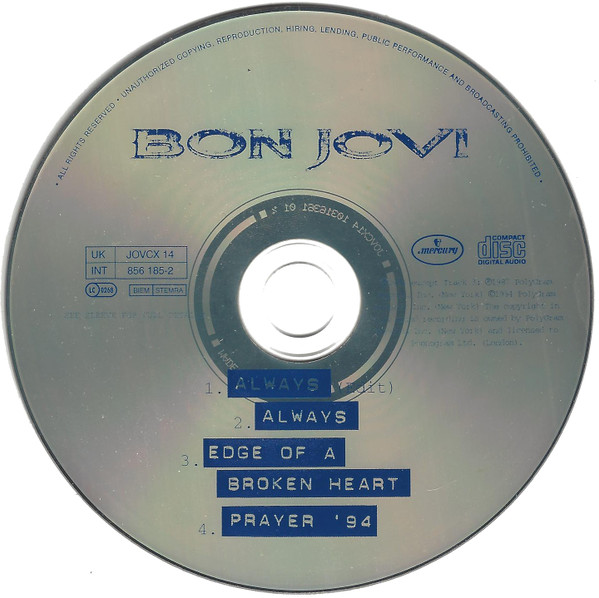
BON JOVI - ALWAYS

Publicació: 12 de setembre de 1994

Llistes: EUA: #4  Regne Unit: #2 


"Always" és una balada de Bon Jovi, llançada al setembre de 1994 com a senzill del seu àlbum de grans èxits, "Cross Road". Es va convertir en un dels seus singles de més èxit, amb més d'un milió de còpies venudes als Estats Units i més de tres milions a tot el món. La cançó va arribar al número quatre al Billboard Hot 100 dels Estats Units, marcant el seu 11è i últim èxit en el Top 10. Internacionalment, va arribar al número u a Bèlgica, Canadà, Irlanda i Suïssa, al número dos a Austràlia i al Regne Unit, i al número quatre a Alemanya.


La cançó va ser escrita inicialment per Jon Bon Jovi per a la banda sonora de la pel·lícula de 1993 "Romeo Is Bleeding", protagonitzada per Gary Oldman com a policia corrupte que afronta problemes matrimonials. Després de quedar decebut en veure una còpia del film, Jon Bon Jovi va decidir no contribuir amb la cançó a la banda sonora. Va deixar la pista de racó fins que l'executiu A&R John Kalodner la va redescobrir i el va persuadir per tornar-la a enregistrar i publicar-la.


La lletra transmet un profund sentit de compromís i devoció, però, quan s'analitza de prop, també revela una inquietant obsessió. La declaració d'amor del protagonista, juntament amb la resolució de dedicació eterna, pot ser interpretada com romàntica per alguns, però inquietant per altres, especialment si l'afecte no és mutu. El mateix Jon Bon Jovi va reconèixer els tons més foscos de la cançó, describint-la com "malalta" i retratant el protagonista com "pràcticament un assetjador" en la seva implacable recerca de l'amor.


El vídeo musical va ser dirigit per Marty Callner i compta amb els actors Jack Noseworthy, Carla Gugino, Jason Wiles i Keri Russell. Una versió alternativa del vídeo mostra únicament la banda interpretant la cançó.


BON JOVI - ALWAYS


Released: September 12, 1994

Charted:  US: #4  UK: #2  


"Always" is a ballad by Bon Jovi, released in September 1994 as a single from their greatest hits album, “Cross Road”. It became one of their best-selling singles, with over a million copies sold in the US and more than three million worldwide. The song peaked at number four on the US Billboard Hot 100, marking their 11th and final top 10 hit. Internationally, it reached number one in Belgium, Canada, Ireland, and Switzerland, number two in Australia and the United Kingdom, and number four in Germany.


The song was initially written by Jon Bon Jovi for the soundtrack to the 1993 film “Romeo Is Bleeding”, featuring Gary Oldman as a corrupt cop facing marital turmoil. After being disappointed after saw a viewing copy by, Jon Bon Jovi chose not to contribute the song to the soundtrack. He left the track on the shelf until A&R executive John Kalodner rediscovered it and persuaded him to re-record and release it.


The lyrics convey a deep sense of commitment and devotion, but when examined closely, they also reveal an unsettling obsession. The protagonist's unwavering declaration of love, coupled with imagery of eternal dedication, can be interpreted as romantic by some but disturbing by others, especially if the affection is not mutual. Jon Bon Jovi himself acknowledged the darker undertones of the song, describing it as "sick" and portraying the protagonist as "practically a stalker" in his relentless pursuit of love.


The music video for "Always" was directed by Marty Callner and features actors Jack Noseworthy, Carla Gugino, Jason Wiles, and Keri Russell. An alternate version of the video solely features the band performing the song. 


MARILLION - KAYLEIGH


Publicació: 7 de maig de 1985

Llistes: EUA: #74  Regne Unit: #2 


"Kayleigh" és una cançó de la banda britànica Marillion, que serveix com a single principal del seu àlbum conceptual "Misplaced Childhood". Esdevé el senzill més exitós de la banda al Regne Unit, arribant a la segona posició a la llista de singles mantenint-se en la llista durant 14 setmanes. La cançó també va assolir l'èxit internacional, entrant al top 10 a Irlanda, Noruega i Alemanya Occidental. Als Estats Units, "Kayleigh" va significar l'única aparició de Marillion a la llista Billboard Hot 100, assolint la posició número 74 l'octubre de 1985. La cançó va contribuir a fer popular el nom Kayleigh al Regne Unit.


"Kayleigh" va enfrontar una dura competició per aconseguir el primer lloc al juny de 1985, ja que va ser superada per una versió de "You'll Never Walk Alone" interpretada pel supergrup de beneficència The Crowd. Aquest single es va publicar com a resposta al tràgic incendi de l'estadi Bradford City, que va ocórrer aquell any. 


"Kayleigh" va inspirar-se en les pròpies experiències i relacions del cantant Fish. La cançó reflecteix el peatge que la seva carrera va suposar per a la seva vida personal, especialment en la seva relació amb una dona anomenada Kay Lee. La seva ruptura va servir de teló de fons per a la lletra. La curiositat sobre l’identitat de Kayleigh va despertar un interès generalitzat, amplificant la popularitat de la cançó i contribuint al seu èxit comercial. L’ansia dels tabloids va alimentar encara més la intriga pública, impulsant "Kayleigh" i l'àlbum de Marillion a la part superior de les llistes i revivint l'interès pels seus llançaments anteriors.


La improvisació del guitarrista de Marillion, Steve Rothery, mentre explicava el seu procés musical a la seva futura dona, va donar lloc a l'iconic riff de "Kayleigh". Sense aquella interacció particular, la trajectòria de la carrera musical de Marillion podria haver seguit un camí molt diferent.


El vídeo promocional del senzill es va gravar a Berlin Occidental, on es va enregistrar l'àlbum "Misplaced Childhood". Va comptar amb Tamara Nowy, una dona alemanya que més tard es va casar amb el cantant Fish, i Robert Mead, el nen retratat a la portada tant de l'àlbum com del single.


Malgrat l’èxit generalitzat a la majoria de parts del món, especialment a Europa, van lluitar per fer-se un lloc en el mercat nord-americà. La seva primera gira pels Estats Units el 1983 va ser rebuda amb decepció, deixant la banda descoratjada. Fins i tot després de l'èxit de "Misplaced Childhood", la seva gira del 1986 com a teloners de Rush no va aconseguir captar l'atenció dels americans, consolidant el seu estatus com una de les principals bandes britàniques oblidades als Estats Units.


MARILLION - KAYLEIGH


Released: May 7, 1985

Charted:  US: #74   UK: #2 


"Kayleigh" is a song by the British band Marillion, serving as the lead single from their concept album "Misplaced Childhood." It stands as the band's most successful single in the UK, reaching the second position on the UK Singles Chart and remaining on the chart for 14 weeks. The song also achieved success internationally, entering the top 10 in Ireland, Norway, and West Germany. In the United States, "Kayleigh" marked Marillion's sole appearance on the Billboard Hot 100 chart, peaking at number 74 in October 1985. 


"Kayleigh" faced stiff competition for the number-one spot in June 1985, as it was edged out by a version of "You'll Never Walk Alone" performed by the charity supergroup the Crowd. This rendition was released in response to the tragic Bradford City stadium fire, which occurred earlier that year. Additionally, the song contributed to popularizing the name Kayleigh in the UK.


"Kayleigh" drew inspiration from singer Fish own experiences and relationships. The song reflects his realization of the toll his career took on his personal life, particularly his romance with a woman named Kay Lee. Their breakup served as a backdrop for the lyrics. The curiosity surrounding the identity of Kayleigh sparked widespread interest, amplifying the song's popularity and contributing to its commercial success. The tabloid frenzy further fueled public intrigue, driving "Kayleigh" and Marillion's album to the top of the charts and reigniting interest in their previous releases.


Marillion guitarist Steve Rothery's improvisation while explaining his musical process to his wife-to-be led to the creation of the iconic "Kayleigh" riff. Without that particular interaction, the trajectory of Marillion's musical journey might have unfolded quite differently.


The promotional video for the single was filmed in West Berlin, where the album "Misplaced Childhood" was recorded. It featured Tamara Nowy, a German woman who later married lead singer Fish, and Robert Mead, the boy depicted on the sleeve of both the album and the single.


"Kayleigh" marked Marillion's sole chart entry in America. Despite their widespread success in most parts of the world, especially in Europe, they struggled to break into the US market. Their first American tour in 1983 was met with disappointment, leaving the band disheartened. Even after the success of "Misplaced Childhood," their 1986 tour supporting Rush failed to garner significant attention, solidifying their status as one of the major British acts largely overlooked in the US.


INXS - ORIGINAL SIN

Estrena: desembre de 1983

Llistes: EUA: #58


"Original Sin" és el primer senzill del quart àlbum de la banda, "The Swing". Escrita per Michael Hutchence i Andrew Farriss, i produïda per Nile Rodgers, la cançó va fer furor en el seu llançament el desembre de 1983. Va suposar un èxit significatiu per a la banda, ja que va ser el seu primer senzill a entrar al top 10 australià i, finalment, va arribar al desitjat lloc número 1 a principis de 1984. Aquest èxit va consolidar la seva posició com el seu únic número u a Austràlia. A més, "Original Sin" va tenir aparicions destacades a les llistes internacionals, arribant al número 20 al Canadà i al número 58 als Estats Units.


La col·laboració d'INXS amb Nile Rodgers va marcar un moment cabdal en la seva trajectòria professional. Inspirats per l’influent àlbum en solitari de Rodgers "Adventures In The Land Of The Good Groove", la banda el va persuadir per produir una pista anomenada "Brand New Day" per al seu pròxim àlbum. Les sessions d'enregistrament van tenir lloc als Power Station Studios de Nova York, una sortida dels seus entorns habituals d'estudi a Austràlia. Sota la direcció de Rodgers, "Brand New Day" es va transformar en "Original Sin", impregnada del seu distintiu so de funk. Per millorar encara més les veus, Rodgers va contractar els talents de Daryl Hall. Aquesta col·laboració amb Rodgers i Hall va catapultar INXS a noves alçades, preparant l'escenari per al seu èxit arrollador amb "Original Sin".


La decisió de Nile Rodgers de modificar la lletra original de "Original Sin" a "black boy white girl” (noi blanc noia negra) va afegir una dinàmica interracial provocadora a la cançó. Aquest moviment audaç va desafiar les normes socials de l'època, especialment en relació amb les relacions entre persones de diferenta raça. Al demanar a un noi blanc i a una noia negra que "play with fire" i "dream on, the name of love” (jugui amb el foc i somii, en nom de l'amor), la cançó va transmetre un poderós missatge d'inclusió i desafiament contra les barreres racials. Aquest ajustament audaç de la lletra també va provocar controvèrsia i va portar a la prohibició de la cançó en algunes emissores de ràdio dels Estats Units.


La lletra d'obertura de "Original Sin", referint-se al concepte de pecat original de la Bíblia, simbolitza la noció de la fragilitat humana inherent i la imperfecció moral. En el relat bíblic, la desobediència d'Adam i Eva va portar a la introducció del pecat en el món, afectant totes les generacions posteriors. En el context de la cançó, el "pecat original" representa metafòricament la transmissió de creences, valors i normes socials d'una generació a l'altra. La lletra insinua que els individus poden ser modelats per aquestes ideologies heretades, sovint sense qüestionar-les ni examinar-les críticament.


El videoclip presenta dues versions, totes dues filmades al Japó. En una versió, els membres de la banda passegen amb motocicletes al costat d'una caravana de camions fins a un terreny buit, on s'instal·la una fira i més tard es desmunta al seu voltant mentre ells interpreten la cançó. El vídeo acaba amb la banda marxant amb els camions. La versió alternativa, que és la original, incorpora plans d'una dona asiàtica en moments clau al llarg del vídeo i presenta un final diferent.


INXS - ORIGINAL SIN


Released: December 1983

Charted: US: #58 


"Original Sin" is the lead single from the band’s fourth album, "The Swing." Penned by Michael Hutchence and Andrew Farriss, and produced by Nile Rodgers, the song made waves upon its release in December 1983. It marked a significant achievement for the band, becoming their first single to break into the Australian top 10 and eventually reaching the coveted No. 1 spot in early 1984. This success solidified its place as their only chart-topping hit in Australia. Additionally, "Original Sin" made notable appearances on international charts, peaking at No. 20 in Canada and No. 58 in the US.


INXS's collaboration with Nile Rodgers marked a pivotal moment in their career trajectory. Inspired by Rodgers's influential solo album "Adventures In The Land Of The Good Groove," the band persuaded him to produce a track called "Brand New Day" for their upcoming album. The recording sessions took place at Power Station Studios in New York City, a departure from their usual studio settings in Australia. Under Rodgers's guidance, "Brand New Day" was transformed into "Original Sin," infused with his distinctive funk sound. To further enhance the vocals, Rodgers enlisted the talents of Daryl Hall. This collaboration with Rodgers and Hall catapulted INXS to new heights, setting the stage for their breakthrough success with "Original Sin."


Nile Rodgers's decision to alter the original lyrics of "Original Sin" to "black boy white girl" added a provocative interracial dynamic to the song. This bold move challenged societal norms of the time, particularly regarding relationships between people of different races. By urging a white boy and black girl to "play with fire" and "dream on, the name of love," the song conveyed a powerful message of inclusivity and defiance against racial barriers. This daring lyric adjustment also sparked controversy and led to the song being banned from some US radio stations.


The opening lyrics of "Original Sin," referencing the concept of original sin from the Bible, symbolize the notion of inherent human frailty and moral imperfection. In the biblical narrative, Adam and Eve's disobedience led to the introduction of sin into the world, affecting all subsequent generations. In the context of the song, "original sin" metaphorically represents the transmission of beliefs, values, and societal norms from one generation to the next. The lyrics imply that individuals may be shaped by these inherited ideologies, often without question or critical examination. 


The music video for "Original Sin" features two versions, both filmed in Japan. In one version, the band members ride motorcycles alongside a convoy of trucks to a vacant lot, where a fairground is assembled and later disassembled around them as they perform. The video concludes with the band riding away with the trucks. The alternate version, which is the original one, incorporates shots of an Asian woman at key moments throughout the video and features a different ending. 


10.5.24


ANNIE LENNOX - NO MORE I LOVE YOU’S


Released: February 6, 1995

Charted:  US: #23  UK: #2 


"No More 'I Love You's'" originally written and recorded by the Lover Speaks, gained significant commercial success when Scottish singer Annie Lennox covered it in 1995. Lennox's rendition was released as the lead single from her second studio album, "Medusa" and reached number two on the UK Singles Chart. 


"No More 'I Love You's'" was released in 1986 by the UK synth-pop duo The Lover Speaks, consisting of instrumentalist Joseph Hughes and singer David Freeman. The duo's debut self-titled album, produced by Jimmy Iovine, featured the song as its first single. Although it reached only number 58 on the UK charts, The Lover Speaks gained visibility by supporting the Eurythmics on tour. It was during this time that Annie Lennox discovered the song. Lennox's decision to record her own version was influenced by her belief in the song's quality and potential impact. In a 1995 article she wrote for The Independent, Lennox expressed her admiration for the song's lyrics, describing them as "extraordinary, poetic, and abstract," making it a perfect fit for her style. 


The ambiguity of the song leaves room for interpretation, but it appears to depict a situation where the singer has reached a breaking point in a relationship, leading to a loss of the ability to express love. In the original version by The Lover Speaks, sung by David Freeman with backing vocals by June Miles-Kingston, the gender of the protagonist is not explicitly defined, allowing Annie Lennox to cover the song without making significant changes to the lyrics.


The music video showcases her in yet another striking persona, this time portraying a fashion-forward aristocrat from the 1800s, set in a late 19th-century French bordello. Directed by Lennox and Joe Dyer, the video features men dressed as ballerinas entertaining her as she luxuriates in the opulent surroundings. Lennox explained in a blog post that the video explores themes of human behavior and the masks people wear to conceal hidden agendas and existences, particularly in the realms of sexuality and romantic love.


Annie Lennox's rendition of "No More 'I Love You's'" earned her the prestigious Grammy Award for Best Female Pop Vocal Performance in 1995.