Total de visualitzacions de pàgina:

7.8.24


CHER - STRONG ENOUGH


Publicada: 22 de febrer de 1999

Llistes: Regne Unit: #5   EUA: #57


"Strong Enough," llançada des de l'àlbum "Believe" el 1998, és una cançó influenciada per la música disco que va ser llançada com a segon senzill de l'àlbum el febrer de 1999 per Warner Music. Tot i que va arribar al número cinquanta-set del Billboard Hot 100, mantenint-se a la llista durant dotze setmanes, el seu llançament inicial no va aconseguir una atenció significativa als Estats Units. No obstant això, amb el posterior llançament de remixos promocionals, "Strong Enough" va assolir un èxit considerable al capdavant de la llista Billboard Hot Dance Club Play. La cançó va debutar al número cinc de la llista de singles del Regne Unit.


"Strong Enough" tracta sobre una persona que ha emergit més forta i independent després d'una relació complicada. La lletra transmet un missatge de força i autoassegurança mentre la cantant es reafirma en la seva capacitat de seguir endavant sense la parella. En els versos, Cher rebutja qualsevol intent de reconciliació o simpatia per part de l'exparella, insinuant una història de decepció i traïció. La qüestió d'on va passar la nit la parella fa pensar en infidelitat, reforçant la determinació de la cantant de posar fi a la relació.


El videoclip dirigit per Nigel Dick i llançat globalment a principis de 1999, presenta Cher en un paper conceptual com a virus informàtic. En la narrativa, actua com a consellera que llista raons a un noi (interpretat per Shannyn Sossamon) explicant per què la seva nòvia podria deixar-lo. El vídeo inclou diverses escenes amb adolescents en una festa, dues dones, dos lladres i diversos instrumentalistes gòtics. Versions promocionals del vídeo en cinta VHS i CD-R van ser llançades als Estats Units, i que ara són considerades articles rars.


La cançó va rebre ressenyes positives per part dels crítics. El diari suec Aftonbladet la va lloar, comparant-ne l'impacte amb el poderós himne de Gloria Gaynor "I Will Survive". Larry Flick de Billboard va acollir "Strong Enough" com una continuació de l'estil d'èxit de Cher a partir de "Believe", destacant les seves qualitats comercials i d'himne.


CHER - STRONG ENOUGH


Released: February 22, 1999

Charted:  UK: #5    US: #57 


"Strong Enough" released from Cher’s album “Believe” in 1998, is a disco-influenced track that was launched as the album's second single on February 1999, under Warner Music. While the song reached number fifty-seven on the US Billboard Hot 100, remaining on the chart for twelve weeks, its initial release did not generate significant attention in the United States. However, with the subsequent release of promotional remixes, "Strong Enough" achieved considerable success by topping the Billboard Hot Dance Club Play chart. The song debuted at number five on the UK Singles Chart.


"Strong Enough" portrays a person who has emerged stronger and more independent after a challenging relationship. The lyrics convey a message of empowerment and self-assurance as the singer asserts their capability to move forward without their partner. In the verses, the narrator dismisses any attempts at reconciliation or sympathy from their ex-partner, suggesting a history of disappointment and betrayal. The question of where the partner spent the night hints at infidelity, reinforcing the narrator's resolve to end the relationship. 


The music video directed by Nigel Dick and released globally in early 1999, features Cher in a conceptual role as a computer virus. In the narrative, she acts as an advisor who lists reasons to a boyfriend (played by Shannyn Sossamon) explaining why his girlfriend might leave him. The video also includes various scenes involving teens at a party, two women, two robbers, and several gothic instrumentalists. Promo versions of the video on VHS tape and CD-R were released in the US, though they are considered rare items.


The song received positive reviews from critics. Swedish newspaper Aftonbladet praised it, likening its impact to Gloria Gaynor's empowering anthem "I Will Survive." Larry Flick of Billboard welcomed "Strong Enough" as a continuation of Cher's successful style from "Believe," noting its catchy and anthemic qualities.


6.8.24


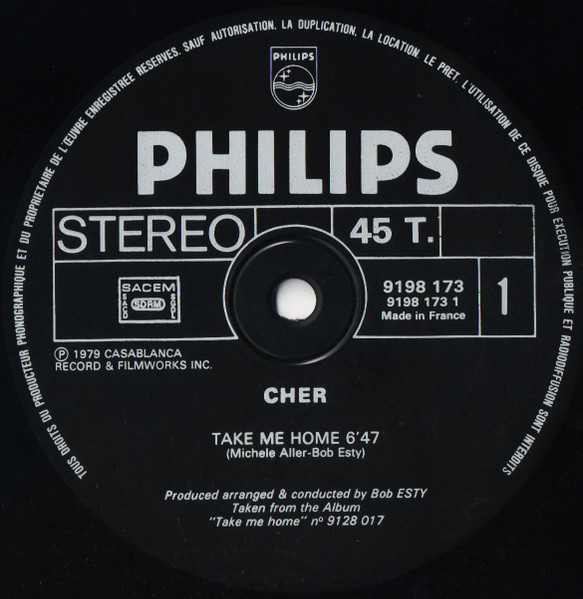
CHER - TAKE ME HOME


Released: January 1979

Charted:  US: #8 


"Take Me Home" is a disco song recorded by Cher for her fifteenth studio album, also titled "Take Me Home," released in 1979. Following commercial setbacks with her previous albums, Cher was advised to explore the disco genre. It was released as the lead single from the album in January 1979 by Casablanca Records, primarily on a 12-inch single format. The song was written by Michele Aller and Bob Esty, with Esty also serving as the producer. Michele Aller and Bob Esty collaborated on several songs for Cher during that era, including "Wasn't It Good" and "Hell On Wheels." The album gained attention for its cover art, featuring Cher in a striking and daring outfit that reflected her status as a fashion icon. The cover portrays Cher in a skimpy and provocative outfit, evoking the image of a warrior princess. 


After experiencing a string of commercial failures with her previous albums Cher sought to revive her music career. She visited Casablanca Records' headquarters with intentions to record rock and roll-tinged music, but Neil Bogart, the head of Casablanca Records, advised her to delve into disco music instead, suggesting that rock was not her forte. Initially reluctant due to her view of disco as superficial and not serious music, Cher eventually took Bogart's advice. Esty himself was skeptical at first but changed his mind after starting to work with Cher. He played her a demo of "Take Me Home," which she surprisingly liked. 


"Take Me Home" centers around the theme of a woman expressing her desire to be taken home by her lover, which is often interpreted as a metaphor for sexual intimacy. The lyrics are straightforward and direct, with Cher conveying her openness to a one-night affair: "Just a one-night affairWould be so fine". Unlike some disco songs that use euphemisms or innuendos to convey similar themes, Cher's lyrics are more explicit in expressing her desire. The song embraces the disco era's tendency to explore themes of nightlife, desire and liberation.


Cher's video showcases her charismatic stage presence and ability to captivate audiences through her visual performance, which was a hallmark of her career, particularly from her variety show days like The Sonny & Cher Comedy Hour. In the video, Cher exudes confidence as she dances and performs in an elegant yet revealing dress, surrounded by a parade of well-dressed suitors. 


In 2001, British singer Sophie Ellis-Bextor covered "Take Me Home," giving it a fresh interpretation that resonated with contemporary audiences. Sophie Ellis-Bextor's version achieved significant success, reaching number 2 on the UK Singles Chart. 


DIRE STRAITS - BROTHERS IN ARMS


Estrena: 18 d'octubre de 1985

Llistes: Regne Unit: #16


"Brothers in Arms" és la darrera cançó del cinquè àlbum d'estudi de Dire Straits, publicat al maig de 1985 sota el mateix títol. Mark Knopfler va trobar la inspiració durant la guerra de les Malvines que es desenvolupava en el moment de la seva composició. El títol prové d'una declaració feta pel pare de Mark Knopfler durant les discussions sobre aquesta guerra.


La guerra de les Malvines, que va tenir lloc el 1982, va ser un conflicte militar entre Argentina i el Regne Unit sobre la sobirania de les Falkland Islands i Geòrgia del Sud i les Illes Sandwich del Sud, situades a l'oceà Atlàntic Sud. Les illes han estat sota administració britànica des de la dècada de 1830, però Argentina les reclama i les anomena les Malvines.


La guerra va començar quan les forces argentines van envair i ocupar les illes Malvines i Geòrgia del Sud el 2 d'abril de 1982. En resposta, el govern britànic va enviar una força naval per recuperar els territoris. El conflicte que en va resultar va durar unes deu setmanes i va causar la mort de 649 militars argentins, 255 militars britànics i tres habitants de les Malvines.


El 14 de juny de 1982, les forces argentines es van rendir, i les illes van ser retornades al control britànic. La guerra va tenir ramificacions polítiques significatives en ambdós països i va portar a canvis en les polítiques militars i diplomàtiques. Encara és un tema sensible en les relacions entre Argentina i el Regne Unit, amb Argentina continuant reclamant la sobirania sobre les illes.


"Brothers in Arms" reflecteix la commovedora representació de Mark Knopfler d'un soldat moribund en el camp de batalla durant la guerra. La cançó captura l'atmosfera sobria dels soldats que acompanyen el seu company mentre passa, destacant el sense sentit i la tragèdia de la guerra. La lletra de Knopfler subratlla un missatge d'unitat enmig de les divisions globals, lamentant la futilitat del conflicte i defensant la pau. El pare de Knopfler va utilitzar la frase "brothers in arms" per descriure els britànics i els argentins involucrats en el conflicte, destacant que, malgrat estar en bandes oposades, compartien ideologies i valors com a soldats. La cançó ha estat reconeguda per molts com un himne antibèl·lic per la seva poderosa representació del patiment humà i l'impacte perturbador de la guerra.


El vídeo musical, dirigit i animat per Bill Mather, va utilitzar tècniques de rotoscopia i va ser produït per Simon Fields a través de Limelight Films. La cinematografia va ser gestionada per Francis Kenny. A diferència del modern estil contemporani de "Money for Nothing", aquest vídeo va adoptar una aparença clàssica amb imatges en blanc i negre. Combinava seqüències de la banda actuant amb escenes que representaven la Primera Guerra Mundial. El vídeo va guanyar el Premi Grammy al Millor Vídeo Musical a la 29a edició dels Premis Grammy el 24 de febrer de 1987.


DIRE STRAITS - BROTHERS IN ARMS


Released: October 18, 1985

Charted:  UK: #16 


"Brothers in Arms" is the concluding track on Dire Straits' fifth studio album, released in May 1985 under the same title. Mark Knopfler drew inspiration for the song from the ongoing Falklands War at the time of its composition. The title originates from a statement made by Mark Knopfler's father during discussions about this war. 


The Falklands War, which occurred in 1982, was a military conflict between Argentina and the United Kingdom over the sovereignty of the Falkland Islands and South Georgia and the South Sandwich Islands, which are located in the South Atlantic Ocean. The islands have been under British administration since the 1830s, but Argentina claims them and calls them the Malvinas. 


The war began when Argentine forces invaded and occupied the Falkland Islands and South Georgia on April 2, 1982. In response, the British government dispatched a naval task force to reclaim the territories. The ensuing conflict lasted for about ten weeks and resulted in the deaths of 649 Argentine military personnel, 255 British military personnel, and three Falkland Islanders. 


On June 14, 1982, Argentine forces surrendered, and the islands were returned to British control. The war had significant political ramifications in both countries and led to changes in military and diplomatic policies. It remains a sensitive issue in Argentina-UK relations, with Argentina continuing to claim sovereignty over the islands.


"Brothers in Arms" reflects Mark Knopfler's poignant portrayal of a dying soldier on the battlefield during the war. The song captures the somber atmosphere of soldiers standing by their comrade as he passes away, highlighting the senselessness and tragedy of war. Knopfler's lyrics underscore a message of unity amidst global divisions, lamenting the futility of conflict and advocating for peace. Knopfler's father used the phrase "brothers in arms" to describe the Britons and Argentines involved in the conflict, emphasizing that despite being on opposite sides, they shared common ideologies and values as soldiers. The song has been recognized by many as an anti-war anthem for its powerful portrayal of human suffering and the enduring impact of war.


The music video directed and animated by Bill Mather, employed rotoscoping techniques and was produced by Simon Fields through Limelight Films. Cinematography was handled by Francis Kenny. Unlike the contemporarily modern style of "Money for Nothing," this video adopted a classic appearance with noisy black-and-white imagery. It combine footage of the band performing with scenes depicting the First World War. The video went on to win the Grammy Award for Best Music Video at the 29th Annual Grammy Awards on February 24, 1987. 


5.8.24


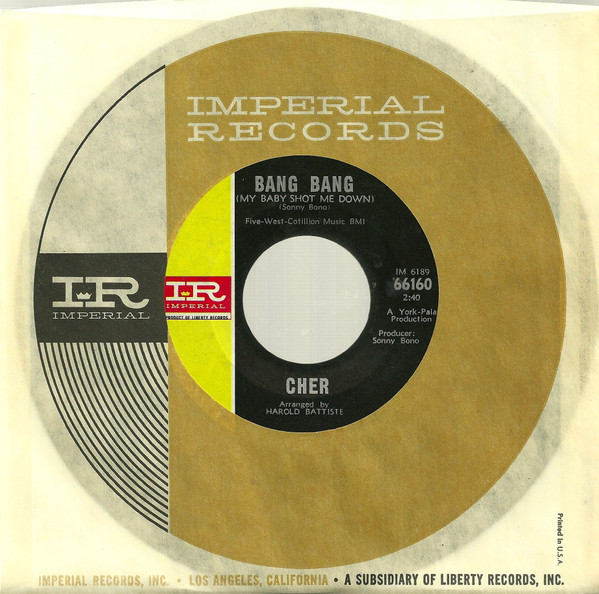
CHER - BANG BANG (MY BABY SHOT ME DOWN)


Released: February 25, 1966

Charted:  UK: #3    US: #2 


"Bang Bang (My Baby Shot Me Down)" is a ballad by Cher, written by her husband Sonny Bono and released in 1966 as the second single from her album "The Sonny Side of Cher." The song achieved significant chart success, reaching No. 3 on the UK Singles Chart and No. 2 on the Billboard Hot 100. It remained a standout hit of Cher's career during the 1960s. 


In "Bang Bang (My Baby Shot Me Down)," Cher narrates a story where she reminisces about childhood games with a boy who would pretend to shoot her with his toy gun. As they grow older, they enter into a romantic relationship and eventually get married. The relationship turns sour as he leaves her, leaving Cher heartbroken and devastated. The song explores themes of love, loss, and the emotional impact of betrayal.


In 1987, Cher recorded a rock version for her self-titled comeback album, which was certified Platinum. Produced by Jon Bon Jovi, Richie Sambora, and Desmond Child, this rendition featured backing vocals by Jon Bon Jovi, Michael Bolton, and others. Although it was released as a promotional single in 1988, it became a prominent part of Cher's live performances on various tours, including the Heart of Stone Tour, Living Proof: The Farewell Tour, and instrumentally on subsequent tours like the Dressed to Kill Tour (2014), Classic Cher (2017-2020), and the Here We Go Again Tour (2018-2020).


Nancy Sinatra's cover gained significant attention when it was used in the opening scenes of Quentin Tarantino's 2003 film "Kill Bill Volume 1." Tarantino had long admired the song and felt it perfectly suited the film's atmosphere. Sinatra's rendition, with its haunting guitar by Billy Strange, resonated with audiences and sparked a renewed interest in her music career. Many viewers were surprised to discover Sinatra's involvement in the song's original recording when they saw her name in the film credits. In 2005, the UK production duo Audio Bullys sampled Nancy Sinatra's version for a dance track, which became a hit reaching number 9 on the UK charts. 


David Guetta released a version of "Bang Bang (My Baby Shot Me Down)" in 2014 titled "Shot Me Down". Featuring Skylar Grey on vocals, the song alternates between Nancy Sinatra's original musical arrangement in the verses and energetic EDM instrumental breaks. In 2017, Dua Lipa covered the song. Additionally, Lady Gaga performed a live cover as a bonus track on her jazz album with Tony Bennett, “Cheek to Cheek”. Gaga personalized the lyrics during a Reddit AMA, changing them to reflect her own experiences, specifically referencing an ex-lover who married someone else, with no wedding bells ringing for her.