Total de visualitzacions de pàgina:

10.8.24


CHER - GYPSYS, TRAMPS & THIEVES


Estrenada: 1 de setembre de 1971

Llistes: Regne Unit: #4   EUA: #1 (2 setmanes)


"Gypsys, Tramps & Thieves" va ser llançada com a primer senzill del seu àlbum de 1971 inicialment titulat Chér (posteriorment reeditat com Gypsys, Tramps & Thieves). Produïda per Snuff Garrett i escrita per Bob Stone, la cançó va marcar un punt d'inflexió en la carrera de Cher. Després d'intents infructuosos per part de Sonny Bono de revifar la seva carrera discogràfica, Garrett va ser contractat per produir i Stone va ser encarregat d'escriure una cançó destinada a captivar un públic adult específicament per Cher.


La cançó narra la història d'una noia que creix en un espectacle itinerant ("nascuda en la caravana d'un espectacle itinerant"), on la seva mare treballa com a ballarina i el seu pare fa diversos treballs esporàdics per guanyar-se la vida. Als 16 anys, la noia s'enamora d'un home de 21 anys al sud de Mobile, Alabama. Tres mesos més tard, es queda embarassada ("en problemes"), i l'home desapareix. Seguint els passos de la seva mare, continua ballant a l'espectacle, acabant per donar a llum a la seva pròpia filla a la mateixa caravana on ella va néixer.


Snuff Garrett, el productor de Cher, era conegut per la seva aproximació pragmàtica a l'estudi. Va buscar una cançó que complementés la veu i la imatge de Cher, acabant per triar la composició de Bob Stone. Inicialment titulada "Gypsies and White Trash", el títol es va modificar per ser menys controversial. Garrett va contractar membres del conegut col·lectiu de músics d'estudi de Los Angeles.


"Gypsys, Tramps & Thieves" va marcar el retorn triomfal de Cher al capdamunt de les llistes, convertint-se en el seu primer número 1 en solitari després d'un important declivi en la seva carrera des de 1967. Després d'una sèrie de contratemps, incloent-hi una pel·lícula fallida i un àlbum sense èxit, Cher i Sonny van revifar la seva carrera cantant en clubs nocturns el 1969, fet que va perfeccionar les habilitats vocals de Cher. El 1971, van aconseguir un contracte per al seu propi espectacle de varietats, The Sonny & Cher Comedy Hour, que va debutar amb alts índexs d'audiència a l'agost. Poc després de la seva estrena, Cher va llançar "Gypsys, Tramps & Thieves" el setembre, que ràpidament va arribar al número 1 a la llista Billboard Hot 100 a principis de novembre. L'espectacle va tenir èxit fins al 1974, i Cher va continuar tenint èxits durant la dècada de 1970. La seva carrera va experimentar un altre descens fins al seu nou ressorgiment a finals dels anys vuitanta.


El videoclip va ser el debut de Cher en els vídeos musicals. Inicialment enregistrat com una actuació a The Sonny & Cher Comedy Hour el 1971, mostrava Cher cantant davant d'una caravana i prop d'un foc. Un segon vídeo, que s’assemblava estretament a l'original, afegia clips de gitanes ballant. Un vídeo promocional emès a Top of the Pops de la BBC la mostrava viatjant pel camp, en consonància amb la lletra de la cançó que descriu la vida en un espectacle itinerant.


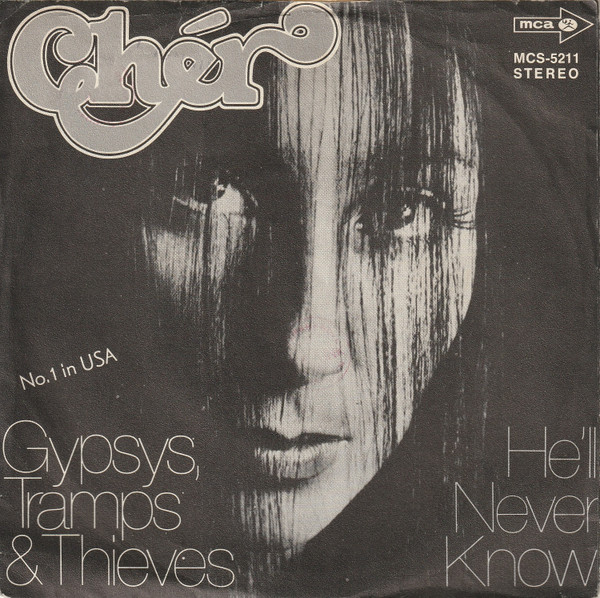
CHER - GYPSYS, TRAMPS & THIEVES


Released: September 1, 1971

Charted:  UK: #4 US: #1 (2 weeks)


"Gypsys, Tramps & Thieves" was released as the lead single from her 1971 album initially titled Chér (later reissued as Gypsys, Tramps & Thieves). Produced by Snuff Garrett and written by Bob Stone, the song marked a turning point in Cher's career. After earlier unsuccessful attempts by Sonny Bono to revive her recording career, Garrett was brought in to produce and Stone was commissioned to write a song aimed at appealing to an adult audience specifically for Cher.


The song tells the story of a girl who grows up in a traveling show ("born in the wagon of a traveling show"), where her mother works as a dancer and her father does various odd jobs to make a living. At the age of 16, the girl becomes romantically involved with a 21-year-old man south of Mobile, Alabama. Three months later, she finds herself pregnant ("in trouble"), but the man disappears. Following in her mother's footsteps, she continues to dance in the show, eventually giving birth to her own daughter in the same wagon where she was born.


Snuff Garrett, Cher's producer was known for his pragmatic approach in the studio. He sought a song that would complement Cher's distinctive voice and image, eventually settling on Bob Stone's composition. Originally titled "Gypsies and White Trash," the title was modified to be less controversial. Garrett enlisted members of the famed Los Angeles studio musician collective. In Garrett's own words from the documentary "The Wrecking Crew," his focus was straightforward: producing hits to generate revenue and secure future work. He emphasized his reliance on gut instinct to identify potential hits, driven by the mantra that success in the charts validated his efforts in the studio.


"Gypsys, Tramps & Thieves" marked Cher's triumphant return to the top of the charts, becoming her first solo #1 hit after a significant career lull since 1967. Following a series of setbacks, including a failed movie and unsuccessful album, Cher and Sonny revived their nightclub act in 1969, which honed Cher's vocal abilities. In 1971, they secured a deal for their own variety show, The Sonny & Cher Comedy Hour, which debuted to high ratings in August. Shortly after its premiere, Cher released "Gypsys, Tramps & Thieves" in September, which quickly climbed to the #1 spot on the Billboard Hot 100 by early November. The show ran successfully until 1974, and Cher continued to chart six more times during the 1970s. Her career then experienced another downturn until her remarkable resurgence in the late 1980s.


The music video marked Cher's debut in music videos. Initially recorded as a performance on The Sonny & Cher Comedy Hour in 1971, it featured Cher singing in front of a house wagon and by a fire. A second video closely resembling the original added clips of dancing female gypsies. A promotional video aired on BBC's Top of the Pops showcased Roma traveling through the countryside, aligning with the song's lyrics depicting life in a traveling show.



8.8.24


CHER - JUST LIKE JESSE JAMES / HEART OF STONE


JUST LIKE JESSE JAMES

Released: October 1989

Charted:  UK: #11   US: #8 


"Just Like Jesse James" is a track from Cher's nineteenth album, "Heart of Stone," released in 1989. Written by Desmond Child and Diane Warren and produced by Child, the song was released as the third single in North America and the second in Europe in October 1989 by Geffen Records. It became a top-ten hit in December 1989.


"Just Like Jesse James" draws its title from the legendary Wild West figure Jesse James. The phrase was previously featured in Linda Ronstadt's hit "Poor Poor Pitiful Me." Jesse James, the real historical figure, was infamously shot in the back of the head on April 3, 1882, by Robert Ford. Ford and his brother were arrested, indicted, pleaded guilty, sentenced to hang, and then pardoned all on the same day. Given James' outlaw status, these legal proceedings were considered lawful and legitimate at the time.


HEART OF STONE

Released: January 23, 1990

Charted:  UK: #43   US: #20 


"Heart of Stone" was released as the fourth single from Cher's 19th studio album of the same name in 1989. The music video features Cher in a dark room with old clips of herself projected onto screens in the background, shot in early 1990. The song achieved success by entering the top 20 on the Billboard Hot 100 chart in the United States, while narrowly missing the top 40 in the UK. This accomplishment made Cher the first female artist to have a Billboard Hot 100 hit in four decades or more.


Bill Coleman from Billboard praised "Heart of Stone" as his favorite track from Cher's platinum album, predicting its success following the top 10 achievements of its predecessors. Mark Millan from The Daily Vault regarded "Heart of Stone" as one of Cher's best moments, noting its soulful pop quality despite some lyrical ambiguity mixing social commentary and autobiography. Terry Staunton from NME highlighted Cher's successful dual career in acting and singing as demonstrated by the song.


CHER - IF I COULD TURN BACK TIME


Publicació: 20 de juny de 1989

Llistes: Regne Unit: #6   EUA: #3


"If I Could Turn Back Time" (Si Pogués Tornar Enrere el Temps) és una cançó de l'àlbum "Heart of Stone". Publicada com a primer senzill al juny de 1989, va ser escrita per Diane Warren i produïda per Warren i Guy Roche. Inicialment poc impressionada per la demo de Warren, Cher va gravar la cançó per insistència de Roche. Aquesta cançó és un himne poderós on Cher demana perdó a un antic amor, expressant el desig d'una segona oportunitat. La cançó ha esdevingut un dels grans èxits de Cher i continua sent una favorita en les seves actuacions en directe.


Diane Warren va revelar a The Hollywood Reporter que a Cher inicialment no li agradava i es resistia a gravar-la. Warren fins i tot va fer una broma sobre sostenir la cama de Cher durant una sessió d'enregistrament per convèncer-la. La resposta inicial de Cher va ser una desafiadora i divertida exclamació: "F- you, bitch! M'estàs fent mal a la cama! D'acord, ho provaré." No obstant això, després de gravar-la Cher va reconèixer la persuasió de Warren amb una mirada que indicava que estava convencuda i que la lletrista tenia raó sobre el potencial de la cançó.


La carrera de Cher ha estat marcada per diversos retorns musicals. La seva segona ressorgida va començar el 1987 quan va signar amb Geffen Records i va llançar el seu àlbum autotitulat, que incloïa l'èxit "I Found Someone." Aquest període va coincidir amb els seus èxits en el cinema amb "The Witches of Eastwick," "Moonstruck" i "Suspect." Després d'això, "If I Could Turn Back Time" va ser l’èxit més significatiu del seu següent àlbum "Heart of Stone," que va aconseguir l’estatus multi-platí. Malgrat un descens de popularitat amb els seus àlbums següents, el tercer gran retorn de Cher va ser el 1998 amb el llançament de "Believe," que contenia el single pioner amb Auto-Tune que va liderar les llistes mundials.


El vídeo musical es va gravar a bord del cuirassat USS Missouri al Long Beach Naval Shipyard. Dirigit per Marty Callner, va incloure autèntics mariners de la Marina com a figurants, afegint autenticitat a les escenes. Cher va explicar que inicialment el vídeo tenia la intenció d'incloure una narrativa amb diversos escenaris, però finalment, l'enfocament es va centrar en la icònica posada en escena de Cher actuant entre els mariners al cuirassat. Tot i no ser especialment provocador pels estàndards de MTV en aquell moment, el vídeo va generar polèmica per la seva associació amb la Marina. Alguns espectadors van trobar inapropiada o degradant la presència de Cher en aquest vaixell històric. Com a resultat, MTV va emetre inicialment el vídeo però després el va restringir a la franja nocturna, retransmetent-lo només després de les 9 del vespre.


CHER - IF I COULD TURN BACK TIME


Released: June 20, 1989

Charted:  UK: #6  US: #3 


"If I Could Turn Back Time" is a song from the 1989 album "Heart of Stone". Released as the lead single in June 1989, it was written by Diane Warren and produced by Warren and Guy Roche. Initially unimpressed by Warren's demo, Cher recorded the song at Roche's insistence. This song it's a powerful anthem where Cher apologizes to a former lover, expressing a desire for a second chance. The song has become one of Cher's biggest hits and remains a favorite in her live performances.


Diane Warren revealed to The Hollywood Reporter that Cher initially disliked "If I Could Turn Back Time" and resisted recording it. Warren even jokingly mentioned holding Cher's leg down during a recording session to convince her. Cher's initial response was humorous defiance, exclaiming, "F- you, bitch! You're hurting my leg! OK, I'll try it." However, after recording the song, Cher acknowledged Warren's persuasion with a look that conveyed she had been convinced and that Warren was right about the song's potential.


Cher's career has been marked by several distinct musical comebacks. Her second resurgence began in 1987 when she signed with Geffen Records and released her self-titled album, which included the hit "I Found Someone." This period coincided with her successful film roles in "The Witches of Eastwick," "Moonstruck," and "Suspect." Following this, "If I Could Turn Back Time" became a hit from her subsequent album "Heart of Stone," which achieved multi-Platinum status. Despite a decline with her next albums, Cher's third major comeback occurred in 1998 with the release of "Believe," featuring the pioneering Auto-Tuned hit single that topped charts worldwide.


The music video was filmed aboard the battleship USS Missouri at the Long Beach Naval Shipyard. Directed by Marty Callner, it featured actual Navy sailors as extras, adding authenticity to the scenes. Cher recounted that the video was originally intended to have a narrative with various settings, but ultimately, the focus shifted to the iconic shot of her performing among the sailors on the battleship. Despite not being overly provocative by MTV standards at the time, the video sparked controversy due to its association with the Navy. Some viewers found Cher's presence on the historic ship inappropriate or degrading. As a result, MTV initially aired the video but later restricted it to night-time slots, airing it only after 9 p.m.


DIRE STRAITS - PRIVATE INVESTIGATIONS


Estrena: 27 d'agost de 1982

Llistes: Regne Unit: #2


"Private Investigations," inclosa a l'àlbum "Love over Gold," va assolir un èxit notable a les llistes del Regne Unit, arribant al número 2 malgrat la seva llarga durada. La cançó destaca per la seva llarga introducció acústica i el fet de presentar la lletra de manera parlada i en un to xiuxiuejat en lloc de ser cantada de manera tradicional.


Mark Knopfler va explicar que "Private Investigations" es va inspirar en Philip Marlowe, l’icònic detectiu privat creat per Raymond Chandler. Va comparar la cançó amb una experiència cinematogràfica, reflectint el gènere del film noir que va sorgir a Amèrica després de la Segona Guerra Mundial. El film noir es caracteritzava per la representació fosca i crua de la vida urbana i l'ambigüitat moral, sovint representada en blanc i negre amb un enfocament inspirat en el submón de la societat.


"Private Investigations" comença amb una orquestració de sintetitzador de baix to. Aquesta introducció porta a una progressió lenta de piano acompanyada d'una guitarra clàssica. La cançó inclou diversos versos parlats, creant una atmosfera narrativa. En l'edició del senzill, la cançó comença directament amb guitarra acústica, saltant-se la introducció del sintetitzador. Després dels versos, la cançó fa la transició a un ritme lent impulsat pel baix, complementat per acords forts de guitarra elèctrica cap al final. La cançó conclou amb un diminuendo gradual, destacat per una interacció llarga entre la guitarra acústica de Mark Knopfler i les marimbes tocades per Mike Mainieri.


"Private Investigations" ha estat present en diversos àlbums de recopilació al llarg dels anys. Apareix a "Money for Nothing" i "Sultans of Swing: The Very Best of Dire Straits," dues recopil·lacions destacades que mostren els grans èxits de la banda. A més, la cançó és el títol de l'àlbum recopilatori de 2005 "Private Investigations: The Best of Dire Straits & Mark Knopfler," que destaca els millors temes tant de Dire Straits com de la carrera en solitari de Mark Knopfler.


DIRE STRAITS - PRIVATE INVESTIGATIONS


Released: August 27, 1982

Charted:  UK: #2   


"Private Investigations" featured on their album Love over Gold, achieved significant chart success in the United Kingdom, reaching number 2 despite its lengthy duration. The song is notable for its extended acoustic introduction and spoken, whispered delivery of the lyrics instead of traditional singing.


Mark Knopfler explained that "Private Investigations" was inspired by Philip Marlowe, the iconic private detective created by Raymond Chandler. He likened the song to a deliberate cinematic experience, reflecting the film noir genre that emerged in post-World War II America. Film noir was characterized by its dark, gritty portrayal of urban life and moral ambiguity, often depicted in black and white with a focus on the underbelly of society. 


"Private Investigations" starts with a deep-pitched synthesizer orchestration. This opening leads into a slow piano progression accompanied by a classical guitar. The song features several spoken verses, creating a narrative atmosphere. In the single edit, the song begins directly with acoustic guitar, skipping the synthesizer intro. After the verses, the song transitions into a slow, bass-driven beat, complemented by strident electric guitar chords towards the end. The song concludes with a gradual diminuendo, highlighted by extended interplay between Mark Knopfler's acoustic guitar and marimba played by Mike Mainieri. 


"Private Investigations" has been prominently featured on several compilation albums over the years. It appears on "Money for Nothing" and "Sultans of Swing: The Very Best of Dire Straits," two notable collections that showcase the band's greatest hits. Additionally, the song serves as the title track on the 2005 compilation album "Private Investigations: The Best of Dire Straits & Mark Knopfler," which highlights the best tracks from both Dire Straits and Mark Knopfler's solo career.