Total de visualitzacions de pàgina:

11.9.24


U2 - MYSTERIOUS WAYS 

Estrena: 2 de desembre de 1991

Llistes: EUA: #9  Regne Unit: #13


"Mysterious Ways" és la vuitena pista de l'àlbum “Achtung Baby” i es va publicar com el segon senzill el desembre de 1991. Inicialment concebut durant una improvisació anomenada "Sick Puppy", el tema va atraure l'atenció del baixista Adam Clayton, que va crear una línia de baix central per a la cançó. Va aconseguir un gran èxit, arribant al top 10 en diversos països, incloent-hi Canadà i Irlanda, on va liderar les llistes. Als Estats Units, va arribar al número nou de la llista Billboard Hot 100.


"Mysterious Ways" representa U2 en el seu moment més exòtic i espiritual, combinant elements de romanç amb un ritme funky que convida a ballar. U2 va sorprendre amb la seva capacitat de crear música ballable, una desviació dels estils previs de la banda. Bono la va descriure com el moment "més funky" d’U2 i va destacar la seva atractiva qualitat com a "música sexy".


Aquesta cançó explora temes de romanç, espiritualitat i l'atractiu de les dones a través de l'encontre de Johnny amb una presència femenina misteriosa. Segons Bono, "Mysterious Ways" explora la dinàmica entre homes i dones, abordant-la des de la perspectiva de Johnny. Bono també fa referència a termes teològics com El Shaddai, que significa "el que té pits", subratllant la seva creença en l'aspecte femení de l'espiritualitat. La cançó és una celebració de les dones en general, reconeixent la seva influència captivadora i a vegades dominant sobre els homes. Bono aclara que, encara que la cançó pugui idealitzar les dones i retractar-les amb un contrast dramàtic, no pretén ser anti-femenina, sinó explorar les complexitats des d'una perspectiva masculina, incorporant moments d'enuig i dolor sense presentar les dones de manera negativa.


El vídeo musical dirigit per Stephane Sednaoui es va filmar al Marroc i presenta a una ballarina fent el ball del ventre encarnant la figura femenina misteriosa esmentada a la cançó. Aquest motiu visual es va integrar posteriorment en les actuacions de la gira Zoo TV de U2, on una ballarina de ventre apareixia a l'escenari durant la interpretació de la cançó. Inicialment, Morleigh Steinberg, que havia fet la coreografia per a la banda, va assumir aquest paper. Curiosament, Steinberg va acabar entrant en una relació amb The Edge durant un període tumultuós quan el seu matrimoni es va trencar durant l'enregistrament de l'àlbum “Achtung Baby”.


U2 - MYSTERIOUS WAYS 


Released: December 2, 1991

Charted:  US: #9  UK: #13 


"Mysterious Ways" is the eighth track from the album, “Achtung Baby”, and was released as its second single on December 1991. Initially conceived during an improvisation called "Sick Puppy," the band was drawn to bassist Adam Clayton's bassline, which became central to the song. It achieved significant success, reaching the top ten in multiple countries, including Canada and Ireland where it topped the charts. In the United States peaked at number nine on the Billboard Hot 100.


"Mysterious Ways" represents U2 at their most exotic and spiritually evocative, blending elements of romance with a funky beat that invites dancing. The song defied expectations by showcasing U2's ability to create danceable music, a departure from their previous styles. Bono described it as U2 at their "funkiest" and noted its appeal as "sexy music."


This tune explores themes of romance, spirituality, and the allure of women through the character Johnny's encounter with a mysterious feminine presence. According to Bono, the song delves into the dynamics between men and women, addressing them from Johnny's perspective. Bono also touches on theological references, including El Shaddai, a biblical term meaning "the breasted one," which underscores his belief in the feminine aspect of spirituality. The song celebrates women in general, acknowledging their captivating and sometimes dominant influence over men. Bono clarifies that while the song may idealize women and portray them with dramatic contrast, it is not meant to be anti-women but rather explores complexities from a male perspective, incorporating moments of anger and hurt without casting women negatively.


The music video directed by Stephane Sednaoui, was filmed in Morocco and prominently features a belly dancer embodying the mysterious feminine figure referenced in the song. This visual motif was later integrated into U2's Zoo TV tour performances, where a belly dancer appeared on stage during their rendition of the song. Initially, Morleigh Steinberg, who had done choreography for the band, took on the role. Interestingly, Steinberg eventually entered a relationship with The Edge, U2's guitarist, during a tumultuous period when his marriage was breaking down amid the recording of the “Achtung Baby” album.



10.9.24


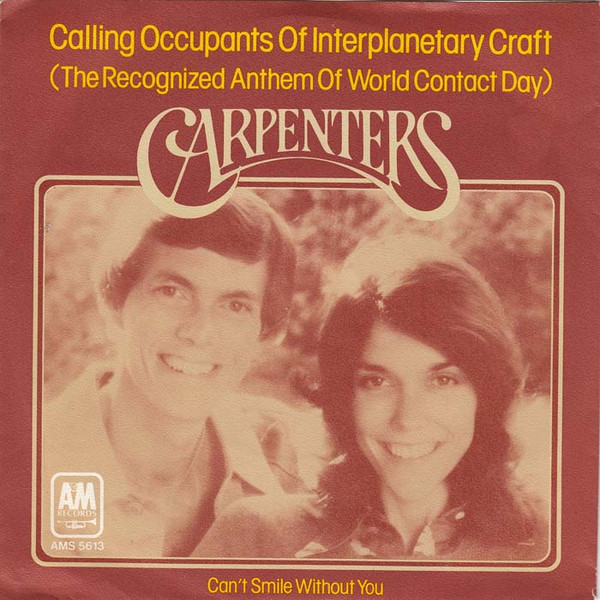
CARPENTERS - CALLING OCCUPANTS OF INTERPLANETARY CRAFT


Released: September 20, 1977

Charts:  UK: #9   US: #32 


"Calling Occupants of Interplanetary Craft" was originally released by Canadian rock band Klaatu in 1976. The story behind the track is filled with intrigue and mystery. When Canadian band Klaatu released the track in 1976 on their album “3:47 EST”, rumors began swirling that the group was actually The Beatles recording in disguise. The song’s somewhat Beatlesque sound, combined with the fact that no personal information about the band members was provided, fueled speculation of a secret Beatles reunion. The album was released by Capitol Records, which had previously distributed Beatles albums in the US. Capitol Records amplified the band's mystique by stoking rumors that Klaatu might secretly be the Fab Four. These rumors were never confirmed or denied, fueling intrigue. 


Carpenters were captivated by the song’s unique futuristic theme, and decided to cover the song employing a crew of 160 musicians for their rendition. Remember we are in 1977, the year of “Star Wars” fever and “Close Encounters”. Their version of "Calling Occupants of Interplanetary Craft" became a hit, reaching #9 in the UK and topping the charts in Ireland, marking the Carpenters' last top 10 UK hit.


The origins of "Calling Occupants of Interplanetary Craft" trace back to 1953, when the International Flying Saucer Bureau initiated "World Contact Day," encouraging its members to send a collective telepathic message to extraterrestrials. This message famously began with the phrase “Calling occupants of interplanetary craft.” Fast forward to 1967, when Jay David’s “The Flying Saucer Reader” influenced John Woloschuk, a founding member of the Canadian band Klaatu. 


Formed in 1973, Klaatu, named after the alien in the 1951 sci-fi film “The Day the Earth Stood Still”, embraced sci-fi themes in their music. Woloschuk and Dee Long crafted the song "Calling Occupants of Interplanetary Craft," which was co-written with drummer Terry Draper. Klaatu’s self-titled debut album with its cryptic lack of musician credits, helped the single chart modestly, reaching #62 on the Billboard Hot 100. Carpenters cover brings greater commercial success to the song peaking at #32. The cover art featured on the US single was painted by Star Trek designer, Andrew Probert.


Klaatu's original version opens with sounds from various living species, while the Carpenters' rendition begins with a radio DJ on a request show. The DJ, voiced by their guitarist Tony Peluso, asks a caller named "Mike Ledgerwood" for his song request, only to be answered by an alien-sounding voice. Peluso can be seen performing this DJ role in the track's music video.


Carpenters' version was released on their ”Passage” album, and appeared also on multiple greatest hits compilations. Their version featured the tagline "(The Recognized Anthem Of World Contact Day)" under the title, leading to a surge of letters from fans inquiring about the next World Contact Day. The popularity of the song even inspired a successful Carpenters TV special titled “The Carpenters...Space Encounters”.  


SONNY & CHER - I GOT YOU BABE


Estrena: 9 de juliol de 1965

Llistes: Regne Unit: #1 (2 setmanes) EUA: #1 (3 setmanes)


"I Got You Babe" és una cançó clàssica interpretada pel duo nord-americà Sonny & Cher, escrita per Sonny Bono. Llançada com a primer senzill del seu àlbum debut "Look at Us" el 1965, va assolir un gran èxit, encapçalant la llista Billboard Hot 100 als Estats Units durant tres setmanes. La cançó també va arribar al número u al Regne Unit i Canadà, venent més d'un milió de còpies als Estats Units i guanyant la certificació d'Or. La seva popularitat ha perdurat al llarg dels anys, convertint-la en una icònica cançó d'amor dels anys 1960.


Sonny Bono, inicialment un jove productor discogràfic, va aconseguir a Cher un treball com a cantant de sessió amb Phil Spector. La seva relació romàntica es va desenvolupar durant aquest temps, i eventualment es van traslladar a la casa del seu manager. Va ser aquí on Sonny va compondre "I Got You Babe", escrivint la lletra en un tros de cartró. Cher inicialment no va quedar molt entusiasmada amb la cançó i recorda que Sonny la va despertar enmig de la nit per cantar-la. A contracor, va acceptar interpretar-la una vegada, i Sonny va ajustar la clau al pont per millorar-la. Després d'aquesta adaptació, Cher va acabar adorant la cançó.


Ahmet Ertegun, el cap d'Atco Records, inicialment no tenia grans expectatives per "I Got You Babe" i tenia previst llançar-la com a cara B de "It's Gonna Rain". Sonny Bono creia fermament en el seu potencial com a èxit, però va haver d’anfrontar-se a l'escepticisme d'Ertegun. Durant aquesta època, els locutors de ràdio tenien un poder significatiu sobre les decisions de difusió, sovint sobrepassant les eleccions dels executius discogràfics.


Per demostrar el seu punt de vista, Bono va prendre la decisió de portar una còpia de "I Got You Babe" a KHJ, una important emissora de ràdio a Los Angeles. Allà, va fer un acord amb el director del programa, Ron Jacobs: a canvi de ser retransmesa cada hora, Jacobs podia tenir la cançó en exclusiva. Quan KHJ va començar a emetre-la i va rebre una resposta positiva dels oients, Ertegun va reconsiderar el seu punt de vista i finalment va decidir llançar-la com a cara A. Aquest moviment va ser decisiu, ja que la cançó es va convertir en un èxit massiu per a Sonny & Cher, arribant al número u a les llistes de diversos països. 


El 1985, UB40 va versionar "I Got You Babe" amb Chrissie Hynde de The Pretenders com a cantant femenina. La seva interpretació va arribar al número u a la llista de singles del Regne Unit i va assolir el número 28 a la Billboard Hot 100 dels EUA.


"I Got You Babe" va aconseguir nova difusió gràcies al seu ús a la pel·lícula de 1993 "Groundhog Day", protagonitzada per Bill Murray. A la pel·lícula, el personatge de Murray es desperta cada matí a les 6:00 a.m. amb aquesta cançó com a despertador en un escenari de bucle temporal. Aquesta associació amb "Groundhog Day" ha inclòs la cançó en la cultura popular, ja que els fans de la pel·lícula sovint la revisiten anualment el 2 de febrer, dia que comença el calvari de Murray a la pel·lícula.


El 2020, Bill Murray va repetir el seu paper de "Groundhog Day" en un anunci de La Super Bowl per al Jeep Gladiator, on la cançó sona de manera destacada. A l’anunci, Murray descobreix la joia de conduir el Jeep, cosa que canvia els seus dies repetitius en aventures emocionants.


El 1987, Sonny i Cher van fer una aparició sorpresa a "The David Letterman Show". Inicialment reticents a actuar, van acabar cedint a la insistència de l'amfitrió i van cantar "I Got You Babe" una última vegada junts. Aquesta reunió inesperada va permetre a Sonny i Cher deixar de banda les seves diferències momentàniament, oferint una interpretació sincera i memorable de la seva icònica cançó a la televisió nacional.


SONNY & CHER - I GOT YOU BABE


Released: July 9, 1965

Charted:  UK: #1 (2 weeks)  US: #1 (3 weeks)


"I Got You Babe" is a classic song performed by the American duo Sonny & Cher, written by Sonny Bono. Released as the lead single from their debut album "Look at Us" in 1965, it achieved significant success, topping the Billboard Hot 100 chart in the United States for three weeks. The song also reached number one in the United Kingdom and Canada, selling over one million copies in the US and earning a Gold certification. Its popularity has endured over the decades, making it an iconic love song of the 1960s.


Sonny Bono, initially a budding record producer, secured Cher a job as a session singer with Phil Spector. Their romantic relationship developed during this time, and they eventually moved into their manager's house. It was here that Sonny composed "I Got You Babe," crafting the lyrics on a piece of cardboard. Cher initially wasn't fond of the song and recalls being awakened by Sonny in the middle of the night to sing it. Reluctantly, she agreed to sing it once, with Sonny adjusting the key in the bridge to better suit her voice. Cher ended up loving the song after this adaptation.


Ahmet Ertegun, the head of Atco Records, initially didn't have high hopes for "I Got You Babe" and planned to release it as the B-side to "It's Gonna Rain." Sonny Bono strongly believed in the song's potential as a hit, but he faced skepticism from Ertegun. During this era, radio disc jockeys held significant power over airplay decisions, often overriding record executives' choices.


To prove his point, Bono took matters into his own hands and brought a copy of "I Got You Babe" to KHJ, a prominent radio station in Los Angeles. There, he struck a deal with the program director, Ron Jacobs: in exchange for exclusive airplay once an hour, Jacobs could have the song exclusively. When KHJ started playing it and received a positive response from listeners, Ertegun reconsidered and ultimately decided to release it as the A-side. This move proved pivotal, as the song went on to become a massive hit for Sonny & Cher, reaching number one on charts in the US, UK, and Canada.


In 1985, UB40 covered "I Got You Babe" with Chrissie Hynde from The Pretenders providing the female vocals. Their rendition of the song reached number 1 on the UK Singles Chart and peaked at number 28 on the US Billboard Hot 100. 


"I Got You Babe" gained iconic status through its use in the 1993 film Groundhog Day, starring Bill Murray. In the movie, Murray's character wakes up to the song every morning at 6:00 a.m. on his alarm clock in a comedic time loop scenario. This association with Groundhog Day has embedded the song in popular culture, as fans of the film often revisit it annually on February 2nd.


The film's enduring popularity has solidified "I Got You Babe" as a symbol of the Groundhog Day tradition. In 2020, Bill Murray reprised his Groundhog Day role in a Super Bowl commercial for the Jeep Gladiator, where the song plays prominently. In the commercial, Murray discovers the joy of driving the Jeep, which changes his repetitive days into exciting adventures.


In 1987, Sonny and Cher made a surprise appearance on "The David Letterman Show." Initially reluctant to perform, they eventually gave in to the host's insistence and sang "I Got You Babe" one last time together. This unexpected reunion allowed Sonny and Cher to set aside their differences momentarily, delivering a heartfelt and memorable performance of their iconic song on national television.


WHITNEY HOUSTON - SAVING ALL MY LOVE FOR YOU


Estrena: 13 d'agost de 1985

Llistes: EUA: #1 (1 setmana)  Regne Unit: #1 (2 setmanes)


"Saving All My Love for You" és una balada escrita per Michael Masser i Gerry Goffin. Originalment gravada per Marilyn McCoo i Billy Davis Jr. per al seu àlbum de 1978 “Marilyn & Billy”, la cançó va guanyar una gran popularitat quan Whitney Houston la va versionar per al seu àlbum debut “Whitney Houston” el 1985. Publicada el 13 d'agost de 1985 per Arista Records, es va convertir en el segon senzill de l'àlbum als Estats Units i el tercer a nivell mundial. La cançó li va valer el seu primer Premi Grammy i es va convertir en el primer dels set singles consecutius que van arribar al número 1 a la llista Hot 100.


Michael Masser va quedar captivat per la interpretació de Whitney a Sweetwater's, un club de Nova York, on va cantar una de les seves cançons, "The Greatest Love of All." La seva interpretació el va impressionar, mostrant el seu increïble talent vocal i profunditat emocional. Reconeguent el seu potencial per connectar profundament amb els oients, Masser va suggerir a Whitney una altra de les seves composicions, "Saving All My Love for You." Creia que la cançó tenia el potencial ideal per agradar poderosament a les dones.


"Saving All My Love for You" explica la història d'una dona profundament enamorada d'un home que no correspon completament als seus sentiments perquè està casat. Malgrat saber que la relació és equivocada i en contra dels consells dels seus amics, ella es manté emocionalment implicada, mantenint l'esperança que un dia ell serà completament seu.


Clive Davis, l'influencial executiu musical que va jugar un paper fonamental en la carrera de Whitney Houston, tenia una visió clara del seu atractiu transversal. Quan Michael Masser estava produint "Saving All My Love for You", Davis li va aconsellar que no fes el disc "massa negre", amb l'objectiu d'assegurar-se que agradés tant al públic negre com al blanc. Masser va tenir en compte aquest factor mantenint un arrenjament simple i centrant-se en mostrar la veu excepcional de Whitney.


El videoclip dirigit per Stuart Orme es va filmar a Londres durant la gira promocional de Whitney Houston. La mostra com una artista enregistrant un disc, atrapada en un romanç amb el seu productor casat, interpretat per Ricco Ross. Al final del vídeo, el productor torna amb la seva dona i família, deixant el personatge de Houston amb el cor trencat.


La cançó i el vídeo van provocar controvèrsia per la seva audaç representació d'una relació amb un home casat, un tema que es veia com moralment qüestionable. La mare de Whitney Houston, Cissy Houston, estava especialment preocupada per com això podria marcar la seva filla, tement que enviés un missatge equivocat al públic. Houston va revelar més tard que la narrativa de la cançó reflectia la seva pròpia experiència personal amb Jermaine Jackson, amb qui va tenir una relació difícil i finalment insatisfactòria mentre ell encara estava casat.


WHITNEY HOUSTON - SAVING ALL MY LOVE FOR YOU


Released: August 13, 1985

Charts:  US: #1 (1 week)  UK: #1 (2 weeks)


"Saving All My Love for You" is a soulful ballad written by Michael Masser and Gerry Goffin. Originally recorded by Marilyn McCoo and Billy Davis Jr. for their 1978 album “Marilyn & Billy”, the song gained massive popularity when Whitney Houston covered it for her debut studio album “Whitney Houston” in 1985. Released on August 13, 1985, by Arista Records, it became the second single from the album in the United States and the third worldwide. The song earned her first Grammy Award and became the first of seven consecutive #1 Hot 100 hits for her.


Michael Masser was captivated by Whitney's performance at Sweetwater's, a New York City club, where she sang one of his songs, "The Greatest Love of All." Her rendition left a lasting impression on him, showcasing her incredible vocal talent and emotional depth. Recognizing her potential to connect deeply with listeners, Masser suggested another one of his compositions, "Saving All My Love for You," to Whitney. He believed the song had the potential to resonate powerfully with women.


"Saving All My Love for You" tells the story of a woman deeply in love with a man who doesn't fully reciprocate her feelings because he is married. Despite knowing the affair is wrong and against the advice of her friends, she remains emotionally invested, holding out hope that he will one day be hers entirely.


Clive Davis, the influential music executive who played a pivotal role in Whitney Houston's career, had a clear vision for her crossover appeal. When Michael Masser was producing "Saving All My Love for You," Davis advised him not to make the record "too black," aiming to ensure it resonated with both black and white audiences. Masser took this direction into account by keeping the arrangement simple and focused on showcasing Whitney's exceptional voice. 


The music video directed by Stuart Orme, was filmed in London during Whitney Houston's promotional tour. It depicts Houston as a recording artist entangled in a romance with her married producer, portrayed by Ricco Ross. By the end of the video, the producer returns to his wife and family, leaving Houston's character heartbroken.


The song and video stirred controversy because of its bold portrayal of an affair with a married man, a theme that was seen as morally questionable. Whitney Houston's mother, Cissy Houston, was particularly concerned about how this might reflect on her daughter, fearing it would send the wrong message to the public. Houston later revealed that the song's narrative mirrored her own personal experience with Jermaine Jackson, with whom she had a difficult and ultimately unfulfilling relationship while he was still married.