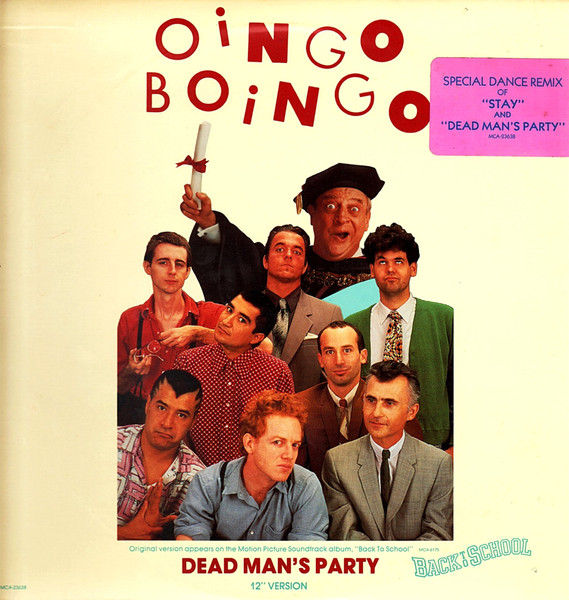
"Dead Man's Party" by Oingo Boingo was released as the third single from their album of the same name and quickly became a fan favorite. Known for its iconic dancing skeletons, the song has become one of the band's most recognized tracks, symbolizing their darkly playful aesthetic.
"Dead Man's Party" uses dark, clever lyrics to depict themes of death and a symbolic funeral. Lines like "All dressed up with nowhere to go" and "Walking with a dead man over my shoulder" set a morbid tone, evoking a journey to the afterlife. Danny Elfman references funeral customs, singing about "my best suit and my tie" and "shiny silver dollar on either eye," alluding to traditions of dressing the deceased in fine clothes and placing coins on their eyelids. The lyrics even nod to mythology with the ferryman of the River Styx.
The line about the chauffeur saying, “there’s room for maybe just one more” draws on an old campfire horror story. In that tale, a man is awakened at night by a car horn and, looking out, sees his six friends dressed in suits inside the car. The driver calls out, “There’s room for one more,” but the man chooses not to join. Later, he recounts the eerie story to a friend before tragically dying in a car accident, leading his friend to believe he foresaw his own death.
Danny Elfman of Oingo Boingo is the well-known composer for many Tim Burton movies, including The Nightmare Before Christmas (on which he is also the singing voice of Jack Skellington), Batman, the theme for the Simpsons, and many others.
THE ASSOCIATES - PARTY FEARS TWO
Released: 26 February 1982
Charts: UK: #9
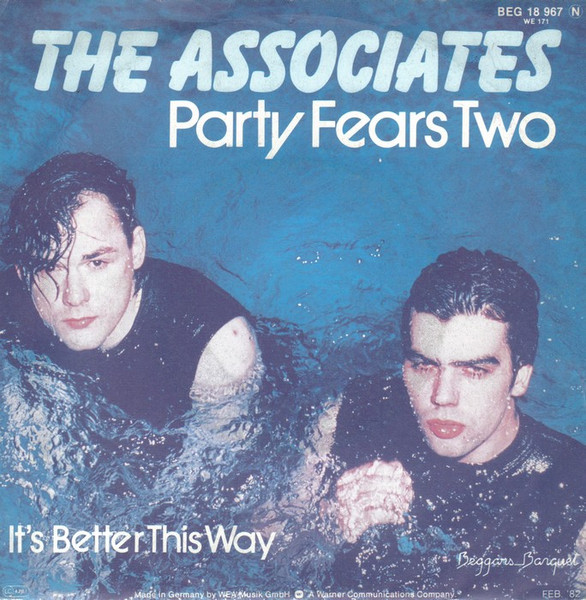
"Party Fears Two" is a song by Scottish new wave band the Associates, written by band members Billy Mackenzie and Alan Rankine. Released as both a 7-inch and 12-inch single, it appeared on their 1982 album “Sulk”.
Originally written in 1979 around a piano riff, "Party Fears Two" was initially set aside by band members Billy Mackenzie and Alan Rankine for being "too tuneful" during the tail-end of punk. "Party Fears Two" addresses themes of alcoholism and the tension between individualism and conformity. The song’s title came from a story about Mackenzie’s brother observing two girls trying to break into a party, whom he dubbed the "Party Fears Two." The lyrics reflect Mackenzie’s typical style, setting a mood of introspective anxiety rather than conveying a clear narrative. After two years spent refining the lyrics, the song was released in 1982 and became their most successful hit, reaching No. 9 on the UK Singles Chart and No. 16 in Ireland.
Alan Rankine, co-writer of "Party Fears Two," sees the song as reflecting a deeper sense of alienation rather than a specific event. He explained that both he and Billy Mackenzie often felt like outsiders who didn’t belong, even when they managed to gain access to social circles or parties. Rankine described this feeling of being “impostors,” as if they were only there with “forged papers.” The song conveys their sense of disconnection and the impression that others seemed to navigate social situations effortlessly.
The song was largely written in 1977 but was delayed until 1982, as the band felt the art pop tune was too ahead of its time for the punk and new wave era. Co-writer Alan Rankine reflected that releasing it earlier would have been a “waste,” and even in 1982, its unusual sound and slightly unsettling quality made it distinct.
The song ends with frontman Billy Mackenzie smashing cups and spitting out gum, sounds captured in a recording experiment with bassist Michael Dempsey, symbolizing Mackenzie’s disconnect from the world around him.
29.10.24
OMD - ENOLA GAY
Llançament: 26 de setembre de 1980
Llistes d'èxits: Regne Unit: #8
"Enola Gay" és una cançó antimilitarista de la banda electrònica anglesa Orchestral Manoeuvres in the Dark (OMD), escrita pel vocalista i baixista Andy McCluskey, i llançada com a únic senzill del seu àlbum de 1980 “Organisation”. Com moltes de les primeres peces d’OMD, la cançó utilitza una melodia de sintetitzador en lloc d’una tornada tradicional cantada.
"Enola Gay" rep el nom del bombarder nord-americà que va llançar la bomba atòmica sobre Hiroshima el 1945, causant la mort de més de 100.000 persones. El pilot de l’avió, el coronel Paul Tibbets, va batejar-lo amb el nom de la seva mare, Enola Gay Tibbets, que havia estat nomenada així en honor a l’heroïna d’una novel·la. Andy McCluskey va explicar que, tot i que la cançó fa referència a aquest esdeveniment devastador, molts oients van malinterpretar-ne el significat, amb alguns fins i tot especulant que era un missatge codificat sobre la sexualitat dels membres de la banda. McCluskey va esmentar que l'interès del grup pels avions de la Segona Guerra Mundial va fer de "Enola Gay" un títol escaient per a la cançó.
La lletra reflexiona sobre l’ambigüitat moral de l’ús de la bomba atòmica a Hiroshima. La frase "It shouldn’t ever have to end this way" (No hauria d’haver acabat mai d’aquesta manera) convida els oients a qüestionar-se si el bombardeig era necessari. La frase "Is mother proud of Little Boy today?" (Està orgullosa la mare de Little Boy avui?) al·ludeix tant a la bomba, anomenada “Little Boy”, com al pilot de l’avió, Paul Tibbets. L’esment de les 8:15, "the time that it’s always been" (l'hora que sempre ha estat), fa referència al moment exacte de la detonació de la bomba, que va aturar molts rellotges en aquella hora. Tot i ser reconeguda com una cançó antimilitarista, McCluskey va afirmar que no tenia un impuls polític concret, sinó que va néixer de la fascinació pels bombarders de la Segona Guerra Mundial, deixant lloc a la reflexió sobre si l'acte va ser justificat.
El videoclip es va filmar als estudis ITN en només tres hores. Comença amb imatges accelerades de núvols movent-se pel cel, establint un to reflexiu. Es mostra el conegut riff de teclat, amb els dits del teclista tocant i amb un efecte rotoscòpic digital que crea una sensació escaient d’animació. El vídeo també inclou una superposició transparent de McCluskey cantant i tocant el baix, barrejant aquests elements per emfatitzar el to eteri i contemplatiu de la cançó.
Andy McCluskey va compartir detalls sobre el procés creatiu de la banda, explicant que la música sol ser el primer pas, sovint inspirada per sons, patrons de bateria o samples. Tot i que McCluskey sol tenir idees temàtiques o lletres per a les cançons, la música és la base sobre la qual construeix. Recorda que, en els inicis, mantenia una carpeta amb possibles títols i idees per a cançons, que intentava combinar amb la música creada, demostrant així un mètode de composició sistemàtic en què la música precedeix les lletres.
OMD - ENOLA GAY
Released: September 26, 1980
Charts: UK: #8
"Enola Gay" is an anti-war song by the English electronic band Orchestral Manoeuvres in the Dark (OMD), written by lead vocalist and bassist Andy McCluskey and released as the only single from their 1980 album “Organisation”. Like many early OMD tracks, the song uses a melodic synthesizer break in place of a traditional sung chorus.
"Enola Gay" is named after the U.S. bomber that dropped the atomic bomb on Hiroshima in 1945, killing over 100,000 people. The plane's pilot, Colonel Paul Tibbets, had named it after his mother, Enola Gay Tibbets, who in turn was named after a novel's heroine. Lead singer Andy McCluskey explained that while the song references the devastating historical event, many listeners misunderstood its meaning, with some even speculating it was a coded message about the band members' sexuality. McCluskey noted their interest in WWII airplanes, making "Enola Gay" a fitting title for the song.
The lyrics reflect on the moral ambiguity surrounding the use of the atomic bomb on Hiroshima. The line "It shouldn't ever have to end this way" encourages listeners to question whether the bombing was necessary. The phrase "Is mother proud of Little Boy today?" alludes to both the bomb, nicknamed "Little Boy," and the plane's pilot, Paul Tibbets, who named the aircraft after his mother. The line "It's 8:15, and that's the time that it's always been" refers to the time the bomb detonated, freezing many timepieces at 8:15 AM. While recognized as an anti-war song, McCluskey stated it wasn't politically driven, but rather born from a fascination with WWII bombers, leaving room for reflection on whether the act was justified.
The music video was filmed at the ITN studios in just three hours. It opens with sped-up footage of clouds moving through the sky, setting a reflective tone. The keyboard riff is featured prominently, shown as the keyboardist's hands playing, with the footage digitally rotoscoped for a unique animated effect. The video also includes a transparent overlay of lead vocalist Andy McCluskey singing and playing bass guitar, blending these elements to match the song's ethereal and contemplative mood.
Andy McCluskey shared insights into the band's creative process. He explained that the music typically comes first, often inspired by sounds, drum patterns, or samples. While he has lyrical or thematic ideas for songs, the music is the foundation upon which he builds. McCluskey recalled that in the early days, he kept a ring binder filled with proposed song titles and ideas, which he would try to pair with the music they created, demonstrating a systematic approach to songwriting where the music precedes the lyrics.
QUEEN - A KIND OF MAGIC
Publicació: 17 de març de 1986
Llistes: EUA: #42 Regne Unit: #3
"A Kind of Magic" és la cançó principal de l’àlbum de 1986, escrita pel bateria Roger Taylor per a la pel·lícula “Highlander”, on s’utilitza com a tema final. La cançó es va convertir en un èxit internacional, arribant al #3 al Regne Unit, al #1 a l'Argentina i a Espanya, i classificant-se entre els deu primers en diversos països europeus, tot i que només va arribar al #42 als EUA.
Inicialment, Roger Taylor va escriure la melodia i els acords de "A Kind of Magic", però Freddie Mercury va reestructurar-la significativament, afegint una nova línia de baix, reorganitzant les seccions i produint una nova mescla amb David Richards. La línia de baix de John Deacon a la versió de Mercury aporta profunditat a la peça, convertint-se en un dels elements més destacats. Es diu que Taylor es va sentir frustrat, ja que Mercury va fer aquests canvis mentre ell era de vacances, encara que la cançó continua acreditada únicament a Taylor. La versió original de Taylor sona a la pel·lícula “Highlander”, mentre que la versió de Mercury apareix a l'àlbum.
A “Highlander”, Connor MacLeod (interpretat per Christopher Lambert) descriu la seva immortalitat com "una mena de màgia", una frase que va inspirar Roger Taylor, qui la va utilitzar com a base per a la cançó. La lletra conté múltiples referències a la pel·lícula, incloent-hi frases com "one prize, one goal" (un premi, un objectiu), "no mortal man" (cap home mortal), i "there can be only one" (només en pot quedar un). La portada del single també es relaciona amb la pel·lícula, amb Clancy Brown caracteritzat com el temible malvat, el Kurgan.
El vídeo musical, dirigit per Russell Mulcahy, presenta Freddie Mercury com una figura màgica que reviu els seus companys de banda—Brian May, Roger Taylor i John Deacon—mostrats com rodamóns en un teatre abandonat. L'entrada de Mercury els transforma en les seves versions habituals amb els seus instruments, abans de tornar als seus papers de rodamóns quan ell surt. El vídeo, filmat al Playhouse Theatre de Londres, inclou elements animats creats per The Walt Disney Company, sincronitzats amb el ritme de la cançó. Brian May va utilitzar una rèplica de 1984 de la seva guitarra Red Special, i la banda va suportar el fred de març en el teatre sense calefacció.
"A Kind of Magic" es va convertir en un dels moments àlgids de la gira “Magic” de Queen l'any 1986, que va resultar ser la seva última gira amb la formació original, ja que Freddie Mercury va ser diagnosticat amb la sida l'any 1987, fet que li va impedir continuar amb les gires.
QUEEN - A KIND OF MAGIC
Released: March 17, 1986
Charts: US: #42 UK: #3
Queen's "A Kind of Magic" is the title track from their 1986 album, written by drummer Roger Taylor for the movie “Highlander”, where it serves as the ending theme. The song became an international hit, reaching #3 in the UK, #1 in Argentina and Spain, and ranking in the top ten across several European countries, while peaking at #42 in the U.S.
Roger Taylor initially wrote the melody and chords for "A Kind of Magic" but Freddie Mercury reworked it significantly, adding a new bass line, rearranging sections, and producing a fresh mix with David Richards. John Deacon's bass line on Mercury's version adds notable depth, making it a standout element of the track. Taylor was reportedly frustrated, as Mercury made these changes while he was on holiday, though the song remains credited solely to Taylor. Taylor's original version plays in the “Highlander” film, while Mercury's appears on the album.
In “Highlander”, Connor MacLeod (played by Christopher Lambert) describes his immortality as "a kind of magic," a phrase that inspired Roger Taylor, who used it as the basis for the song. The lyrics contain multiple references to the film, including lines like "one prize, one goal," "no mortal man," and "there can be only one." The single's cover art also ties back to the film, featuring Clancy Brown in character as the menacing villain, The Kurgan.
The music video directed by Russell Mulcahy, features Freddie Mercury as a magician figure who revives his bandmates—Brian May, Roger Taylor, and John Deacon—portrayed as tramps in an abandoned theater. Mercury’s entrance transforms them into their regular personas with instruments, before they revert to their tramp roles as he exits. The video, filmed at London’s Playhouse Theatre, includes animated elements created by The Walt Disney Company, synchronized with the beat of the song. Brian May used a 1984 replica of his Red Special guitar, and the band endured the March cold in the unheated theater.
"A Kind of Magic" became a major highlight of Queen's 1986 “Magic” tour, which turned out to be their final tour with the original lineup. This was due to Freddie Mercury’s AIDS diagnosis in 1987, after which he became too unwell to continue touring.