Total de visualitzacions de pàgina:

7.6.24


LED ZEPPELIN - ROCK AND ROLL


Publicació: 21 de febrer de 1972

Llistes: EUA: #47


"Rock and Roll" va ser llançada en el quart àlbum d'estudi el 1971. La cançó compta amb l’actuació del pianista original dels Rolling Stones, Ian Stewart. El crític musical nord-americà Robert Christgau la va qualificar com "simplement la cançó hard rock més dinàmica de 1972”. Fidel al seu títol, la cançó segueix la clàssica progressió de blues de 12 compassos en A, una pedra angular del rock and roll. La frase "Rock and Roll" en si mateixa era originalment un terme utilitzat pels músics de blues com a eufemisme per al sexe.


Robert Plant va escriure la lletra com a resposta als crítics que van desestimar el seu àlbum anterior, "Led Zeppelin III", per no encarnar veritablement l'essència del rock and roll. "Led Zeppelin III" tenia un so més acústic i folklòric, la qual cosa va portar Plant a reafirmar l'habilitat de la banda pel rock. En una entrevista amb Creem el 1988, Plant va explicar: "Només vam pensar que necessitàvem fer un retorn al rock and roll". Va destacar que la intenció darrere de la cançó no era intel·lectual sinó més aviat un impuls visceral per alliberar el seu talent musical. Es tractava de deixar fluir l'energia bruta lliurement, una expressió animalística i poderosa de la seva essència musical.


La concepció d'aquesta cançó va tenir lloc durant una sessió d'enregistrament a la mansió Headley Grange a Hampshire, Anglaterra. La frustració va augmentar mentre John Bonham lluitava amb el complicat patró de bateria de "Four Sticks". En un moment d'exasperació, va canviar de marxa i va començar a tocar un riff inspirat en la introducció de la cançó "Keep a Knockin'" de Little Richard del 1957. Aquesta explosió espontània de creativitat va portar la banda a apartar "Four Sticks" i centrar-se en aquest nou riff. Anomenada "It's Been a Long Time", la cançó va prendre forma ràpidament, amb Jimmy Page tocant una part de guitarra frenètica. En només 30 minuts, se’n va establir la base.


Led Zeppelin va utilitzar la unitat d'enregistrament mòbil dels Rolling Stones per a l'àlbum, i Ian Stewart va ser enviat com a tècnic per ajudar amb el procés d'enregistrament. Quan la banda va buscar un piano boogie-woogie per a "Rock and Roll", es va considerar l’habilitat de Stewart i va intervenir per proporcionar la interpretació de piano entusiasta que s'escolta a la pista.


"Rock and Roll" va ocupar una posició destacada en les actuacions en viu de Led Zeppelin, apareixent en els seus repertoris des del 1971 en endavant. Introduïda inicialment a l'escenari com "It's Been A Long Time", presa de la seva primera frase, es va convertir en la cançó d'obertura de totes les actuacions en concert el 1972 i es va mantenir com a tema inicial fins al 1975. Durant la gira nord-americana de 1977 es va interpretar com a bis en un medley juntament amb "Whole Lotta Love". Posteriorment, del 1979 al 1980, va tornar com a bis sencera.


Jason Bonham, seguint les passes del seu pare, ha assumit la difícil tasca de tocar la bateria per a Led Zeppelin durant diverses actuacions de reunions des de la mort del seu progenitor. Segons ell, "Rock and Roll" suposa un repte especialment formidable a causa dels seus patrons de bateria complicats. Bonham va explicar an American Songwriter que molts intenten tocar la cançó, però la seva exigent marxa de dos mans, mantenint les notes dels seixants durant tota la cançó, requereix precisió i habilitat. No és simplement una qüestió d'un ritme bàsic boom-bap; més aviat, implica una interacció complexa entre la caixa de tambor i els charles, la qual cosa la converteix en una peça difícil de dominar.


LED ZEPPELIN - ROCK AND ROLL


Released: February 21, 1972

Charted: US: #47 


"Rock and Roll" was released on the fourth studio album in 1971. The song features a guest performance by original Rolling Stones pianist Ian Stewart. American music critic Robert Christgau dubbed it "simply the most dynamic hard-rock song in the music" in 1972. True to its title, the song follows the classic 12-bar blues progression in A, a cornerstone of rock and roll. The phrase "Rock and Roll" itself was originally a term used by blues musicians as a euphemism for sex.


Robert Plant wrote the lyrics as a response to critics who dismissed their previous album, “Led Zeppelin III”, as not truly embodying the essence of rock and roll. “Led Zeppelin III” featured a more acoustic folk sound, prompting Plant to assert the band's ability to rock out. In an interview with Creem in 1988, Plant explained, "We just thought rock and roll needed to be taken on again." He emphasized that the intention behind the song wasn't intellectual but rather a visceral urge to unleash their musical prowess. It was about letting the raw energy flow freely—an animalistic and powerful expression of their musical essence.


This song's inception occurred during a recording session for "Four Sticks" at the Headley Grange mansion in Hampshire, England. Frustration mounted as John Bonham struggled with the complex drum pattern of "Four Sticks." In a moment of exasperation, he shifted gears and began playing a riff inspired by the intro to Little Richard's 1957 song "Keep a Knockin'." This spontaneous burst of creativity led the band to set aside "Four Sticks" and focus on this new direction. Dubbed "It's Been a Long Time," the song took shape rapidly, with Jimmy Page laying down a blistering guitar part. Within just 30 minutes, the foundation of the song was established.


Led Zeppelin utilized the Rolling Stones' mobile recording unit for the album, and Ian Stewart was dispatched as a technician to aid with the recording process. When the band sought a boogie-woogie piano for "Rock and Roll," Stewart's skills proved invaluable, and he stepped in to provide the spirited piano performance heard on the track.


"Rock and Roll" held a prominent position in Led Zeppelin's live performances, featuring in their setlists from 1971 onward. Initially introduced on stage as "It's Been A Long Time," taken from the song's opening line, it became the opening number of all concert performances in 1972 and retained this status until 1975. During the band's 1977 North American tour, it transitioned into a medley encore alongside "Whole Lotta Love." Subsequently, from 1979 to 1980, it returned as an encore in its own right, ensuring its enduring presence and impact on their live shows.


Jason Bonham, following in his father's footsteps, has taken on the daunting task of drumming for Led Zeppelin during various reunion performances since his father's passing. According to him, "Rock and Roll" poses a particularly formidable challenge due to its intricate drumming patterns. Bonham explained to American Songwriter that many attempt to play the song, but its demanding two-handed shuffle, maintaining sixteenth notes throughout, requires precision and skill. It's not simply a matter of a basic boom-bap rhythm; rather, it involves a complex interplay between the snare and hi-hat, making it a difficult piece to master.


6.6.24


LED ZEPPELIN - RAMBLE ON


Llançament: 22 d'octubre de 1969

Àlbum: Led Zeppelin II


"Ramble On", co-escrita per Jimmy Page i Robert Plant, va ser enregistrada el 1969 i inclosa en el segon àlbum d'estudi, "Led Zeppelin II". Produïda per Page, la cançó ocupa la setena posició a l'àlbum. Els crítics n’han elogiat la combinació de veu i guitarra.


"Ramble On" no va ser llançada com a senzill en vinil als Estats Units o al Regne Unit durant el segle XX. Malgrat això, l'àlbum "Led Zeppelin II" va arribar al número 1 en ambdós països, amb més de 12 milions de còpies venudes arreu del món. Quan finalment es va llançar com a senzill digital, va arribar al número 66 a la llista de vendes digitals de cançons de Billboard al Canadà el 2007.


La cançó reflexa la novel·la de fantasia de Tolkien "El Senyor dels Anells" en la seva lletra, mostrant l'interès de la banda per temes místics. Led Zeppelin fa referència a les aventures de Frodo Baggins mentre es dirigeix a Mordor i es troba amb Gollum i les forces del mal. No obstant, Robert Plant va expressar posteriorment vergonya per aquestes referències a Tolkien, reconeixent la seva manca de coherència, ja que una donzella no sol estar a Mordor i les prioritats de Gollum giren únicament al voltant de l'anell precios.


Jimmy Page va aconseguir el to suau i sostenible semblant al violí en el solo emprant unes tècniques específiques. Va utilitzar un micro al coll a la seva guitarra Gibson Les Paul amb els aguts tallats, creant un so melós. A més, va utilitzar una unitat d'efectes que produeix un so sostingut dissenyada per l'enginyer d'àudio Roger Mayer.


L'especulació sobre la percussió que acompanya la bateria de John Bonham en aquesta cançó ha portat a diverses teories. El so s'assembla a bongos, però també s'ha rumorejat que es va crear utilitzant un cubell de brossa de plàstic, el seu propi genoll o una maleta de guitarra; alguns suggereixen que estava tocant sobre un sofà. La font exacta de la percussió roman incerta.


"Ramble On" es manté com un dels clàssics perdurables de Led Zeppelin, tot i que la banda mai no la va interpretar en directe íntegrament durant els seus anys actius. La cançó va ser inclosa al seu repertori per al concert de reunió a l'O2 Arena de Londres el 10 de desembre de 2007. El fill de John Bonham, Jason, va substituir-lo a la bateria per a aquesta actuació.


LED ZEPPELIN - RAMBLE ON


Released: October 22, 1969

Album: Led Zeppelin II


"Ramble On" co-written by Jimmy Page and Robert Plant, was recorded in 1969 and featured on the second studio album, “Led Zeppelin II”. Produced by Page, the song stands as the seventh track on the album. Critics have praised the combination of vocals and guitar playing on the song.


"Ramble On" wasn't released as a vinyl single in the US or UK during the 20th century. Despite this, the album, "Led Zeppelin II," reached number 1 in both countries, with over 12 million copies sold worldwide. When it was eventually released as a digital single, it reached number 66 on the Billboard Canadian Digital Song Sales chart in 2007. 


The song reflects Tolkien's fantasy novel "The Lord of the Rings" in its lyrics, showcasing the band's interest in mystical themes. Led Zeppelin references the adventures of Frodo Baggins as he ventures into Mordor and encounters Gollum and the evil forces. However, Robert Plant later expressed embarrassment over these Tolkien references, acknowledging their lack of coherence, as a fair maiden wouldn't typically be found in Mordor, and Gollum's priorities revolve solely around the precious ring.


Jimmy Page achieved the smooth, sustaining violin-like tone on the solo of "Ramble On" by employing specific techniques. He used the neck pickup on his Gibson Les Paul guitar with the treble cut, creating a mellow sound. Additionally, he utilized a sustain-producing effects unit designed by the audio engineer Roger Mayer.


Speculation about the percussion accompanying John Bonham's drums on this song has led to various theories. The sound resembles bongos, but has also been rumored to be created using a plastic garbage pail, his knee or a guitar case; some suggest he was tapping on a sofa. The exact source of the percussion remains unclear.


"Ramble On" stands as one of Led Zeppelin's enduring classics, yet the band never performed it live in its entirety during their active years. The song was included in their setlist for their reunion concert at the O2 Arena in London on December 10, 2007. John Bonham's son, Jason, filled in on drums for this performance.


LED ZEPPELIN - IN THE EVENING / ALL MY LOVE / FOOL IN THE RAIN


Publicades: 15 d'agost de 1979

Àlbum: In Through the Out Door


"In the Evening" és el tema d'obertura de l'àlbum del 1979 "In Through the Out Door". Jimmy Page fa servir un Gizmotron per a efectes de guitarra, un dispositiu destinat a aconseguir un so distorsionat peculiar. John Paul Jones contribueix amb sons sintetitzats i la veu de Robert Plant expressa temes de solitud, acompanyada per la potent percussió de John Bonham. La cançó mostra una fusió de l'experimentació electrònica de Jones i la destresa rockera del grup. Potser és l'última gran cançó de la banda inspirada pel seu so més clàssic.


"All My Love" és una balada rock que es presenta com el sisè tema de l'àlbum. Amb crèdits a Robert Plant i John Paul Jones, inclou un solo de sintetitzador de Jones. La cançó té un significat emocional ja que va ser escrita en record del fill de Plant, Karac, que va morir mentre la banda estava de gira per Amèrica del Nord el 1977. Remarcablement, "All My Love" és una de les dues úniques cançons dels Led Zeppelin en què Jimmy Page no va participar en el procés de composició, l'altra és "South Bound Saurez", també d'aquest àlbum.


"Fool in the Rain" és el tercer tema de l'àlbum i va ser el darrer senzill llançat als EUA abans que la banda es dissolgués el 1980. La cançó va arribar al número 21 del Billboard Hot 100 el 16 de febrer de 1980. La lletra descriu un escenari on un home creu que ha estat plantat per una dona, només per adonar-se més tard que esperava al carrer equivocat, fent-lo sentir com un "Fool in the Rain" (insensat sota la pluja). Jimmy Page va treure inspiració pel ritme de Samba que es presenta a la cançó en veure el torneig de futbol de la Copa del Món del 1978, celebrat a Argentina, on va escoltar molts ritmes de Samba.


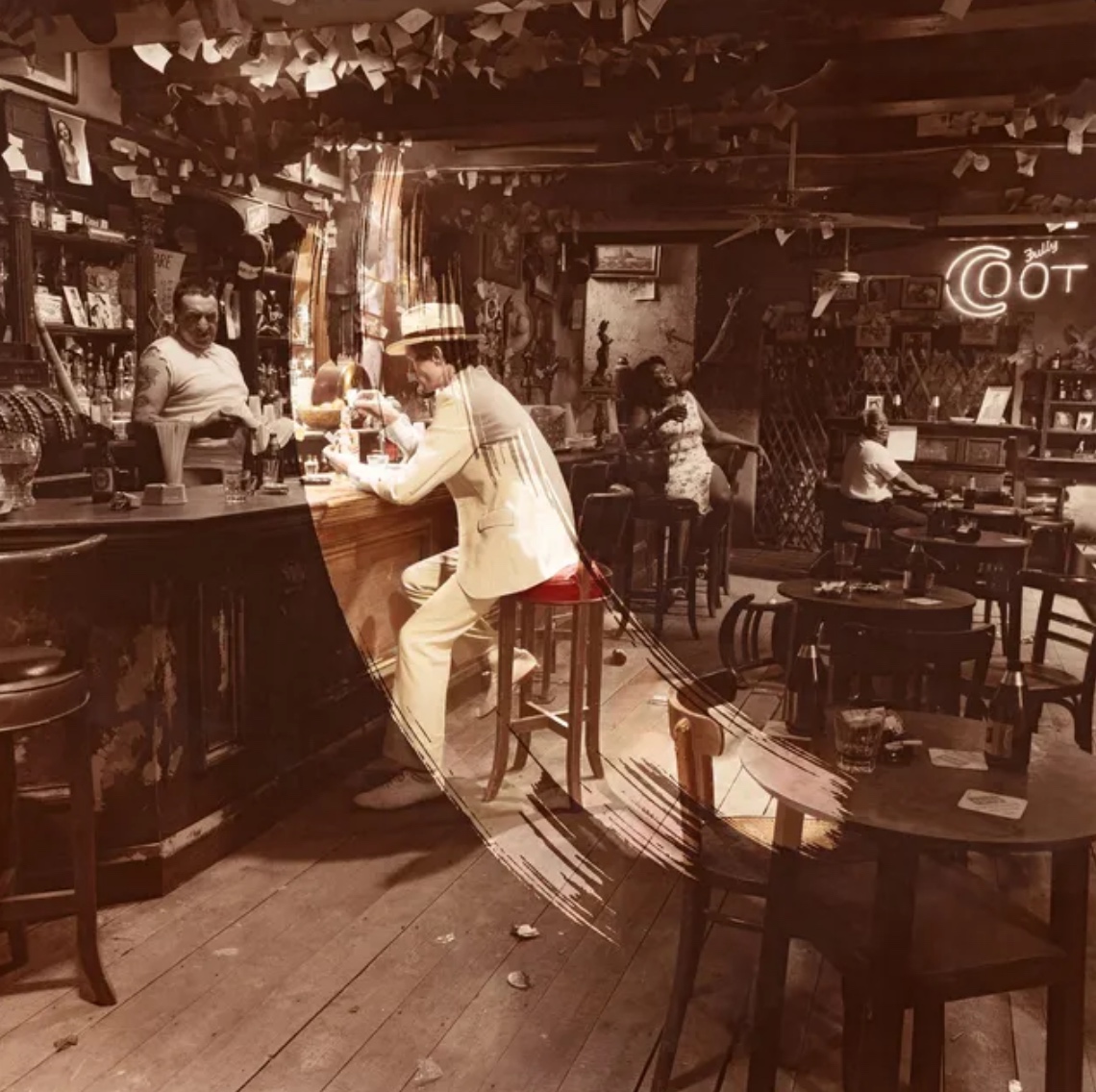
"In Through the Out Door" és el darrer àlbum d'estudi dels Led Zeppelin, enregistrat en un ràpid període de tres setmanes als estudis Polar d'ABBA a Estocolm, Suècia, i llançat per Swan Song Records l’agost de 1979. La presentació original de l'àlbum imitava una bossa de paper marró, amb una funda interior que presentava una obra d'art interactiva. Dissenyat per Storm Thorgerson d’Hipgnosis, l'art del disc va rebre una nominació als Grammy com a Millor embalatge d'Àlbum el 1980.


L'àlbum va presentar sis variants de portada diferents (A - F), mostrant cadascuna un parell de fotos per a les cobertes frontal i posterior. Una escena d'un home cremant una carta de Dear John a un bar, envoltat per sis espectadors, incloent un cambrer, un pianista, un home amb la seva jaqueta i tres clients femenines. Cada foto ofereix una perspectiva única i poses lleugerament diferents, totes preses des de punts de vista diferents. La sessió de fotos va tenir lloc a un estudi de Londres i tenia com a objectiu recrear l'ambient del Vell Absinthe House a Nova Orleans, Louisiana.


La funda exterior de paper marró ocultava les cobertes, fent impossible per als compradors de discos esveinar quina variant estaven comprant. Per saber-ho, una carta que indicava la lletra de la variant de la coberta es va imprimir a l'espina dorsal. De tant en tant, aquesta lletra era visible mentre el disc romania precintat, oferint una pista sobre la variant de la coberta que es trobava a l’interior.


LED ZEPPELIN - IN THE EVENING / ALL MY LOVE / FOOL IN THE RAIN


Released: August 15, 1979

Album: In Through the Out Door


"In the Evening" is the opening track of 1979 album "In Through the Out Door." Jimmy Page employs a Gizmotron for guitar effects, a device intended to achieve a peculiar distorted sound. John Paul Jones contributes synthesized sounds and Robert Plant's vocals express themes of loneliness, accompanied by John Bonham's powerful drumming. The song showcases a fusion of Jones' electronic experimentation and the band's rock prowess. Perhaps it is the band's last great song inspired by their most classic sound.


"All My Love" is a rock ballad featured as the sixth track on Led Zeppelin's 1979 album "In Through the Out Door." Credited to Robert Plant and John Paul Jones, it includes a synthesizer solo by Jones. The song holds emotional significance as it was written in memory of Plant's son Karac, who passed away while the band was on their 1977 North American tour. Remarkably, "All My Love" is one of only two Led Zeppelin songs in which Jimmy Page had no involvement in the songwriting process, the other being "South Bound Saurez," also from this album.


"Fool in the Rain" is the third track on the album and was their last single released in the US before the band disbanded in 1980. The song reached number 21 on the Billboard Hot 100 on 16 February 1980. The lyrics depict a scenario where a man believes he has been stood up by a woman, only to realize later that he was waiting on the wrong street corner, making him feel like a "fool in the rain." Jimmy Page drew inspiration for the Samba beat featured in the song from watching the World Cup soccer tournament in 1978, held in Argentina, where he was exposed to a lot of Samba rhythms.


"In Through the Out Door" marks Led Zeppelin's final studio album, recorded in a swift three-week period at ABBA's Polar Studios in Stockholm, Sweden, and released by Swan Song Records in August 1979. The album's original packaging mimicked a brown paper bag, with an inner sleeve featuring interactive artwork. Designed by Storm Thorgerson, the album's artwork earned a Grammy nomination for Best Album Package in 1980.


The album featured six different cover sleeve variants (A - F), each showcasing a distinct pair of photos for the front and back covers. A scene of a man burning a Dear John letter at a bar, surrounded by six onlookers including a bartender, a piano player, a man holding his coat, and three female patrons. Each photo offers a unique perspective and slightly different poses, all taken from different viewpoints. The photo session took place in a London studio and aimed to recreate the ambiance of the Old Absinthe House in New Orleans, Louisiana.


The external brown paper sleeve obscured the covers, making it impossible for record buyers to discern which variant they were purchasing. To address this, a corresponding letter indicating the cover variant was printed on the spine. Occasionally, this letter was visible while the record remained sealed, providing a clue to the cover variant.