Total de visualitzacions de pàgina:

6.6.24


LED ZEPPELIN - IN THE EVENING / ALL MY LOVE / FOOL IN THE RAIN


Publicades: 15 d'agost de 1979

Àlbum: In Through the Out Door


"In the Evening" és el tema d'obertura de l'àlbum del 1979 "In Through the Out Door". Jimmy Page fa servir un Gizmotron per a efectes de guitarra, un dispositiu destinat a aconseguir un so distorsionat peculiar. John Paul Jones contribueix amb sons sintetitzats i la veu de Robert Plant expressa temes de solitud, acompanyada per la potent percussió de John Bonham. La cançó mostra una fusió de l'experimentació electrònica de Jones i la destresa rockera del grup. Potser és l'última gran cançó de la banda inspirada pel seu so més clàssic.


"All My Love" és una balada rock que es presenta com el sisè tema de l'àlbum. Amb crèdits a Robert Plant i John Paul Jones, inclou un solo de sintetitzador de Jones. La cançó té un significat emocional ja que va ser escrita en record del fill de Plant, Karac, que va morir mentre la banda estava de gira per Amèrica del Nord el 1977. Remarcablement, "All My Love" és una de les dues úniques cançons dels Led Zeppelin en què Jimmy Page no va participar en el procés de composició, l'altra és "South Bound Saurez", també d'aquest àlbum.


"Fool in the Rain" és el tercer tema de l'àlbum i va ser el darrer senzill llançat als EUA abans que la banda es dissolgués el 1980. La cançó va arribar al número 21 del Billboard Hot 100 el 16 de febrer de 1980. La lletra descriu un escenari on un home creu que ha estat plantat per una dona, només per adonar-se més tard que esperava al carrer equivocat, fent-lo sentir com un "Fool in the Rain" (insensat sota la pluja). Jimmy Page va treure inspiració pel ritme de Samba que es presenta a la cançó en veure el torneig de futbol de la Copa del Món del 1978, celebrat a Argentina, on va escoltar molts ritmes de Samba.


"In Through the Out Door" és el darrer àlbum d'estudi dels Led Zeppelin, enregistrat en un ràpid període de tres setmanes als estudis Polar d'ABBA a Estocolm, Suècia, i llançat per Swan Song Records l’agost de 1979. La presentació original de l'àlbum imitava una bossa de paper marró, amb una funda interior que presentava una obra d'art interactiva. Dissenyat per Storm Thorgerson d’Hipgnosis, l'art del disc va rebre una nominació als Grammy com a Millor embalatge d'Àlbum el 1980.


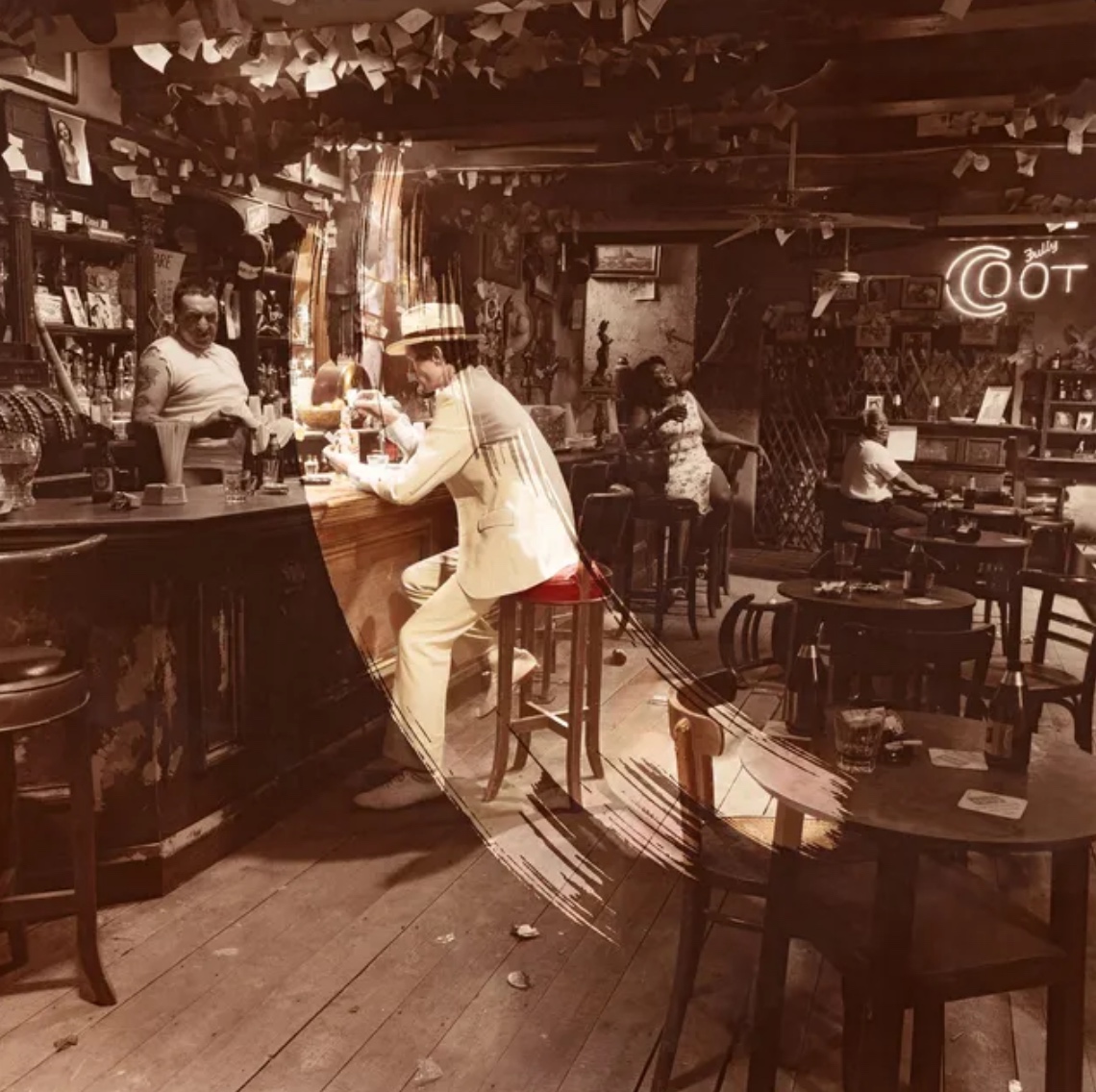
L'àlbum va presentar sis variants de portada diferents (A - F), mostrant cadascuna un parell de fotos per a les cobertes frontal i posterior. Una escena d'un home cremant una carta de Dear John a un bar, envoltat per sis espectadors, incloent un cambrer, un pianista, un home amb la seva jaqueta i tres clients femenines. Cada foto ofereix una perspectiva única i poses lleugerament diferents, totes preses des de punts de vista diferents. La sessió de fotos va tenir lloc a un estudi de Londres i tenia com a objectiu recrear l'ambient del Vell Absinthe House a Nova Orleans, Louisiana.


La funda exterior de paper marró ocultava les cobertes, fent impossible per als compradors de discos esveinar quina variant estaven comprant. Per saber-ho, una carta que indicava la lletra de la variant de la coberta es va imprimir a l'espina dorsal. De tant en tant, aquesta lletra era visible mentre el disc romania precintat, oferint una pista sobre la variant de la coberta que es trobava a l’interior.


LED ZEPPELIN - IN THE EVENING / ALL MY LOVE / FOOL IN THE RAIN


Released: August 15, 1979

Album: In Through the Out Door


"In the Evening" is the opening track of 1979 album "In Through the Out Door." Jimmy Page employs a Gizmotron for guitar effects, a device intended to achieve a peculiar distorted sound. John Paul Jones contributes synthesized sounds and Robert Plant's vocals express themes of loneliness, accompanied by John Bonham's powerful drumming. The song showcases a fusion of Jones' electronic experimentation and the band's rock prowess. Perhaps it is the band's last great song inspired by their most classic sound.


"All My Love" is a rock ballad featured as the sixth track on Led Zeppelin's 1979 album "In Through the Out Door." Credited to Robert Plant and John Paul Jones, it includes a synthesizer solo by Jones. The song holds emotional significance as it was written in memory of Plant's son Karac, who passed away while the band was on their 1977 North American tour. Remarkably, "All My Love" is one of only two Led Zeppelin songs in which Jimmy Page had no involvement in the songwriting process, the other being "South Bound Saurez," also from this album.


"Fool in the Rain" is the third track on the album and was their last single released in the US before the band disbanded in 1980. The song reached number 21 on the Billboard Hot 100 on 16 February 1980. The lyrics depict a scenario where a man believes he has been stood up by a woman, only to realize later that he was waiting on the wrong street corner, making him feel like a "fool in the rain." Jimmy Page drew inspiration for the Samba beat featured in the song from watching the World Cup soccer tournament in 1978, held in Argentina, where he was exposed to a lot of Samba rhythms.


"In Through the Out Door" marks Led Zeppelin's final studio album, recorded in a swift three-week period at ABBA's Polar Studios in Stockholm, Sweden, and released by Swan Song Records in August 1979. The album's original packaging mimicked a brown paper bag, with an inner sleeve featuring interactive artwork. Designed by Storm Thorgerson, the album's artwork earned a Grammy nomination for Best Album Package in 1980.


The album featured six different cover sleeve variants (A - F), each showcasing a distinct pair of photos for the front and back covers. A scene of a man burning a Dear John letter at a bar, surrounded by six onlookers including a bartender, a piano player, a man holding his coat, and three female patrons. Each photo offers a unique perspective and slightly different poses, all taken from different viewpoints. The photo session took place in a London studio and aimed to recreate the ambiance of the Old Absinthe House in New Orleans, Louisiana.


The external brown paper sleeve obscured the covers, making it impossible for record buyers to discern which variant they were purchasing. To address this, a corresponding letter indicating the cover variant was printed on the spine. Occasionally, this letter was visible while the record remained sealed, providing a clue to the cover variant.




5.6.24


LED ZEPPELIN - ACHILLES LAST STAND


Llançament: 31 de març de 1976

Àlbum: Presence


"Achilles Last Stand" és la primera pista del setè àlbum d'estudi de Led Zeppelin, "Presence". Jimmy Page i Robert Plant van començar a escriure la cançó l'estiu de 1975, inspirant-se en la música oriental, la mitologia i els seus viatges. Amb més de deu minuts de durada, és una de les gravacions d'estudi més llargues i complexes de la banda, amb seccions entrellaçades i múltiples parts de guitarra editades.


"Achilles Last Stand" es basa en el mite d'Aquil·les, que va ser submergit al riu Estigia per guanyar la immortalitat però va seguir sent vulnerable al seu taló. París el va matar durant la Guerra de Troia disparant-li una fletxa al taló. La lletra de Robert Plant també reflexa els seus viatges per Marroc, Grècia i Espanya, inspirada en el flamenc i les tradicions marroquines. També es fa referència a la poesia de William Blake, especialment a "La dansa d'Albion", simbolitzant un ressorgiment. La menció de les muntanyes de l'Atles serveix com a doble sentit, al·ludint tant a la seva presència física com al mite del tità Atlas, que sostenia el món.


Robert Plant i la seva dona van patir un accident de cotxe a Grècia, trencant-li el turmell a Plant. En lloc de fer una gira pels Estats Units, Plant i Jimmy Page van escriure material per a "Presence", enregistrant-lo a Munich, Alemanya, amb Plant en una cadira de rodes. Durant la gravació, Plant va patir una recaiguda en el seu turmell, reflectint el destí d'Aquil·les. El títol reflecteix la lesió de Plant i també rendeix homenatge a l'atmosfera mística de les muntanyes de l'Atles al Marroc, que va influir en la lletra.


"Achilles Last Stand" va rebre resenyes positives dels crítics musicals. Stephen Davis, periodista de Rolling Stone, en una crònica de 1976 de "Presence", la va comparar amb els Yardbirds, elogiant la intensa percussió de John Bonham i el treball de Jimmy Page amb una feina de guitarra molt elaborada. Andrew Earles, periodista musical, en una ressenya retrospectiva, la va descriure com una pista de heavy metal potent i emocionant, suggerint-la com a precursora de la nova onada de heavy metal britànic.


LED ZEPPELIN - ACHILLES LAST STAND


Released: March 31, 1976

Album: Presence


"Achilles Last Stand" is the opening track on Led Zeppelin's seventh studio album, "Presence". Jimmy Page and Robert Plant started writing the song in the summer of 1975, drawing inspiration from Eastern music, mythology, and their travels. At over ten minutes long, it's one of the band's longest and most intricate studio recordings, featuring interwoven sections and multiple overdubbed guitar parts.


"Achilles Last Stand" draws on the myth of Achilles, who was dipped in the river Styx to gain immortality but remained vulnerable at his heel. Paris killed him in the Trojan War by hitting him in the heel with an arrow. Robert Plant's lyrics also reflect his travels through Morocco, Greece, and Spain, inspired by Flamenco and Moroccan traditions. They also reference William Blake's poetry, particularly "The Dance of Albion," symbolizing a resurgence. The mention of the Atlas mountains serves as a double entendre, alluding both to their physical presence and to the titan Atlas's mythological burden of holding up the world.


Robert Plant and his wife were in a car accident in Greece, breaking Plant's ankle. Rather than touring the US, Plant and Jimmy Page wrote material for “Presence”, recording it in Munich, Germany, with Plant in a wheelchair. During recording, Plant reinjured his ankle, mirroring the fate of Achilles. The title reflects Plant's injury and also pays homage to the mystic atmosphere of the Atlas Mountains in Morocco, which influenced the song's lyrics.


"Achilles Last Stand" garnered positive reviews from music critics. Rolling Stone journalist Stephen Davis, in a 1976 review of “Presence”, likened it to the Yardbirds, praising John Bonham's intense drumming and Jimmy Page's takeover with intricate guitar work. Music journalist Andrew Earles, in a retrospective review, described it as a galloping and exhilarating heavy metal track, suggesting it as a precursor to the new wave of British heavy metal.


LED ZEPPELIN - SINCE I’VE BEEN LOVING YOU


Released: October 5, 1970

Album: Led Zeppelin III


"Since I've Been Loving You" is a track by Led Zeppelin from their 1970 album “Led Zeppelin III”. It's notable for its live-in-the-studio recording approach with minimal overdubbing, making it one of the hardest tracks to capture during the album's sessions. John Paul Jones contributed Hammond organ to the song, using bass pedals instead of a bass guitar, while John Bonham's distinctive drum pedal, the Ludwig Speed King model 201, produced noticeable squeaks during the recording, earning it the nickname "Squeak King." Additionally, the opening and closing lyrics bear a striking resemblance to those of the 1968 Moby Grape song "Never."


"Since I've Been Loving You" stands as one of Led Zeppelin's most soulful tracks, characterized by Jimmy Page's meticulous guitar work, which oscillates between restrained moments and fiery, impassioned solos. Regardless of spending months perfecting his solo, Page ultimately decided to use his original demo, a decision that proved fortuitous given the song's raw, emotive quality. John Paul Jones's blazing organ adds depth to the arrangement, while Robert Plant's vocals convey pure heartbreak.


Robert Plant's vocal performance on "Since I've Been Loving You" showcased his impressive vocal range, yet it also posed a considerable challenge due to the song's demanding nature. In a 2003 interview with Mojo, Plant reflected on the song's musical progression, particularly the chord choices at the end of each verse, noting that they were not typical and required a shift to a higher, more emotional register. 


The iconic riff at the beginning was borrowed from "New York City Blues" by The Yardbirds, a band in which Jimmy Page had not yet joined at the time of its creation. Page's guitar solo on the track was accomplished in a single take. Engineer Terry Manning hailed Page's solo as "The best rock guitar solo of all time," recognizing its technical brilliance.


LED ZEPPELIN - MOBY DICK


Publicació: 22 d'octubre de 1969

Àlbum: Led Zeppelin II


"Moby Dick" és un solo de bateria instrumental de Led Zeppelin, inclòs al seu àlbum del 1969 “Led Zeppelin II”. Anomenat en honor a la novel·la de Herman Melville, inicialment era conegut pels títols "Pat's Delight" i "Over the Top" durant la carrera de la banda. La peça és considerada un dels grans solos de bateria de la història del rock.


Segons la dona de Bonham, Pat, el nom de la cançó va originar-se quan el seu fill va demanar "la cançó llarga", comparant-la amb alguna cosa tan gran com Moby Dick. La peça va evolucionar a partir del solo de bateria de Bonham, inicialment titulat "Pat's Delight" en honor a la seva esposa. Les cintes d'estudi de les sessions de "Led Zeppelin II" revelen que el solo de bateria enregistrat per "Moby Dick" va ser editat d'una versió molt més llarga. Jimmy Page gravava les improvisacions de Bonham a l'estudi, muntant-les eventualment en la composició final. El riff de guitarra va sortir de la pista no utilitzada "The Girl I Love She Got Long Black Wavy Hair", enregistrada a l'estiu de 1969 a la BBC.


"Moby Dick" va servir com a mostra del talent del bateria John Bonham durant les primeres gires de Led Zeppelin. El seu solo podia durar fins a 20 minuts, amb la resta de la banda marxant de l'escenari. El vigor de Bonham a vegades provocava que es fes sang a les mans amb la caixa i els tom toms. El nom del solo de bateria de Bonham va ser canviat més tard a "Over The Top" per a la gira pels Estats Units del 1977.


S'han publicat diverses versions en viu de "Moby Dick" al llarg dels anys. La primera versió oficialment enregistrada va ser d'una actuació a l'Olympia de París, França, el 10 d'octubre de 1969. Aquesta versió es va incloure al disc dos de l'edició de luxe de Led Zeppelin (primer àlbum). La primera versió oficial enregistrada en viu es va incloure a la pel·lícula "The Song Remains the Same" i la seva banda sonora corresponent. Les versions originals de l'àlbum i de la pel·lícula presenten interpretacions diferents de les tres nits al Madison Square Garden del 27 al 29 de juliol de 1973. Altres versions oficialment publicades inclouen una actuació filmada al Royal Albert Hall el 9 de gener de 1970, presentada al "Led Zeppelin DVD", i una actuació al LA Forum el 25 de juny de 1972, presentada a l'àlbum en viu "How the West Was Won".


LED ZEPPELIN - MOBY DICK


Released: October 22, 1969

Album: Led Zeppelin II


"Moby Dick" is an instrumental drum solo by Led Zeppelin, featured on their 1969 album Led Zeppelin II. Named after Herman Melville's novel, it was initially known by the titles "Pat's Delight" and "Over the Top" during the band's career. The track is considered one of the greatest drum solos in rock history.


According to Bonham's wife Pat, the song's name originated when their son requested "the long song," likening it to something as big as Moby Dick. The piece evolved from Bonham's drum solo, initially titled "Pat's Delight" after his wife. Studio outtakes from the “Led Zeppelin II” sessions reveal that the drum solo recorded for "Moby Dick" was edited down from a much longer version. Jimmy Page would capture Bonham's studio jams, eventually assembling them into the final composition. Additionally, the guitar riff can be traced back to the BBC unused session track "The Girl I Love She Got Long Black Wavy Hair," which was recorded in the summer of 1969.


"Moby Dick" served as drummer John Bonham's showcase during early Led Zeppelin tours. His solo could extend up to 20 minutes, with the rest of the band stepping offstage. Bonham's vigorous playing sometimes resulted in him drawing blood from his hands on the snare and tom toms. The name of Bonham's drum solo was later changed to "Over The Top" for the 1977 US tour.


Several live versions of "Moby Dick" have been officially released over the years. The earliest recorded official release was from a performance at the Olympia in Paris, France on October 10, 1969. This version was included on disc two of the deluxe edition of Led Zeppelin (first album). The first official release of a live version was included in the film "The Song Remains the Same" and its accompanying soundtrack. The original album and film versions feature different performances from the three nights performed at Madison Square Garden from July 27 to 29, 1973. Other officially released versions include a filmed performance from the Royal Albert Hall on January 9, 1970, featured on the "Led Zeppelin DVD," and a performance from the LA Forum on June 25, 1972, featured on the live album "How the West Was Won."