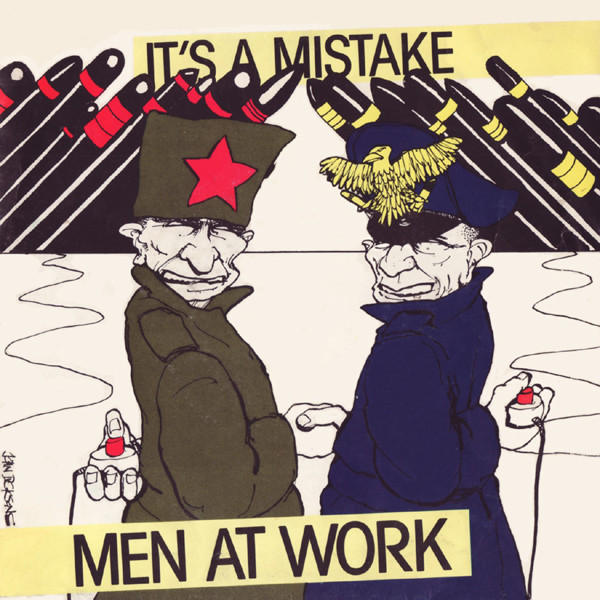
"It's a Mistake" is a song by Men at Work, written by lead singer and guitarist Colin Hay and produced by Peter McIan. Released in June 1983 as the third single from their album "Cargo," it reached number 34 on the Australian charts. In the United States, the song debuted on July 2, 1983, at number 42 on the Billboard Hot 100 and later peaked at number 6, marking Men at Work's fourth and final top 10 hit in the country.
This is an anti-war song written during the Cold War era between the United States and the Soviet Union (U.S.S.R.). The song explores the fear and uncertainty surrounding a potential nuclear war resulting from the arms buildup between NATO and the Warsaw Pact countries. The lyrics, sung from the perspective of a military officer, reflect on the consequences and decisions that could lead to a catastrophic conflict. References to political figures like US President Ronald Reagan underscore the song's critique of global military tensions and the potential for disastrous outcomes.
The music video presents a satirical narrative depicting the outbreak of war between the Eastern and Western blocs during the Cold War. The video features stop-motion animation of Eagle Force toy soldiers and tanks at the beginning. It then transitions to the band members dressed as children playing soldiers, who are invited into an officer's tent by an American officer where allied officers are seen drinking and partying.
The video further portrays four adult men—a businessman, a road worker, a war protester, and a doctor—each depicted in their civilian roles. They are shown fading into military uniforms corresponding vaguely to their civilian professions with surprised expressions, suggesting they have been drafted into the military amid the conflict.
U2 - THE FLY
Estrena: 21 d'octubre de 1991
Llistes: EUA: #61 Regne Unit: #1 (1 setmana)
"The Fly" va suposar una gran evolució per a U2, introduint un so més experimental i abrasiu en comparació amb la seva feina anterior. Publicada com a senzill principal del seu àlbum “Achtung Baby”, el 21 d'octubre de 1991, la cançó incorporava elements com ritmes ballables de hip-hop, textures industrials, vocals distorsionades i un complex solo de guitarra. Malgrat el seu desviament del so anterior, "The Fly" va aconseguir èxit comercial, convertint-se en el segon single número u de U2 al Regne Unit.
"The Fly" va servir com a plataforma per a Bono durant el Zoo TV Tour, on es va transformar en un personatge que encarnava el prototip de rockstar vestit de cuir. Conegut per les seves grans ulleres de sol envoltants i la seva forta presència escènica, Bono va adoptar aquest personatge com una barreja de dadaisme, provocació artística i un bufó shakesperià. En les seves memòries “Surrender”, Bono va descriure el rol com a alliberador, permetent-li deixar enrere la imatge seriosa del seu personatge anterior i explorar una identitat més irreverent i diferent.
Parts del videoclip de "The Fly" es van filmar a Dublín a mitjans de setembre de 1991 sota la direcció de Jon Klein i Ritchie Smyth. Posteriorment, es va gravar material addicional a Londres unes setmanes més tard. Aquest vídeo promocional va ser el debut del personatge The Fly i va mostrar el "nou aspecte" de U2 associat amb la seva reinvenció durant l'era “Achtung Baby”.
U2 - THE FLY
Released: October 21, 1991
Charts: US: #61 UK: #1 (1 week)
"The Fly" marked a significant departure for U2, introducing a more experimental and abrasive sound compared to their previous work. Released as the lead single from their 1991 album Achtung Baby on October 21, 1991, the song incorporated elements such as danceable hip-hop beats, industrial textures, distorted vocals, and an intricate guitar solo. Despite its departure from their earlier sound, "The Fly" achieved commercial success, becoming U2's second number-one single in the UK.
"The Fly" served as a platform for Bono's persona during the Zoo TV Tour, where he transformed into a character embodying a stereotypical leather-clad rock star. Known for his large wrap-around sunglasses and confident stage presence, Bono embraced this persona as a blend of Dadaism, artistic provocation, and a Shakespearean fool. In his memoir Surrender, Bono described the role as liberating, allowing him to shed the earnest image of his previous persona and explore a more irreverent and contrarian identity.
Parts of the "The Fly" music video were filmed in Dublin in mid-September 1991 under the direction of Jon Klein and Ritchie Smyth. Subsequently, additional footage was shot in London a few weeks later. This promotional video marked the debut of The Fly character and showcased U2's "new look" associated with their reinvention during the “Achtung Baby” era.
MEN AT WORK - WHO CAN IT BE NOW?
Estrena: 25 de maig de 1981
Llistes: EUA: #1 (1 setmana) Regne Unit: #45
"Who Can It Be Now?" és una cançó d'èxit de la banda australiana Men at Work, llançada originalment a Austràlia el 1981, abans del seu àlbum debut "Business as Usual". Va aconseguir un gran èxit, arribant al número 2 a la llista de singles australiana i guanyant un disc d'or. Després de la seva publicació a Canadà a principis de 1982, on va arribar al número 8, va ser llançada més tard als Estats Units. Malgrat que ja tenia més d'un any, va pujar al capdamunt de la llista Billboard Hot 100 a l'octubre de 1982.
A mitjans de 1982 Men at Work van ser els teloners a la gira Mirage de Fleetwood Mac. CBS Records havia retardat la publicació de "Who Can It Be Now?" al país fins a l’inici de la gira, malgrat l'èxit previ de la cançó a Austràlia. El retard va permetre a Men at Work completar la seva gira australiana i després embarcar-se en la gira Mirage amb Fleetwood Mac. Aquestes actuacions van augmentar encara més la popularitat de la cançó, que finalment va aconseguir el número u a les llistes dels EUA al final de la gira.
La famosa part de saxofon apareixia originalment al mig de la cançó, cosa que era ideal per a les seves actuacions en directe en bars. Quan van gravar la cançó, el productor Peter McIan va reconèixer el riff de saxofon com un ganxo i el va traslladar estratègicament al començament. Aquest ajustament no només va ressaltar el saxofon durant tota la cançó sinó que també la va fer instantàniament reconeixible.
El vídeo musical complementava la lletra de la cançó sobre un home paranoic a casa seva i va ser un èxit a MTV gràcies al seu contingut intrigant. Colin Hay, parlant sobre com creaven els seus vídeos, va explicar que normalment involucraven tres o quatre persones que feien un esborrany d’un storyboard i filmaven amb un pressupost mínim. S’ajudaven d’amics en els llocs adequats, jugant amb els punts forts de cada membre de la banda de manera espontània, per injectar la personalitat del grup a les imatges i donar sentit al fil argumental dels vídeos.
MEN AT WORK - WHO CAN IT BE NOW?
Released: May 25, 1981
Charts: US: #1 (1 week) UK: #45
"Who Can It Be Now?" is a hit song by the Australian band Men at Work, originally released in Australia in 1981 ahead of their debut album "Business as Usual." It achieved significant success, reaching No. 2 on the Australian singles chart and earning a gold disc. Following its release in Canada in early 1982, where it reached No. 8, the track was later released in the United States. Despite being over a year old by then, it climbed to the top of the Billboard Hot 100 chart in October 1982, becoming a number-one hit.
By the end of the Mirage tour with Fleetwood Mac, "Who Can It Be Now?" had surged to the top of the charts in the United States. This timing was fortuitous as CBS Records had delayed its release there until mid-1982, despite the song's earlier success in Australia. The delay allowed Men at Work to complete their Australian tour and then embark on the Mirage tour as Fleetwood Mac's opening act. This exposure further boosted the song's popularity, ultimately leading to its ascent to number one on the US charts by the tour's conclusion.
The famous saxophone part originally appeared in the middle of the song, which was ideal for their live performances in bars. When they recorded the song, producer Peter McIan recognized the saxophone riff as a hook and strategically moved it to the beginning of the track. This adjustment not only highlighted the saxophone throughout the song but also made it instantly recognizable.
The music video complemented the song's lyrics about a paranoid man in his house and became a hit on MTV due to its intriguing and distinctive content. Colin Hay, discussing how they created their videos, explained that they typically involved three or four people who would rough out a storyboard and shoot with a minimal budget. They relied on friends and suitable locations, incorporating a narrative and playing to each band member's strengths in a spontaneous manner to inject the band's personality into the visuals.
5.9.24
U2 - VERTIGO
Publicada: 8 de novembre de 2004
Llistes: EUA: #31 Regne Unit: #1 (1 setmana)
"Vertigo", la primera pista de l'àlbum "How to Dismantle an Atomic Bomb", va ser llançada com a single principal de l'àlbum el novembre del 2004. Ràpidament va guanyar popularitat a nivell internacional, especialment després de ser presentada en un anunci de l'iPod d'Apple. La cançó va arribar al número u en els rànquings de diversos països com Dinamarca, Grècia, Irlanda, Itàlia, Espanya i el Regne Unit. Als Estats Units, va assolir el número 31 a la llista Billboard Hot 100.
"Vertigo" és coneguda per la seva introducció on Bono compta "Uno, dos, tres, catorce". Hi ha diverses teories sobre per què Bono va utilitzar aquest compte inicial. Una teoria suggereix que podria ser una referència a un versicle de la Bíblia, Èxode 3:14, on Déu es revela a Moisès com "Jo sóc qui sóc". Una altra teoria especula que Bono va usar "14" per indicar que "How To Dismantle An Atomic Bomb" era el 14è àlbum de U2.
El pont de la cançó presenta a Bono cantant "All of this can be yours" (Tot això pot ser teu), simbolitzant una temptació de la història bíblica del diable temptant Jesús. El vers "Just give me what I want and no one gets hurt" (Només dona'm el que vull i ningú sortirà ferit) contribueix a aquest tema de temptació i desig de poder o control. La cançó s'atura abruptament abans de tornar a la tornada, creant un efecte dramàtic. Bono va explicar en les seves memòries "Surrender" que la cançó explora la idea d'aspirar a ser una figura mundana però sense conformar-se amb les normes d'aquest món. Va assenyalar la línia de baix com proporcionant una resposta desafiadora a l'oferta del diable, encarnant un rebuig o una resistència simbolitzada per un contundent "fuck off".
El vídeo musical va ser dirigit per Alex & Martin i filmat a Punta Del Fangar (Delta de l'Ebre) a Espanya. El vídeo mostra U2 actuant en un paisatge desertic i àrid amb corrents d’aire negres que surten de darrere de cada membre de la banda. Al terra, hi ha un destacable símbol de diana blanca, que serveix com a motiu coherent amb la gràfica de l'àlbum. La plataforma circular sobre la qual la banda actua es mou amunt i avall en un patró espiral, mentre el vent bufa amb força a les seves cares, afegint intensitat visual de la interpretació.
A la 47a edició dels Premis Grammy el 2005, "Vertigo" va guanyar tres premis: Millor Actuació de Rock per un Duo o Grup amb Vocal, Millor Cançó de Rock i Millor Vídeo Musical Curt.
U2 - VERTIGO
Released: November 8, 2004
Charts: US: #31 UK: #1 (1 week)
"Vertigo", the opening track from the album “How to Dismantle an Atomic Bomb” was released as the album's lead single on November 2004. It quickly gained popularity internationally, especially after being featured in an Apple iPod advertisement. The song reached number one on the charts in several countries including Denmark, Greece, Ireland, Italy, Spain, and the United Kingdom. In the United States, it peaked at number 31 on the Billboard Hot 100.
"Vertigo" it's known for its distinctive intro where Bono counts "Uno, dos, tres, catorce," which translates to "1, 2, 3, 14" in Spanish. There are a couple of theories about why Bono used this count-in. One theory suggests it could be a reference to a Bible verse from Exodus 3:14, where God reveals himself to Moses as "I am who I am". Another theory speculates that Bono used "14" to signify that “How To Dismantle An Atomic Bomb” was U2's 14th album.
The bridge features Bono singing, "All of this can be yours," symbolizing a temptation reminiscent of the biblical story of the devil tempting Jesus. The line, "Just give me what I want and no one gets hurt," adds to this theme of temptation and desire for power or control. The song then abruptly stops before launching back into the chorus, creating a dramatic effect. Bono explained in his memoir Surrender that the song explores the idea of striving to be a worldly figure but not conforming to the norms of this world. He noted the bass line as providing a defiant response to the devil's offer, embodying a rejection or defiance symbolized by a forceful "f--k off."
The music video was directed by Alex & Martin and filmed in Punta Del Fangar (Ebro Delta) in Spain. The video features U2 performing in a stark desert landscape with black jet streams emitting from behind each band member. On the ground, there is a prominent white bulls-eye symbol, which serves as a motif consistent with the album's graphics. The circular platform on which the band performs moves up and down in a spiral pattern, while wind blows forcefully in their faces, adding to the visual intensity of the performance.
At the 47th Annual Grammy Awards in 2005, "Vertigo" won three awards: Best Rock Performance by a Duo or Group with Vocal, Best Rock Song, and Best Short Form Music Video.